

Compared to other life forms, humanity is new to planet Earth. If we’re going to figure out how to stick around, Katie Treggiden argues we have a lot to learn from nature.
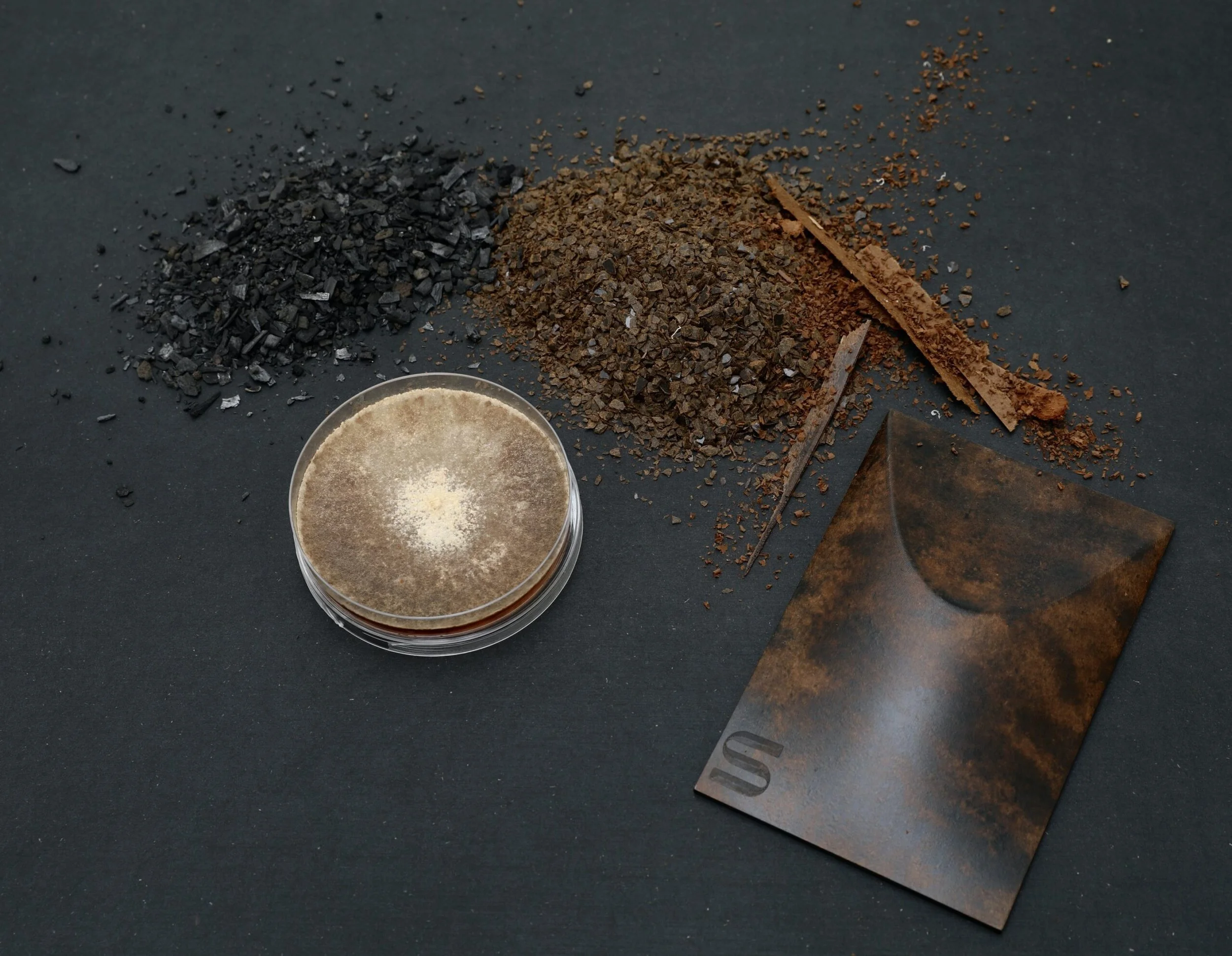
In January, scientists announced that keeping global temperatures within 1.5 degrees of pre-industrial levels, as per the Paris Climate Agreement, had become near impossible. In 2024, global warming exceeded that limit for the whole year for the first time. Only unprecedented levels of carbon reduction will reverse this trend. That’s not to say that all hope is lost. But what is clear is that an environmental approach of ‘doing less harm’ is not cutting it. It’s hard to see how the level of change the climate now needs can come from within the very industrialised systems that created the problem in the first place. Perhaps it is time to look elsewhere.Could nature hold some of the answers? To a certain extent, the design industry has already started exploring this with biomimicry and biophilic design, but cherry-picking ideas from the natural world doesn’t go far enough. “Rather than forcing materials into industrial frameworks, we should work with them as they are, letting nature’s principles guide us,” argues Søuld co-founder, Tobias Øhrstrøm.Søuld makes acoustic building materials from eelgrass. These durable, fire-safe, non-toxic, thermally stable, carbon-storing products are inspired by traditional eelgrass roofs unique to the Danish island of Læsø. To learn from nature, you often need to listen to the people closest to it; and on Læsø, it was local women who harvested driftwood and eelgrass from the shores, turning them into thatched roofs that, due to natural salt impregnation, survived for centuries. PaperShell has gone one step further, with its materials able to return to the earth. Made from sawdust and wood chips generated by forest and agriculture industries, its cellulose-based ‘kraft paper’ is bound together with the hemicellulose lost in pulp production to create ‘reverse engineered wood.’ The carbon sequestered by the trees it’s made from is retained in the paper, which is form-pressed into solid, high-performance components such as the shell of Arper’s Catifa Carta chair. At the end of its life, the material can be turned into biochar using pyrolysis, a low oxygen burning process that prevents carbon release, or broken down using locally native mycelium cultures. Either way, it is returned to the soil as a nutrient.
 Design Academy Eindhoven graduate Lison Guéguen coined the term ‘borrowing materials’ as an antidote to the linear ‘take-make-waste’ model of extraction that characterises the industrial use of natural resources. “Nature is made up of cycles. We have to consider how to reintegrate this cyclical dimension into the way we live, produce and consume,” she says. Her graduate project comprised a collection of objects made from plants ‘borrowed’ from within 5 km of her workshop. “The plants are shaped using slow techniques inspired by traditional know-how such as basketry and weaving. The materials are neither treated nor mixed, so that they can be returned to the environment as nutrients once they have been used,” she explains.Unlike industrial products, they are not designed to be consistent, but instead evolve over time, for instance in their colour. Their lifespans reflect the natural life cycle of the materials.Putting materials back into the earth as nutrients enables circularity and a ‘net good’ impact, but how about undoing the damage we have already done? In French Polynesia, ‘Coral Gardeners’ are collecting fragments of heat-resilient corals to grow on ropes in nurseries, before they are planted onto areas of damaged reef. The problem is that synthetic ropes release microplastics into the ocean and vegetal fibres decay quickly in salt water. Once again, the solution can be found in native ways of knowing. Though they make up just 5 per cent of the global population, Indigenous people hold almost half of the world’s remaining protected areas, approximately 80 per cent of its biodiversity, and the largest carbon stores on the planet within their territories.
 As it turns out, Polynesians traditionally made cordage from human hair for marine applications. “The Indigenous ways of knowing and being that European colonists saw as primitive and uncivilised are now being actively sought out to save our environment,” says Indigenous rights attorney and executive director of the Land Peace Foundation, Sherri Mitchell Weh’na Ha’mu Kwasset.1 Designers and makers are paying attention. Exploring ways to recycle human hair, London-based Dutch designer Sanne Visser noticed its high tensile strength and hit upon the ideaof making ropes. She is now collaborating with bio-designer Christopher Bellamy and the Coral Gardeners to test hair ropes in coral reef regeneration.Humans have been around for 200,000 years; industrialisation, a mere 200. Life on Earth has existed for at least 3.5 billion years. If we want to co-thrive with nature, we have a lot to learn.lisongueguen.compapershell.sesannevisser.comsould.dk Source: 1. All We Can Save by Ayana Elizabeth Johnson & Katherine K Wilkinson | Published by One World, New York, 2021