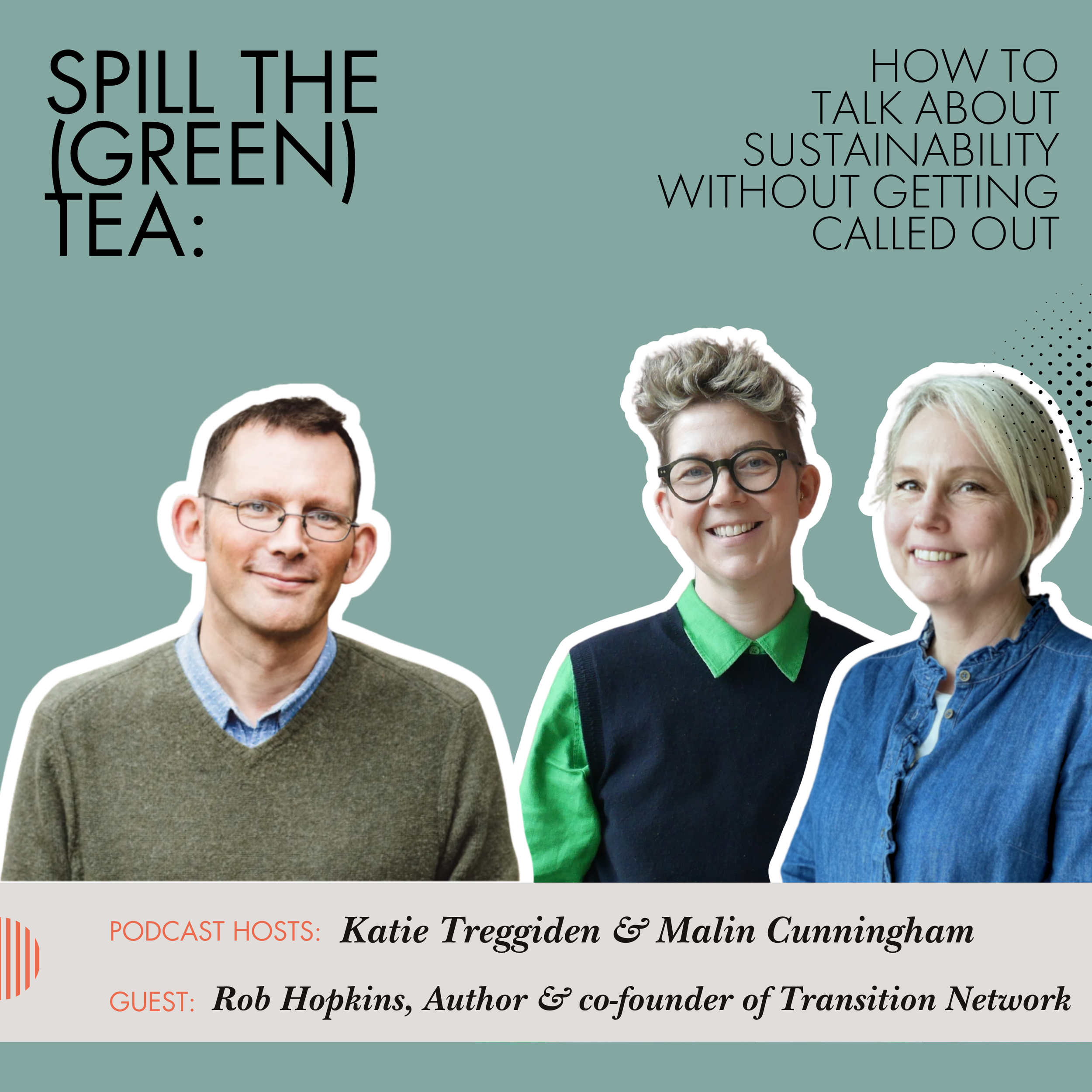
Spill The (Green) Tea with Rob Hopkins
This is an auto-generated transcript that has not been edited or proofread and therefore may contain errors.
Malin Cunningham
Welcome to Spill the Green Tea, the podcast where we dive into perhaps the most controversial part of sustainability, how to talk about it.
Katie Treggiden
That's right, we're exploring how to talk about your eco-efforts without getting called out. Join us for straight-talking, behind-the-scenes insights and practical takeaways that will help you gather the courage to shine your light in these volatile, uncertain, complex and ambiguous times.
Malin Cunningham
It's a serious topic and we don't shy away from that, but we will bring you uplifting, positive and pragmatic conversations with brilliant guests and in-depth discussions between the two of us, all to give you the confidence to talk about your imperfect efforts towards genuine sustainability.
Katie Treggiden
Because it's not just showing off, sharing your progress helps you connect with clients and customers and inspire others to be more open about where they are on their journey. We need your stories now more than ever.
Rob Hopkins
The more people focus on a negative worldview, then the more you find the stories that justify your worldview and then you just go on this sort of downward spiral of like, you can always find reasons to give up and despair and be cynical. That's the easy bit. You try and reverse that spiral going the other way, that's kind of much more of a challenge, but way, way, way more useful.
Katie Treggiden
Welcome to Spill the Green Tea, in which Malin and I talk to the brilliant Rob Hopkins, author of From What Is to What If and How to Fall in Love with the Future. Two books I know many of you will have on your nightstands and if you haven't already, you will by the end of this episode. We talked about everything from reframing naivety into ambition, the importance of through-topias rather than utopias that are grounded in things that are actually happening, the fact that longing at scale is what actually makes history.
Interestingly, everybody from Mickey Mouse to Tintin went to the moon before humans do, so comms professionals have a huge role to play in bringing about the regenerative future that we dream of. I think painting a picture of that future is something that Rob does brilliantly, so enjoy the episode, let us know what you think and please, if you're listening on Apple Podcasts, give us a review. Thank you so much.
Malin Cunningham
Great, so thank you so much, Rob, for joining us today. Me and Katie, we are so excited about this interview because, as Katie said, we absolutely love your books and we always start our podcast asking our guests to confess one of their eco-sins or their eco-sins, so that is something that you might do that surprises people considering you're in the environmental space.
Rob Hopkins
So I don't fly and I haven't eaten meat since I was about 13, so I'm doing all right on that front, but I would say that my vice, we were talking about it before we started, is buying records, as you can see behind me here, which is basically, I've come to think of it as quite a clever kind of carbon sequestration scheme. You take oil that would otherwise be burnt in something and then you squish it into flat plates and then you store them for a long, long time. So I'm actually, although it is using some oil, it's kind of keeping a lot of oil out of being burnt, that's my incredibly bad way of justifying my excess.
Katie Treggiden
I love that, single-handedly bringing about the transition to green energy by keeping all the oil in vinyl.
Rob Hopkins
It's not a record collection, it's a carbon sequestration, carbon storage scheme.
Malin Cunningham
I so wish we could sell that. That's the solution, I really do.
Katie Treggiden
As Malin mentioned, both big fans, I'm holding up Rob's two recent books for folks who are just listening on the audio versions. I think what I love about them so much is they feel like a breath of fresh air in amongst these kind of very cynical, doomy end times, kind of all of the news streams and Instagram streams and conversations and LinkedIn posts and whatever it is that's entering your brain. There's a lot of fear, a lot of division, a lot of negativity and I think they just feel like somewhere I can go and escape into a nicer future.
I read the most recent one on a camping trip so I was sort of sitting outside reading it a lot of the time which was even more lovely. But I guess I wanted to ask you about why it's important to you to strike that hopeful note and how we get the balance right between urgency and optimism.
Rob Hopkins
Well, I think the first thing that I would say is that I don't necessarily regard what I do as optimism. There's degrees of optimism. If I met somebody who was going around being optimistic all the time, I'd be like, are you feeling all right?
Are you reading the like, are you paying any attention here? But then similarly, if I met somebody who was always resigned and pessimistic and miserable, I would kind of feel the same as well. I think the natural response is that we kind of oscillate between those two things.
I'm certainly not kind of giddily optimistic all the time. You know, I think it's much more, there was a film that came out a few years ago called 2040, which some listeners may have seen, which was an Australian director making a film of the world he wanted his daughter to grow up into. And some of it was really smart and some of it not so much, but he described that film as being an experiment in evidence-based dreaming, which I love.
Malin Cunningham
I love that phrase.
Rob Hopkins
That it's about evidence-based dreaming. So for me, when I do talks and I, and in the book, you know, you'll have seen in the book, I'm not like, and then it all worked out fine. It's like, actually, no, no, no.
We all worked really hard and we came together and we found new ways of working together. But the thing was that if you knew where to look in 2026, you could see that what astronomers would call the weak signals of that future in so many different places, but we never hear those stories. So for me, you know, I, some, some environmentalists are quite kind of misanthropic, you know, and well, actually, you know, well, human beings, we're kind of a, kind of a cancer on the planet and the world would be better off without us.
I quite like human beings and I think we're all right. And I think that, but I would hate for us to be the species that went extinct, just leaving a stone that said, sorry, we couldn't think of anything else. You know, I kind of think we're better than that.
And, and there's a lot of the science and the evidence around when people feel excited or positive or like, like there's something to look forward to, they're much, much more likely to act. You know, for me, this is really, I've been around climate work for a long, long, long, long, long time. And I, and I, and I don't know what works, but I know that what we've been doing so far hasn't worked because we're nowhere near where we need to be.
And so this is really about exploring a different, maybe there's a more skilful way rather than just talking about collapse and extinction all the time. You know, we're so good at giving people things to run screaming in the opposite direction from, and not so good at giving people things to run towards. And that's, that's kind of what I'm trying to do.
Malin Cunningham
Yes, that's, I mean, essentially what you're talking about is hope, isn't it? Or, you know, there is some positivity in that, isn't there? So, so our question is really, so some people see that hope, maybe it's a bit naive, whereas like cynicism is a sign of intelligence.
And we, well, when we're talking this through, but it turns out that both Katie and I, as kids were criticised for our vivid imagination. So in my case, it was being a bit dreamy. I had, you know, an imaginary friend who was running behind the car and, you know, not quite with it.
Katie Treggiden
And I think in Katie's case, it was more about, it was, I think there was an implication that I was making stuff up. I was lying. It was like, oh, you've got a vivid imagination, which was code for, I don't believe you.
Yeah. The phrase vivid imagination was definitely not a compliment in either of our childhoods.
Malin Cunningham
No, exactly. So you just thought that was interesting. So how do we change that perspective?
That sort of hope is, you know, being naive and you have to be a cynic to be intelligent.
Rob Hopkins
Well, I think the first question, well, where has that got us? Like, where has that got us that's of any use to anything at all? It's really easy being cynical.
Like you can just sort of sit, you sit around the edges and go, well, see, I told you, well, what was the point? And, you know, it's, it's a really lazy place because you're always proved right. Really?
Because the, the, the psychology of it's interesting that actually the more people expect, the more people focus on a negative worldview, then the more you find the stories that justify your worldview. And then you just go on this sort of downward spiral of like, you're always, you can always find reasons to give up and despair and be cynical. That's, that's the easy bit.
You try and reverse that spiral going the other way. That's kind of much more of a challenge, but way, way, way more useful. You know that I, I think the, the idea of, of saying to children, yo, you're really imaginative as a kind of a put down is just kind of one of the worst things we can do.
You know, I, I feel like childhood should be a house full of cardboard and paint and crayons and, and books and people you're being read stories every night. And when people say, when people say that this kind of approach is naive, like the idea that things don't have to be like this is not a naive idea. It's the launch pad of every innovation that ever happened.
It's the launch pad of every revolution of every shift in society. If Rosa Parks had just thought, Oh, well sod it actually, or if Martin Luther King had stood up and said, I have a nightmare. It was rubbish.
People, it would, where would we, where would we be? You know, it's like, and when people say, well, that what I do is naive. My response to them is to say, look, in 2008, I wrote a book called the transition handbook when the transition movement started, right?
That book set out a thing of saying our dependency on oil and gas represents a key economic vulnerability, a key weakness, and that we need to be moving away from it as rapidly as we possibly can. Actually, what happened instead was that the European union then spent the next, like what, 15 years sending Russia 18 billion euros every month, every month for natural gas, right? Or, and they're saying all the time, Oh, we don't have any money to decarbonise our economy, or we can't afford to decarbonise.
Endless governments who say, Oh, well, you know, austerity, we can't afford to decarbonise in an ambitious way. And then look where that ended up, you know, and then because you've sent 18 billion euros a month to a psychopath. Oh, what a surprise, then what happens?
But then we don't have any money. So who was the naive person at the end of that? At the end of that process?
Katie Treggiden
It's a very good question.
Rob Hopkins
It's like, let's look actually, at this point, people who argue that economic growth and business as usual, when Rachel Reeves said and shame on her forever, when she said, growth, Trump's climate, and a very unfortunate use of the word Trump, but Trump's, but growth, Trump's climate is the most naive thing a politician has ever said in history. Ridiculous. So, you know, I'm happy for people to call me and I don't care.
I think I would replace that, though, with kind of ambitious and, and because also, it's not like anything I'm suggesting, you know, we could move our cities towards a place where every city has the cycling infrastructure of Utrecht, and the car free neighbourhoods of the Valban in Freiburg, and the energy systems of wherever and the food system they're building in Liège, you know, all this stuff is possible.
I'm not saying we need to wait for a unicorn to come and sprinkle its pixie dust over everything. I'm saying actually, we just need to do more of that, and more of that. And we know it works because it already works there.
So I was shifted the naive thing to say, and who are the naive people, the naive people who think we can just carry on doing what we're doing, and it'll all be alright, because it won't.
Katie Treggiden
Yeah, I thought that was one of the things that was really interesting about your books. Margaret Atwood has said that in her dystopian novels, everything is based on something that's happened somewhere in the world. And I love the fact that in your books, which are arguably utopian, you've based everything that you're suggesting on something that's happening somewhere in the world.
And so I love that kind of switch of that device, which then for me is what makes them not utopian.
Rob Hopkins
You see that that's the utopian stuff is often so far away that it's like, oh, yeah, magical. This is I think this is what I do is more through utopian.
Katie Treggiden
Oh, I like that.
Rob Hopkins
Like, like, like, how did we get through? Yeah, we didn't we didn't we the dystopias were horrible. And they just we've had quite enough of those utopias were too far out.
This is about the through utopian stories, which is a term that Rupert Reed coined and Scott now does a lot of work around the idea that we need the stories that start now. It started with Katie and Malin in their place, and they did something together. And then I inspired this person that grew and it grew and it tips and it built into something that had that impact.
That's kind of what I'm focussing on, I think.
Katie Treggiden
I love that term. I love that term. And in from what is to what if you talk about how we can make positive stories more exciting, because I think often in this kind of click world, one of the reason the negative stories rise to the top is because they feel like they've got more drama.
And you introduced the term hope punk, which was coined by fantasy author Alexandra Rowland. Say more. I want to put hope punk on my business card punk.
Rob Hopkins
Hope punk is great, isn't it? Well, there's a couple of things I think it grew out. This is a world that I don't know that much.
I don't really read much fantasy sci fi books. But apparently there was a genre that was called grimdark, which I think is kind of, you know, it's self explanatory what kind of stories they're writing, right? They were writing grimdark stories.
And that and so hope punk kind of emerged as a response to that. And it's this sort of unapologetically positive kind of they had a lovely quote that obviously I can't remember off the top of my head. There was something like all great stories start with somebody in a bar saying, I don't know how, but I'm sure it can be done.
And that's kind of where that's where hope punk stuff starts. And, you know, for me, the punk part of that, because punk was a huge kind of influence on me growing up. And there was that beautiful thing that was in a punk fanzine in the 70s that showed you how to play three chords on a guitar and said, here are three chords now form a band.
You know, and I love that thing of, it's not that hard. Yeah, none of this stuff is that hard. You know, you just need.
And but punk was that sort of kick up the backside that still propels me forward of kind of just do it. Just do it. Just try it.
You know, just it doesn't have to be perfect. Just give it a go. And so for me, hope punk brings those two things together.
It's a kind of unapologetically feisty kind of genre that's about telling stories based in a fundamental belief that good people do good things.
Katie Treggiden
I talk a lot about defiant hope in my work.
Rob Hopkins
Defiant hope is nice, yeah.
Katie Treggiden
To kind of differentiate it from that sort of passive optimism. You know, it's like it's an act of defiance to believe that we can bring about a better world and then act to make that happen.
Rob Hopkins
Rebecca Solnit puts that really beautifully. She says, hope is not a lottery ticket we sit clutching on the sofa. It's an axe we use to break down doors.
Katie Treggiden
Yeah, I love that quote. I love that quote. And hope punk kind of speaks to all of that, doesn't it?
Malin Cunningham
Yeah, that's amazing. And I've not heard I've not heard that before either. So and I'm completely going with it.
So to call you back again, then in terms of the book. So I think it's actually. So in How to Fall in Love with the Future, you quote political theorist Wendy Brown saying only a compelling vision of a less frightening and insecure future will recruit anyone to a progressive or revolutionary alternative future.
And then right at the end, you talk about the fact that seduction and longing aren't typically associated with environmentalist. It's kind of some of the things we talked about already, isn't it? And obviously our audience is more in the comms marketing type space where you would imagine that, you know, we'd have more of that kind of imagination.
We should do because it's what we get paid for. So how can we sort of enlist our audience to sell a green future in a better way? And what what are the tools that we are missing at the moment?
Because it doesn't feel like that, does it? It feels like there's a there is some of it. But, you know, how do we do more of that?
Rob Hopkins
So for me, one of the questions in the book is about is about this question of longing and longing is such a beautiful, powerful word in English. I go, I travel a lot in the French speaking world because I'm weirdly better known there than I am in the UK. And and so I often stand on a stage and give a talk with an interpreter next to me.
So I hear everything that I say repeated back in French. And whenever I use the word longing, they don't really have a word in French for longing. They they use the word desire and put loads of superlatives on the front.
Desire, très, très, très, très profonde. But even très, très, très profonde désir is not the same as longing. It's not as powerful as longing in that sense.
Longing is that kind of soul ache. It's like when your first love leaves town, you know, it's that sort of thing. And for me, I I always like talking about how how the the the the journey that led to human beings setting foot on the moon was something that that was developed over a long, long period of longing that we that we spent 100 years telling stories and films and dances and all kinds of even some of it was rubbish.
Popeye went to the moon. Tintin went to the moon. Mickey Mouse went to the moon.
It was like it got deep in our culture, this idea that we would go to the moon. And I feel like we need to be doing the same thing when it when it when we come to talking about climate. And so with that, we don't have 100 years to do it like we had to get into the moon.
But how do we talk about if we just talk about collapse and extinction all the time? That doesn't fire longing. It doesn't drive longing.
And so with that comes a realisation came a realisation for me that actually the people in our culture who are really good at cultivating longing are not climate activists and they're absolutely not climate scientists. They're writers. They're artists in the widest sense, writers, street artists, poets, musicians, people who work in marketing and advertising who that's what you do, right?
You you you you create desire, often not necessarily in a great way for things that we didn't need in the first place. But you convince us that we absolutely should be longing for this thing. But there are people, and I'm sure people who listen to this podcast as well, who are who work within the world of marketing, who have those kind of kind of dark arts of how to do that.
We need you. We really, really need you. There's a there's a great organisation called Purpose Disruptors, which is people who work in advertising who are like, I have to go home every day and look my children in the eye.
And I'm not quite sure I can do this much longer. And how do we use these skills that we have in service to the times that we live in right now? And yeah, and I kind of feel like in the work that I do, we really, really need you guys alongside this, because the novelist Don DeLillo once in his book Underworld said, longing on a large scale is what makes history.
Katie Treggiden
That's a great quote.
Rob Hopkins
And I feel like right now, the cultivation of longing at scale is the biggest task that we have. And it's kind of what in my own cack handed sort of under-resourced kind of way I'm attempting to sort of stimulate. But that's something where, you know, the skills that come with marketing are absolutely invaluable to being able to do this.
Katie Treggiden
It's so interesting. I saw the founder of Purpose Disruptors speak at the Blue Earth Summit. My background's in advertising.
I did 12 years in the dark arts.
Malin Cunningham
I did 12 years. Yeah, I mean, that's what it felt like by the end.
Katie Treggiden
But what I found really interesting was my response to what their feeling was to walk away from that industry altogether and do something else. And I really admire the resilience that they have to stay inside that industry and use those skills for good. We're going to have to get her on the podcast, Malin.
She's amazing. Yeah, definitely. But you mentioned going to the moon and you introduce not just space travel, but time travel in from what is to what if, and then really dive into that in how to fall in love with the future.
You also mentioned pixie dust, and I know there are spacesuits involved. So for readers who haven't read the book, could you tell them a little bit about how you manifest this idea of time travel?
Rob Hopkins
So it's kind of, yeah, well, in about 2021, 2022, I saw a photo of a young woman on a Black Lives Matter protest in Washington wearing a t-shirt that said, I've been to the future, we won. And it gave me these huge goosebumps. And it was about four weeks before I had been invited to go to London by Extinction Rebellion, who were doing a big event called the Big One.
And they asked me to come up and give a talk. And I'm sure you've both had experiences where you experience something and you think, I need to let this change me. This wants to change me.
I had it when my wife and I went to see an Inconvenient Truth in 2006 in cinema. And at the end, when the credits are going out, we were like, okay, we need to change something as a result of that experience. And then we stopped, we decided to stop flying and we didn't fly since.
And, you know, so this was a kind of a similar moment. It was like something, something wants to happen here. So I had this, I had this ridiculous idea.
I thought this is either career suicide, or this is going to be really interesting.
Katie Treggiden
All the best ideas start with that question.
Rob Hopkins
And so I went to the hardware shop and I bought this white hazmat suit. And I bought this kind of goldfish bowl space helmet thing. And I went and gave this talk that was like, I just parked my time machine around the corner.
So I can't be long. You know what the traffic wardens are like in London, but I just come back from 2030. You need to hear about this because it's awesome.
And then listed all these different things I'd seen and the bicycle rush hours and the urban farms and all this. And then I got to the near the end, I said something like, you know, and the fact that I've been there and the fact that I've seen it, and I can stand here and tell you about it, it just makes me feel really emotional being able to share this with you. And I looked around and people who were standing nearest to me had tears on their faces.
And I thought, this is fascinating. I never had this before. What's happening here?
And so the book then really started to emerge out of that question. Like, what is happening there? What happens?
And I think of it now that what I was doing was helping people to create memories of the future, that for so many people, when the future is being cancelled and colonised and disappearing, the future looks like a very bleak and kind of frightening place. And that when you start to fill it again with things worth fighting for, it can. And also when somebody, I think, kind of when the future looks dark, when someone steps back through the fabric of time and says it's going to be all right, there's a real kind of power to that.
So I've kind of adopted this sort of character of this sort of time traveller and time travel suits and a whole kind of ridiculous, where the moment where we're developing these live shows, we're going to be touring later in the year called Field Recordings from the Future. And so we're for that, we're developing all these video elements, which basically tell a kind of counter narrative about Totnes, that it's like the Cape Canaveral of time travel and the deep underneath Totnes Castle is our laboratory where we work on time travel. And we've been filming in the lab and it's all.
Katie Treggiden
Having been to Totnes, that feels highly believable.
Rob Hopkins
Highly believable. So it's like I just think, well, I don't know what's going to work. Let's try this.
Why not? You know, and it's a lot of fun and it does for some people, it seems to really, really resonate.
Malin Cunningham
Yeah, it's amazing. I just think it's fascinating how it's obviously really emotional, like even when you're obviously, I've read your book and actually I've heard you speak before and part of Marketing Kind.
Rob Hopkins
Yeah.
Malin Cunningham
So I was on that call and like every time I get goosebumps and I was welling up then when you were telling me, because it's such an it really, really moves you, doesn't it? Or it really moves me. However, and then when you and then you talk about all of the things you just talked about, you know, the hat and the suit and all of that, that's clearly very playful, a bit like a bit silly.
And some of that is probably what makes it, you know, that's part of its strength. However, some people will find that scary and embarrassing. You know, the concept of doing that.
So how do we how do we overcome that? How do you overcome that? And, you know, get people to sort of suspend that disbelief that actually if I join in, that's going to happen to me.
Rob Hopkins
Do you mean some people would find it scary to do that themselves or to sit and watch it?
Malin Cunningham
No, both. Yeah. Like it sounds a bit it's fascinating, actually, because we spoke to a client about talking, the fact that they're talking to you and saying, oh, this would be amazing to include, you know, something like this.
And they immediately felt really concerned about that because it feels a bit if you haven't seen it, you haven't experienced it, it can feel a bit weird.
Rob Hopkins
Yeah, it does. Yeah, absolutely. I mean, I think one thing is that I think we all have.
I think that that fear that we have of appearing a bit silly stops us from doing so much.
Malin Cunningham
Yeah, absolutely.
Rob Hopkins
And and, you know, one of the one of the people who I love, who I write about in From What Is To What If is a guy called Antanas Mokas, who was the.
Malin Cunningham
some people will find that scary and embarrassing. You know, the concept of doing that. So how do we overcome that?
How do you overcome that? And, you know, get people to sort of suspend that disbelief that actually, if I join in, that's going to happen to me.
Rob Hopkins
Do you mean some people would find it scary to do that themselves or to sit and watch it?
Malin Cunningham
No, both. Yeah, like it sounds a it's fascinating, actually, because I we spoke to a client about talking, the fact that they're talking to you and saying, oh, this would be amazing to include, you know, something like this. And they immediately felt really concerned about that because it feels a bit if you haven't seen it, you haven't experienced it, it can feel a bit weird.
Rob Hopkins
I mean, yeah, it does. Yeah, I mean, I think one thing is that I think we all have. I think that that fear that we have of appearing a little bit silly stops us from doing so much.
Malin Cunningham
Yeah, absolutely.
Rob Hopkins
And and, you know, one of the one of the people who I love, who I write about in From What Is to What If is a guy called Antanas Mokas, who was the mayor of Bogota in Colombia, who was a politician who believed that he needed to bring play back into politics. And so he ran for parlour, he ran his campaign running for the mayor. He did the whole campaign dressed as a superhero.
And he and when he was when he became the mayor of Bogota, he one of the first things he did was they had a very corrupt traffic police who basically pocketed all the fines. And there were loads of people who died on the roads of Bogota. And he sacked all the traffic police and hired 400 mime artists who stood on the intersections of the streets and and with red cards and yellow cards like football referees.
He's remembered fondly as one of the best mayors that Bogota ever had. You know, it's like I feel like, you know, I'm not saying that like everybody doing climate politics and climate activism should start dressing up as time travellers and building time machines. But we can have a few.
And we can, you know, it's like, and, and there's something really kind of liberating about it for me. It's, you know, it's like, well, why? I like, I like being what people don't expect.
We've got someone coming in to give a talk about climate change. Jeez, brace yourselves, lads, this is going to be like, you know, and actually, why not have a presentation about the climate emergency way that moves you, that makes you laugh, that takes you on a journey. That is kind of, you know, that one of my great heroes is Sun Ra, the great jazz musician who I'm sure you know about from from from having read the book.
And there was a lovely quote about him that said that he did everything he did, because he had this whole backstory where he said he was he wasn't a human being, he was an angel from Saturn. And with his band, he travelled through space, and they always wore these extraordinary costumes. And it said that he did everything that he did with an unshakeable certainty and deadpan humour.
That's how I do it. Like, it's not a joke. Yeah, people come and see me give a talk.
The idea that in Totnes, we have been working on building a time machine. It's not a joke. Like it's, it's very serious.
And it's like, and it's like, okay, so where are we going? And the beautiful thing about about using time travel as a playful device, it's really just like a playful device, right? Like, it's a really great tool for getting people to suspend disbelief.
Because if I stand up in front of 1000 people and tell them that this pencil is actually a time machine, nobody ever says, I'm Rob bollocks, what are you talking about? Come on. People go, Oh, cool.
Where are we going? We all know, so ingrained in our culture, I've got a time machine. Great.
Where are we going? You know, and there's and there's a playfulness with that. Like, why does why does activism around climate?
You know, and of course, there are going to be some people who are always going to say, Oh, that's a bit silly. Yeah, but really, do we really have to? Part of the problem I think we have in the world is that we have allowed those people to shape everything.
And the fear of those people going, Oh, that's a bit silly. I'm like, Okay, you know, I've noticed over the years of doing transition, that even if you if you have a room full of 300 people, and you say, Okay, we're just going to do five minutes, ask you to speak to the person next to you. There's like four people, 4% of people who will say, Oh, I don't like that.
I'm going to leave. And it's too weird for them. Okay.
Yeah. What do we allow those four people to shape and define? It's like, it's like, it's like in British politics.
Now, right, we're kind of allowing the few people who 10 years ago sat in the corner of the pub and grumbled about immigrants. And, and we're so terrified with that we that we kind of just allowing that to sort of shape our politics. I'm like, I don't care if you think I'm ridiculous and silly.
I'm very happy to justify what I do. I don't know what works. None of us know what works, maybe bringing some theatricality and some playfulness, you know, in my experiences, that actually, so many people are like, desperately hungry for it.
It's like it feels so different. Like, really, can we like, I do work with young people, the future is just gone. It's kind of bleak and awful.
And yeah, like, and in that, and in that situation, maybe we need people to dress up as time travellers to shake us out of that sort of apathy that we all have about the future, you know?
Katie Treggiden
Yeah, yeah. Yeah. It's really interesting, because I think just hearing you describe it, then it strikes me that what it does is it makes people feel something.
Yes. As opposed to just hearing something. Yeah.
And it's kind of making me think, oh, what's my equivalent of this when I do public speaking? Like, how can I make people feel something? What's, what's that device?
And I think the reason it's so effective in the way you do it is that often you're using all five senses. So you've used sense, sound effects, video projections, the props, like the spacesuit, and even cake. I love the idea about the cake that kind of helps you get over the time travel lag.
What difference do you think that makes, that kind of full sensory experience that you're creating?
Rob Hopkins
I think it's huge. There's a woman whose work I love who lives in Berlin called Wasima Labich. And Wasima is a young Muslim woman living in Berlin.
And she does work mostly with Muslim women that she calls Muslim Futures. She has Futuring with that community there. She wrote this beautiful article called On Sensual Futuring.
Sensual Futuring.
Katie Treggiden
We're going to find that and link to that in the show.
Rob Hopkins
Yeah, it's beautiful. It's like this idea that actually bringing in, bringing in the, so she does work with like fabric that people can touch and foods that people are comfortable with. And so when I do workshops, one of the things that I do there is I talk about how human beings can remember 10,000 smells, and we can attach memories and emotions to all of those smells.
And and so we do an activity called Making Sense of the Future, but as in S-C-E-N-T-S. So after we've done our kind of collective time travel adventure that we've done together, I say, I'm going to give you a cup and you've got 15 minutes and go outside and you can put, I want you to make a cocktail of smells in that cup that smell like the future that you imagined when you time travelled with me a quarter of an hour ago. And you have to give it a good name because all good cocktails have names, right?
And so they go out and then they come back and then I rearrange all the chairs. So I've made quite a small little compact little, little space. And I tell them they've been invited to a cocktail party in a very, very exclusive neighbourhood in Paris.
And the aim is they want to work the room. They want to get around and smell as many of these things as possible. And, but I packed them in so tight.
They have to be like, oh, excuse me, just, oh, just coming around here, you know. And then by the time after 15, and I put music on, so I make it feel like they're in a party. And after 10, 15 minutes, when they've got around and smelled like 40 or 50 of these smells, something starts to happen, which I think the poet Rilke captured most beautifully when he said the future must enter into you a long time before it happens.
Something happens where as you go around smelling, it's like, it starts to kind of get into your bones somehow. Like it gets into your, it gets in really deep. And that's, that's kind of what we're trying to do with this stuff.
You know, it's like, how do you cultivate a nostalgia for the future that just draws you inexorably towards it? And I think the more we can make it multisensory, the better it works.
Malin Cunningham
Yeah, absolutely. And I think that's part of what maybe that's part of what people are a bit scared of, because you actually have to participate. You have to be actively involved in this.
It's not just being, you know, sitting there taking information and you're actually both emotionally and physically involved in the whole process, aren't you? In a way that you're not normally.
Rob Hopkins
Absolutely.
Malin Cunningham
And so in your book, you recommend a daily practise of time travel, a bit like meditation or yoga or something like that. So assuming it doesn't require a spacesuit, what would that look like? What would people actually do if we were having a go at this?
Rob Hopkins
Well, I think the first thing to note is that our ability to imagine the future in in more hopeful and positive ways is dependent on us being familiar with stories of what that might look like. You know, basically, if you're trying to imagine the future, what's happening in your brain is you're going to your memory and looking through it for things that you can assemble. So if you just watch Fox News all day, it's really hard to imagine a low carbon, more just, equal, fair, beautiful future because you've got nothing to work with.
So I think seeking out the kind of stories that are in the book, seeking out like positive news magazine or imagine five magazine from the Netherlands or, you know, there are people on social media and all the screw this, let's try something else instead, podcast or, you know, there are other people who do this kind of stuff, you know, fill fill the cupboards of your memory with those stories because that's that's the building blocks that you need.
And then I think for me, like when I was 22 and I did my permaculture course, I did my permaculture training, the two week design course. And what it did for me was it kind of rewired my brain so that I could walk down the street and I was seeing what could be rather than what was. And I was seeing the possibilities as I walked around.
And it's a great thing to sort train your brain in when you're looking at something. What else could this be? How could you use that space?
How could you use that space? Where could you take the rainwater off the roof and what might you do with it? And so after that experience, that's just kind of how I walk around the world.
It's a bit like when you go to a Van Gogh exhibition and you walk out and for about 15 minutes afterwards, everything's kind of swirling about. And it's like you're walking in a Van Gogh painting, you know, it's so it needs to be like that. And I think for me, the.
It needs to be a daily practise, but at its best, it's done as a shared practise. So it's something that we do with other people and then share with them what we saw. And the first time you do it, it's really blurry and it's hard to kind of see what there is.
But the more often you do it, I'm working on a comic book with a Belgian cartoonist where we're now down to the kind of details of what's in the shop windows. Like what do you see when you're walking down the street? All that sort of stuff.
So, yeah, that's the it feels to me like it needs to be grounded in in finding the stories of what works. And then it's and then it's a very, very powerful practise.
Malin Cunningham
I think it's fascinating because because there is so much bad news around at the moment. I don't know if you've seen even the BBC have now introduced a positive news kind of that BBC News, as in the Breakfast News, have introduced like a positive news. I can't remember what they call it.
And they had something a bit early this year and it's just been brought back because people are asking for it. I just think this is so interesting, isn't it? All of a sudden, they're celebrating just everyday people and the amazing things they're doing in that community.
Yeah, because it's so powerful.
Katie Treggiden
Yeah, exactly. Radio 4 has a programme which I think is called Radical in which they kind of explore radical ideas of the future. And I listened to an episode recently which was all about politics without politicians.
And, you know, the sort of the idea of having a bit like jury service that you select 12 random members of the population to serve for a year or whatever it is.
Malin Cunningham
Yeah.
Katie Treggiden
Which was very interesting. But yeah, I used to work with my first creative director when I worked in the ad industry, always said that good ideas come from a well furnished mind. And so we were allowed to expense books, theatre tickets, art exhibition tickets, preferably that had nothing to do with what we were working on.
And I've always remembered that. But I think adding to that, that idea of kind of balancing out the negative with the positive and filling your mind with compost or for the future. You quote mythologist Martin Shaw describing the Internet as a toxic mimic and talk about ways to peel us away from screens.
But I think for many sustainable comms professionals, for many of the people listening to this podcast, communicating via digital media, kind of having their message in this toxic mimic environment feels like a non-negotiable part of their job. My question to you is, is it?
Rob Hopkins
I mean, it's interesting that we talk about people who are executives who work at Facebook and social media is a non-negotiable part of their job, but they don't let their kids use it.
Katie Treggiden
Just so interesting.
Rob Hopkins
They don't let their kids use it. They know what it does because they designed it.
Katie Treggiden
Yeah.
Rob Hopkins
And I mean, so obviously, if you work in that space, I mean, it's like if you're a footballer, kicking a football is a non-negotiable part of your of your job in the sense that that's what your job is. But but I think as well, even people who who do that in their own personal lives can renegotiate their own relationships with that, because I think anybody who works in that space. Is a creative person.
And. Spending too much time around social media is really harmful to our ability to be creative, because for me, art and creativity is really about distilled attention.
Katie Treggiden
Mm hmm.
Rob Hopkins
It's like I always tell the story when I do talks that isn't been from what is to what if you know that I ask people to imagine they're in the yellow house in Arles in 1888 with where Vincent van Gogh comes in with a big bunch of sunflowers and arranges them on the table and sits back and looks at them as the sunlight comes through the window and thinks, oh, I must just check my Twitter and my Instagram and my tick tock. And then two hours later, he's watching videos of skateboarders falling downstairs and outtakes from friends.
And he's thinking, why did I even start watching this stuff? Then he never would have painted those paintings, you know, and actually our we are currently seeing a social media is a is a tool that is waging war on our attention spans right now and deliberately. And and so I think it's.
Of course, you know, if you work in that space, you're going to be hired to do to do social media campaigns that they capture people's attention. But I think at the same time, I wonder if we might start to see some kind of a pushback where people are advocating for real life experiences and real, real things that happen. You know, I was talking about this idea of making sense of the future, this cocktail party of smells that we do.
I was thinking, you know, if if you have a if you're a company and you're writing a report about a change you want to see happening in the future, you could write a report and put it online and then do social media posts about it. And some people might see it and a lot of people won't. Maybe you could invite everybody to a cocktail party of smells of what the future would smell like if that report was implemented.
You know, maybe we can go a bit more analogue in terms of the campaigns that we design. There was a survey last year that said that 48 percent of young people said they'd rather live without the Internet. You know, and I was fascinating last year going to Boomtown Festival, speaking to a lot of young people who said, oh, I don't do Instagram anymore.
It's so bad for my mental health and my anxiety and stuff. It's like, OK, people who work in marketing, there's something really interesting you can build on there, I think. Yeah, yeah, 100 percent.
Get get people out, not not not in a daft kind of Pokemon Go way where you're getting out of your house and wondering about it. But, you know, how can you do like things where real people get to meet and do something that you support and that you prompt? That's what I'd like to see.
Malin Cunningham
Yeah, definitely. And I think there is a bit of a movement in that way anyway, because a lot of the digital stuff is less effective for all of the reasons we just we just talked about. And I think there's kind of a swing back to the to the, you know, in-person stuff, basically.
Rob Hopkins
Yeah.
Malin Cunningham
So building on that a bit then. So I think in both books, definitely in what from what is to what if you talk about imagination. So, you know, along the same lines, you define it as the ability to look at things as otherwise, you know, something that requires diversity and abundance.
So what is the relationship between diversity and our imaginations?
Rob Hopkins
I guess you touched upon that a little bit already, but I mean, there's kind of two sides to that, because one one side is that actually the imagination really flourishes with limits. The limits can be a good thing for the imagination. Like I talk about in the book about how when Dr. Seuss wrote Cat in the Hat, and he wrote a book with a with a palette of just 50 words, he said it was the best exercise his imagination ever had, you know, and something like Doughnut Economics, which identifies the limits and says, well, we can't go that way, because that's the planetary boundaries. And you can't go that way, because that's the social foundation. So be brilliant within this sweet spot. And how creative and imaginative people become when you do that.
But also, I know from doing from doing the trainings that I do, and from being around things like the amazing Town Anywhere activity that Ruth Bentovim runs, where you basically imagine the future and then build it with cardboard and string and sticky tape and pens. And is it actually the greater the diversity of people who are in the room, the more imaginative the whole event is. If we just imagine with people like ourselves, yeah, it can be imaginative, but it's a bit limited.
So the greater the diversity, the consciously making sure that the people who are who are who come to do this are as diverse as possible, is something that we have to do consciously. And it takes a lot of work. But it's absolutely essential.
I think it's I think it's why like, citizens assemblies, where you pick people by sortition is such a powerful tool, where you do get the kind of diversity, you get society in a microcosm, making really well informed decisions together in an imaginative way. And that's very powerful, I think.
Malin Cunningham
Yeah, definitely. And I guess that's part of why we're in the mess that we're in. Because it's not a very diverse, you know, you know, group of people that have set us on this track.
Katie Treggiden
Yeah, it's quite frightening, the percentage of people who've not only gone to the same school the same university, but of course, at the same university.
Malin Cunningham
Yeah, exactly.
Katie Treggiden
It's quite frightening. And Rob, I'm sad to say we've reached our quickfire round.
Rob Hopkins
Oh, fingers on buzzers.
Katie Treggiden
Fingers on buzzers. I think I know how you're going to go with the first question. But the first question is, is hope a cop out or vital?
Rob Hopkins
Grounded hope, active hope, a hope, a hope to rather than a hope that I think, yeah, hope that is grounded in what's possible is really the kind of lifeblood of us finding a way through the next 10, 15, 20 years, really, because the opposite hopelessness is not a breeding ground for good things.
Katie Treggiden
No, I love that hope to versus hope that that's a really helpful distinction. And what book is on your nightstand at the moment?
Rob Hopkins
I am finally got round to reading The Nutmeg's Curse by Amitav Ghosh, which is absolutely incredible book all about climate and colonialism and the history of colonialism. And it's extraordinarily well written and very, very thought provoking. Yeah, brilliant.
Katie Treggiden
Amazing. We will put a link in the show notes. Can you give us an example of some good sustainability comms that you've seen recently?
Rob Hopkins
Yes, there is a campaign in the Netherlands, which is called Tegelwippen, which is Dutch for tile flipping. I'm with apologies to any Dutch readers for my lamentable pronunciation. It's Dutch for tile flipping.
So in the Netherlands, they tend to cover large areas not with tarmac and poured concrete. They put these tiles that are about this big bedded onto sand. And there is a campaign that started as a kind of citizen led movement, and then government now supports it and resources it called Tegelwippen, which is like a challenge to people to depave where they live.
And their website is beautiful, and it's really colourful, and they have a rolling clicker. The idea is that when people remove some, they send in how many they've removed. And the campaign makes it really easy for them to do it.
And then neighbourhoods and towns and cities challenge each other to see who can remove the most. The place that removes the most wins the very prestigious golden watering can every year. And it's glorious.
And they've this gorgeous video that I always show in my talks, and I pretend that I've bought it back with me from 2036. Because that's now how everything is communicated. And it's so silly.
And it's like two teams squaring off against each other in a kind of a courtyard, and trying to remove more tiles than each other. And it's like really colourful and ridiculous and slightly Monty Python. And I love it.
And I always say to people that in 2036 is the spirit in which we do everything. So yeah, I would point people towards Tegelvippen.
Katie Treggiden
I love that. This question goes to Malin as well. Malin, what have you seen recently that's interesting?
Malin Cunningham
Thank you. Yeah, so on the theme of time travel, kind of, Vinted did a campaign called New Eras Again at the end of last year. I don't know if you saw it or not, but I'm in the PR world, and it's kind of featured a bit there.
And what they talk about is that life is full of new eras. You know, having a baby, family, moving out, new hobbies, and all of those kind of things.
Katie Treggiden
It's a Taylor Swift reference, isn't it?
Malin Cunningham
Yes, exactly. The eras tour. But I just thought it was really clever.
And I liked the fact that, you know, Vinted isn't selling itself actually on being a sustainability really at all. It's, you know, it's more on fashion and having a personal style and all of that. But I kind of like it because of that, because I think it means that more people are buying into it.
And I'm, you know, I'm sure I've said that on the podcast before, but I think in France, they're the fastest growing retailer. Wow. At the moment.
I mean, it's just amazing, isn't it?
Katie Treggiden
It's so interesting, because when I was growing up, there was a real stigma around secondhand clothes. You wore secondhand clothes because you were poor. And that was that was the only reason.
And it's so interesting that, particularly amongst young people, they'll be like, oh, I like that top. I'll see if I can find a similar one on Vinted. Whereas the question used to be, where did you get it from?
So I can go and buy it new. So, yeah, it's a it's an interesting shift.
Rob Hopkins
I like kids buy all their clothes secondhand.
Katie Treggiden
Yeah, I do now. Yeah. Yeah, I do as well.
I buy most of mine on Vinted. Yeah, I've got to plug it. The scrollability of Vinted kind of hits it in the social media box.
It does.
Malin Cunningham
Yes, indeed.
Katie Treggiden
Bob, do you have a favourite podcast that you would like to share with us that we can link to in the show notes as well?
Rob Hopkins
Well, my very, very favourite podcast of all is called Athletico Mintz. And it's Bob Mortimer's, Bob Mortimer's podcast.
Katie Treggiden
I didn't know he had a podcast.
Rob Hopkins
The most priceless thing in the whole world. It's very, very, very vaguely and loosely about football, but kind of not really. And it and it makes me snort sometimes on trains when I've got to listen to my headphones.
But in a in a more serious one, there's a there's a really lovely podcast called Hurry Slowly, which is all about which is all about doing the activism that we do a little bit more slowly. And then my real kind of guilty pleasure is Uncanny, which is a BBC podcast where people send in their real life ghost stories. And I really enjoy that.
Katie Treggiden
What a triptych. Yeah, I love those three. Finally, what is your top tip for communicating imperfect progress towards genuine sustainability with confidence?
Rob Hopkins
When I look at the government now and not making any party political points, but but I think, you know, actually, they are doing some really good, interesting things, but they never talk about it. They go, look, we've just done this amazing, like, you know, workers' rights policy. And it's this and it's that and the other.
It's all a bit like, you know, whenever he hears about so forth, they don't do they're not doing anything. I mean, they are when even when they do do good things, they don't talk about it. So I think it's like, talk about the good to talk about what's working.
But, you know, like like you said earlier on, you know, everywhere you go, there's amazing things happening.
Katie Treggiden
Yeah, it's the same. I live in Cornwall and Cornwall Council is not popular amongst the citizens, let's say. But my husband works there.
So I get to hear about some of the things that are happening. And they are planting trees on every surface. You can plant trees on down here.
You can't move for new trees. And it's being done properly. You know, they're not just kind of counting them up on a tally somewhere and dropping a seed.
They're taking care of them, planting them the right distance apart, kind of doing all that stuff. And nobody hears about it.
Rob Hopkins
Nobody hears about it. But I think that's where whoever does the comm stuff for Mandani in New York are doing it well because he does like, OK, we're going to fill all the potholes. Two weeks later.
Boom. We filled all the potholes. Hey, we filled all the potholes.
Now we're going to do such and such. Boom. They've done it.
And now we're going to tax the rich. Great. Hey, we did it.
You know, let's let's do that. Yeah. Yeah.
I think whoever does Mandani's or whoever's doing Zak Polanski's comms stuff is smashing it right now. Yeah.
Katie Treggiden
Yeah. Amazing. Thank you so much, Rob.
It's been an absolute joy. They say that you shouldn't meet your heroes, but you did not disappoint.
Rob Hopkins
That's a relief. Well, yeah, thank you. It's been it's been delightful.
And thank you for inviting me on.
Katie Treggiden
We have been Katie Treggiden and Malin Cunningham, and this has been Spill the Green Tea. Please leave us a review and share this episode with anyone you think might find it helpful. And let's get people talking about this stuff.
Malin Cunningham
Thank you my co-host, author, journalist and consultant, Katie Tregidden. Katie is on a mission to share true stories of imperfect progress towards genuine sustainability, and to help purpose-driven brands talk about their eco-efforts for clarity, credibility and confidence. Katie has a brilliant resource called Green, Not Greenwashed, that will help you do just that.
You can find a link in the show notes.
Katie Treggiden
And thank you to my co-host, Malin Cunningham is the founder of B2B comms consultancy, Hattrick. They help businesses build commercial credibility and a competitive edge through standout PR, thought leadership and carbon literacy training. And Malin has a fantastic guide for sales and marketing professionals called Green or Greenwashed?
Great minds think alike, what can I say? And you can find a link to that in the show notes too.
Malin Cunningham
And a final thank you to all our brilliant guests and to Kirsty Spain for editing and producing this and every episode.