This is an auto-generated transcript that has not been edited or proofread and therefore may contain errors.
Malin Cunningham
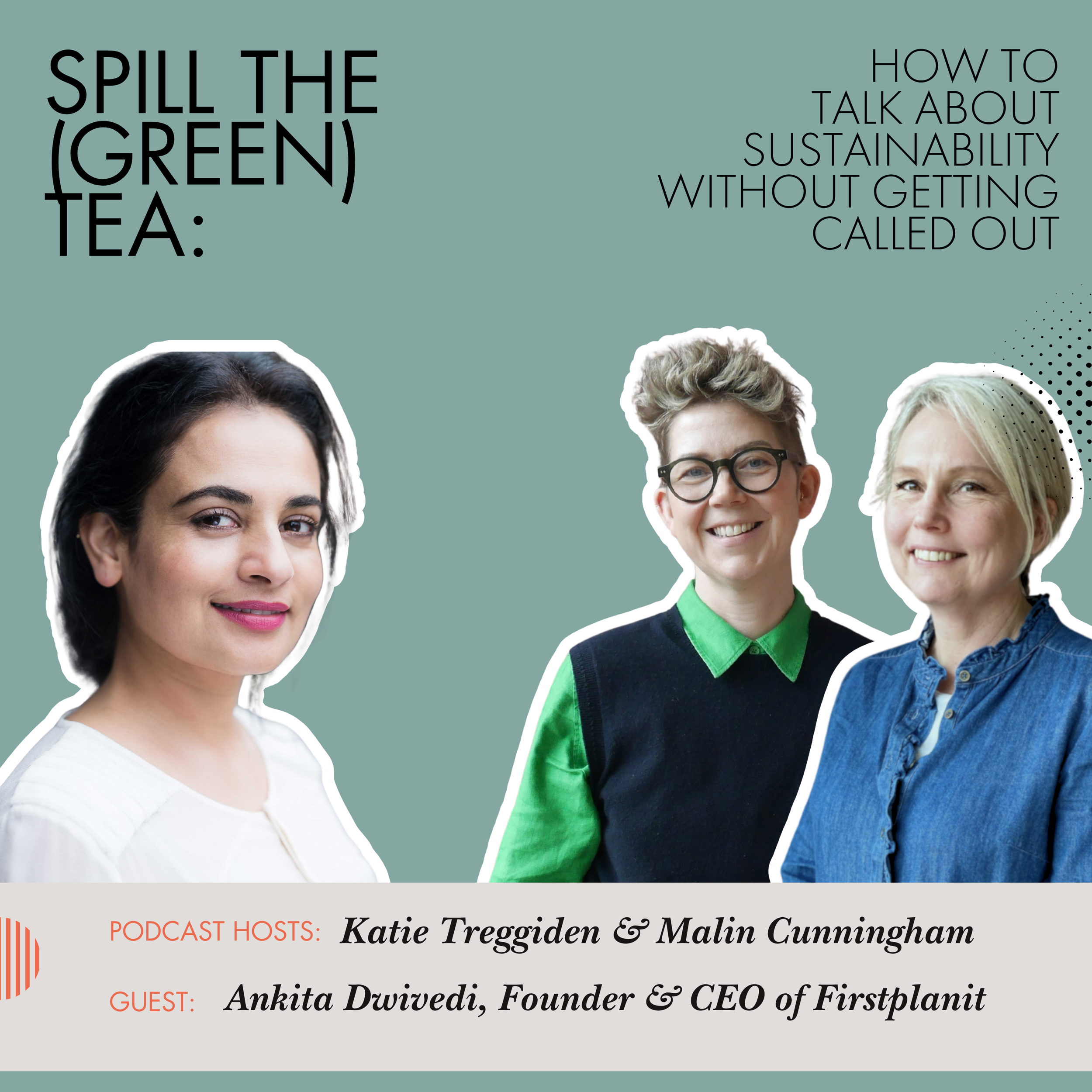
Welcome to Spill the Green Tea, the podcast where we dive into perhaps the most controversial part of sustainability, how to talk about it.
Katie Treggiden
That's right, we're exploring how to talk about your eco-efforts without getting called out. Join us for straight-talking, behind-the-scenes insights and practical takeaways that will help you gather the courage to shine your light in these volatile, uncertain, complex and ambiguous times.
Malin Cunningham
It's a serious topic and we don't shy away from that, but we will bring you uplifting, positive and pragmatic conversations with brilliant guests and in-depth discussions between the two of us, all to give you the confidence to talk about your imperfect efforts towards genuine sustainability.
Katie Treggiden
Because it's not just showing off, sharing your progress helps you connect with clients and customers and inspire others to be more open about where they are on their journey. We need your stories now more than ever.
Ankita – Episode 13
Katie Treggiden
For more than 20 years, Ankita Dwivadi led architecture and design teams, delivering projects for Fortune 100 companies all over the world. And working on complex projects with ambitious clients showed her that the construction industry needed two things. To become greener, and to become more digitally enabled.
Katie Treggiden
She spent more than a decade working alongside her professional practice as an architect, researching how to measure and improve the sector's environmental, social, health, and long-term economic outcomes.
Katie Treggiden
For the past 5 years, she's been fully focused on building First Planet, a tech platform that brings together those years of research, novel methodologies, AI, and curated sustainability data.
Katie Treggiden
It enables design and construction teams to translate really complex knowledge into faster, more informed product decisions that improve those environmental, social, health, and economic outcomes for buildings, their occupants, and the communities that they serve.
Katie Treggiden
Our conversation spanned the idea of products as systems, why radical transparency sells, the unintended consequences of single-issue decision-making, and therefore the need for more complexity in sustainability comms, contrary to the keep it simple, stupid KISS acronym that I grew up with.
Katie Treggiden
Why even the best data needs a story, and why the industry needs to be both more experimental, and to just get on and do the things we can do. Ankita is a legend, you're going to love this conversation, so happy listening.
Malin
Right, so we always start our podcast, as you know, if you're listening frequently, with one particular question, which is, what's one environmentally unfriendly thing that you do that might surprise people?
Ankita
I don't think it'll surprise people, but it is flying. I have to fly. My life is spread across many different countries. My family's spread across many different countries. It is something that I…
Ankita
thought a lot about, but there was no way around it. I have to fly, and I do fly.
Ankita
And it's something that, that, you know, I struggle with.
Ankita
But I've got to do it.
Malin
Yes, and you're definitely not on your own there, I'm in the same boat. It's hard, isn't it?
Ankita
It is very difficult, you know, especially because you know
Ankita
How carbon-intensive that process is, how difficult it is, but, you know, we live in a globalized world, and…
Ankita
Mobility and freedom is so important for us. Ability to go to other countries, see other cultures, and really inhabit those cultures expands our view of the world, and…
Ankita
Our understanding of the world so much.
Ankita
that it's a really hard trade-off. You know, going by boat is not an option for most people. I get really, really sick in a boat anyway, but…
Ankita
Still, you know, we don't have enough boats to take us around the world.
Katie Treggiden
But you've been spending a lot longer in India, haven't you? Kind of staying for months at a time to really.
Ankita
the best out of those flights. Yes, exactly. So, optimizing and clubbing several things together is something that, I really tried to do. So, for example, not making many short trips, but
Ankita
staying longer where you go and working from there. So, for example, you know, my work does allow me flexibility to work from anywhere, which is really a blessing. And that…
Ankita
means that I can go and see family and work at the same time, or take a mini holiday and work a little bit more. It allows me to inhabit that place and those people, and experience those people and those interactions for a little bit longer, which enriches my experience as well.
Ankita
But equally, saves many trips, many short trips.
Katie Treggiden
Yeah, I think that's important, isn't it? And I'm trying to do the same. I fly a vast amount less than I used to, but, you know, there are times when it's necessary, and I do try to see how much I can then
Katie Treggiden
get out of that flight to make sure that it was really worth it, rather than sort of diving in and out of a place at the rate that I used to.
Ankita
And also, just to add to that, I definitely try and fly economies, just a tiny, tiny, tiny reduction, so even if somebody does offer business class, I opt for economy. It's just a little thing that I do. I know it's not a major shift, but it does.
Ankita
Make me feel better.
Katie Treggiden
Yeah, and that's an interesting thing that I think a lot of people aren't aware of. So the way the carbon footprint of a flight is calculated is that they work out the amount of carbon that the whole flight uses it… uses, and then divide it by the amount of passengers, but if you're in first class or business class, you obviously take up a bit more space, so you get allocated a bit more of that carbon, so it is… it is more carbon efficient to fly economy, and cheaper.
Malin
Right.
Katie Treggiden
That isn't always the case.
Katie Treggiden
Ankita, I find myself saying it depends a lot when people ask me which of two options is better or more environmentally friendly. These things are rarely as simple as they seem, and this is a conundrum that First Planet was built to address.
Katie Treggiden: Could you tell us more about how the platform works, and how it helps people to make
Katie Treggiden
Complex decisions on the basis of environmental factors, social factors, kind of all the things that somebody might care about.
Ankita
Yeah, absolutely. And of course, you know, the world… the word sustainability, or… Impact.
Ankita
the very broad umbrella terms, and as you mentioned, Katie, there's many things underneath that.
Ankita
Human beings find it very hard to…
Ankita
take in a lot of complexity quickly. And, you know, we're always in need of certainty or simplicity.
Ankita
In order to make sense of the complex world around us. We have done that very effectively through all the inventions that we have, you know, simplify something.
Ankita
make something easier, make something better. But actually, fundamentally, the world is very complex, and especially if you think about
Ankita
things of doing good or doing better. They're very relative terms, and they require a lot of synthesis, a lot of thinking. We think about all the movements… movement around, you know, self-reflection, or self-awareness, or mental health awareness. We've got to dive deeper and address the complexity in order to find a simple solution or solve a problem.
Ankita
Now, when it comes to products and materials, more tangible things, something similar is required of us, but we don't really…
Ankita
know how to go about it. So what I have been working on for the past, maybe.
Ankita
10 years or so, even longer.
Ankita
You know, as my… as an architect and as a researcher, Is helping people understand that
Ankita
decisions, the most tangible decision for building, which is a material or product, or it could be a piece of furniture, or it could be a light fitting. The most tangible part is the material that is built out of.
Ankita
Everything else is a shape, or a volume.
Ankita
And so, when you look at the tangible part, if you split design into two bits, such as the shape and the material, the material part is less well understood. And also, designers and architects and contractors and makers have less understanding of those materials
Ankita
and the impact of those materials. Traditionally, we did, you know? Traditionally, if you think about it, we found stuff, so if there was a lot of wood around.
Ankita
We knew wood well, and we built with wood.
Ankita
If we found stone around, we knew stone well, and we built with that, right? We created shapes out of the material, understanding the material itself.
Ankita
Now, with industrialization and manufacturing, advancements in all these areas.
Ankita
What started happening with design is that we created shapes, and then we applied materials to it.
Ankita
Which meant that we were excited by all the drama of the shape and the experiences that those shapes allowed us. And somehow, materials within that shape were…
Ankita
they took a backseat. They just needed to do what we wanted. We could bend them to a will, so to speak.
Ankita Dwivedi - Firstplanit: And what that's done is, of course, created a lot of issues, created a lot of negative impact on the world, and also on human beings, also occupants. You know, there's a lot of toxic
Ankita
chemicals and a lot of things that we've used and manufacturers to create those shapes, to bend those things to our will. And I think there's been a big shift towards understanding that better. Now, how do you understand the complex world of materials? There's lots and lots of factors.
Ankita
So, if you think traditionally we understood the properties, you know, for example, if you take wood, you know.
Ankita
how does it age? How does it bend? How does it break? How does it float, right? We understood the properties, which are performance properties. We understood impacts, that we shouldn't cut down all our forests, necessarily, to make ships, or whatever else. But…
Ankita
now, we have to force ourselves to think through those things, because those problems don't arise if we don't actually think about those things. But the problems are arising, we're not seeing them. So, what we've done is we've said, listen, the complexity of understanding a product requires synthesizing lots of different parameters, lots of different data points.
Ankita
And they cover performance, environmental impact, social impact, health implications, aesthetics, cost.
Ankita
And all of this needs to come together very quickly.
Ankita
And it needs to be easy for the decision maker to understand it, because they have to take this complexity and still make other decisions on top of it. They need to understand what a product is and what it isn't, very clearly.
Ankita
Before they can do a good job of using it in the best way possible.
Ankita
So the fundamental bit of information, the knowledge base on which design stands is what we're creating, sort of that base layer. And things can spring
Ankita Dwivedi - Firstplanit: from it, that'll be better. That's our hope, that people use that information in an effective way to create more, I would say consciously.
Ankita
Right? So, First Planet was developed as a platform, as a self-serve platform, that anybody can use, any non-technical person can use, and understand very complex scientific information on materials and products quickly and effectively.
Ankita
And then they can apply it and understand the implications at a larger scale, which could be at the scale of a project.
Ankita
And then another scale, which is, over this past year, what have we done? You know, what do all our housing projects look like? So, at the scale of an organization. So, it's about connecting
Ankita
Tiny decisions to big outcomes by empowering that individual at each stage of decision making.
Ankita
So the fundamentals is if you model a product as a system.
Ankita
And provide that information clearly, people can use that building block much more effectively.
Ankita
Hopefully that was clear enough. It's a lot of take-in.
Malin
Yeah, so I guess a lot of people, I think.
Malin
when you're thinking about sustainability, there's been some certain topics that kind of owned the agenda. So I'm thinking about… we had, you know, plastics was, like, one of the first ones. You know, certainly, if we think broader than
Malin
just the, the built environment. I think that's one of the things that people got really,
Malin
concerned about and wanted to do something about. The other one is, you know, there's lots of talk about the carbon tunnel, isn't there? You know, people are focusing just on the emissions and nothing broader than that. And what… so what… so what's the problem with that? Or it could be, you know, folks, I know that,
Malin
Your platform helps people look at, sort of.
Malin
not just the environmental side, but also there's also the social side of it. So, there are all of these different,
Malin
considerations for…
Malin
you know, a purchase, or a project, or whatever it might be. So what is the problem, then, if you're just focusing on one of those things?
Ankita
Well, there's unintended consequences of all our decisions.
Ankita
And if you… let me just draw a parallel. Say, if you look at medic… medicine or medical science.
Ankita
It would be weird if we went to a doctor with, say.
Ankita
I don't know, a pimple, or whatever, a problem, like a broken arm, and they only fixed that particular thing, and they didn't look at the whole. They didn't look at who you are, how much pain you can tolerate, what diet you have, or whatever else, you know? Diagnosis, for example, required
Ankita
an advisor, in that case a doctor, to really understand the whole, to understand the unintended consequences, or maybe side effects of a medicine that they might give you.
Ankita
Now, similarly, what happens in construction, it's not, you know, you're not sort of…
Ankita
people's lives don't directly depend on your decisions, but indirectly they do. There's a huge amount of responsibility that people have in the built environment.
Ankita
But it's not a direct consequence. So, it's a similar thing. There's unintended consequences of narrowing your view of anything. So, if you're thinking about cost.
Ankita
Is something else that maybe you're not thinking about.
Ankita
So, what's really effective? And again, you can't… you can't tick all the boxes, right? You can… there'll always be unintended consequences of any decision. If you're standing on a path and there's two paths, you take one path, you're not taking the other. That's sort of…
Ankita
what happens in life. But if what's important is awareness, and understanding, and conscious decision making, So…
Ankita
it sort of…
Ankita
If the whole is presented beyond a single data point to say, hey, this is the carbon footprint, hey, this is the waste outcome, and hey, look, this is not locally made, because we can't achieve that here, at the moment, but these are the benefits.
Ankita
Does this work for what you want to achieve?
Ankita
And it could be that there's another… and it might not work for everyone, but it might work for some people in certain situations. So the context of their decision-making
Ankita
It is sort of… if you give somebody a context, they take that context, and they add another layer of context to it and make a better decision. So, it's sort of like giving people the power, or permission even.
Ankita
to take that information. I think we do disservice by narrowing it down and dumbing things down too much.
Ankita
And…
Ankita
what has been said traditionally is that this is too complex a science, sustainability. Let's really reduce it down to, say, a carbon number, so people will get it. But there are problems with it, because it just becomes another number, like cost was.
Ankita Dwivedi - Firstplanit: And then people are, again.
Ankita
using the same mindset and the same behaviors in order to get new outcomes. You've got to shift
Ankita
The way somebody thinks about something.
Ankita
and empower them with the knowledge to do that. So then we see change happen at scale, especially if it's something that is… that requires mass action.
Ankita
It'll cause everybody to participate.
Malin
Yeah, because I guess the… I think… We often feel like,
Malin
you know, the choices we have are things like, you know, yeah, you want to buy local, because that's good for the local community, or that might feel like it's more sustainable, but might not necessarily be. That's what you're saying, isn't it?
Malin
Because the carbon footprint of that might be higher than something that, you know, that somebody's doing in a factory, for instance, because the process is perhaps more efficient, because you, you know, you're producing at scale, and then… but at least you're making that conscious decision between those two.
Malin
Options.
Katie Treggiden
It's all phenomenally complicated, isn't it?
Malin
Yes.
Katie Treggiden
See how…
Malin
Somewhat.
Katie Treggiden: really making a product or a material for the built environment might want to simplify it, and B might want to highlight the bits they're doing well, and maybe not talk so much about the things they're not doing so well.
Katie Treggiden
How can… how can the people who are making these products and materials communicate better so that ESG-conscious architects and specifiers can make more informed decisions?
Ankita
That is such a great question, because… Selling is hard.
Ankita
Okay? Period. Getting somebody… Excited about what you're doing is… hard. And…
Ankita
It's traditionally been, well, people have very little time, and people need to make an impact very quickly, and communicate the benefits of something very quickly.
Ankita
But what we know is that, and I think we've talked about this, Katie, in the past, is that radical transparency, or something that is radically transparent, really sells. People…
Ankita
have a trust issue, generally, because they've heard so much. They've…
Ankita
they know what's wrong, they still don't know what's right. So, they really have a trust issue. So.
Ankita
what I would encourage everyone to do, and I try to do that myself, is to be as transparent as possible. So, for example.
Ankita
The communication could be, this product is better than
Ankita
that in this way, by this much. So you're giving concrete examples of how that's better. At the same time, you're adding, but…
Ankita
This does product does not meet Y, because of this
Ankita
Optimization that we have to do.
Ankita
Now, what you're doing is, you are giving very
Ankita
Clear ways in which your product might be better than something else.
Ankita
But you're also informing The buyer or the specifier, that it is not doing this because of this reason.
Ankita
And you can have your own list of priorities, and you can say, we have measured our product against these, because this is what is important to us.
Ankita
And these are the things that we haven't considered yet.
Ankita
Right? So you've got a real clear way of communicating what you're doing, that you're very good, you have really gone deep into measuring your product.
Ankita
In certain ways, and you're giving them concrete
Ankita
Examples and concrete data on how much better it is, and in what way it is better, but also telling them what it's not doing, how it's not better, or what you couldn't achieve that you wanted to achieve, and the things that you haven't touched upon.
Ankita
Right? Now, this gives the listener, or the specifier, a really good idea that you really intend, you really worked hard on
Ankita
doing something good. It's… they're not left wondering.
Ankita
what about this parameter? It was really important to me, but they didn't address. Or, you know, this other, you know, company I was talking to, they talked about that, and this company hasn't even addressed that, you know?
Ankita Dwivedi - Firstplanit: that is another indicator. You know, they talked about circularity, and you're talking about local procurement, or locally made. You know, how does that equate? How do I measure these things? How do I evaluate these things? Of course, at First Planet, we've normalized all that, and we've helped people understand that, but beyond that.
Ankita
As… as long as people can be as… Clear as possible.
Ankita
It really helps.
Ankita
I think it really helps.
Malin
Yeah, I mean, it's fascinating, because it's… I mean, it's exactly what me and Katie spend a lot of time talking about,
Malin
you know, being brave enough to be open and honest about, you know, where you're at on your journey, what you have still to do, but I think a lot of businesses found that really
Malin
scary, you know, for obvious reasons, because you're, you know, you're exposing, you know, where things aren't, you know, quite… you're not quite as well ahead as you would like to be. So… so what is that… why is that so important, do you think, in terms of…
Malin
Giving people that context when you talk… when you're sort of talking about or communicating about environmental decisions.
Ankita
Well, the importance is, of course, building trust. That's definitely there. The other thing is that there's so many indicators of sustainability. Now, circling back to the first
Ankita
Point, that within the umbrella.
Ankita
There are so many things, you know? Performance is part of a sustainability indicator. Something that lasts very long and is durable is ultimately also sustainable, as is something that degrades within 2 years.
Ankita
There… Opposite indicators, as they're opposite properties, but they're both part of sustainability matrix.
Ankita
Right? So… You have to… Education is really important.
Ankita
Self-education.
Ankita
At the same time, educating the customer is important by giving them the frame of reference, by giving them the context.
Ankita
Now, it is very easy to knee-jerk into one or two parameters, because there's comfort in that.
Ankita
But that also means that you might miss something that's really important to that particular user. Now, we always say, like, I mean, there's always this thing in sales that lead with what you're good at, and people will find you.
Ankita
But right now, people don't know what they're looking for.
Ankita
That's the other problem.
Ankita
Right? So, it's almost like they know they want to do something good, they've heard a little bit of this from here, a little bit of something else from somewhere else, and a little bit of something else from somewhere else. They don't know what they want.
Ankita
And so, in a way, by this frame, you're educating them.
Ankita
or one is educating them, and helping them also figure out what is important to them, and for them in that context. Because it might be… it might be that, you know, when I'm, for example, buying, I don't know.
Ankita
buying a bag, I have a different parameter.
Ankita
And when I'm buying a car, I have a different parameter.
Ankita Dwivedi - Firstplanit: it's not… it shouldn't necessarily… and that parameter needs to link to what that object does. Like, for a bag, I would really like it to be locally made, it could be local fabric, a local artisan, it's really important to me, because it doesn't use up fuel, it doesn't do all those things, right? It does certain things, and I want those properties in it. But, you know, a piece of furniture might…
Ankita
make me want to think of different parameters. So, those are not important parameters to me. I change my parameter also, or I should change my parameter based on what object it is that I'm looking at, and how that becomes sustainable.
Ankita
Right? So…
Ankita
it is a shifting thing, so it is difficult for people to just say, hey, we do this and therefore buy us. It… it… you might lose a lot of people who might love your product for other reasons.
Ankita
because you're saying I could also do this, but I couldn't do this. They might… because you're saying you couldn't do this.
Ankita
It might still be something that
Ankita
Works for them, and they still buy it, because you've considered that parameter.
Katie Treggiden
Mmm.
Ankita
And so, so…
Ankita
What I'm trying to communicate here is that embracing this complexity and embracing this knowledge is very helpful in building a relationship with the customer.
Ankita
Not necessarily just hitting their target or a keyword that they're looking for.
Ankita Dwivedi - Firstplanit: Is that building that relationship requires that complexity to be conveyed in a way that works for them.
Katie Treggiden
And it's interesting, isn't it? Because I can remember when I very first started working in advertising and agencies, gosh, what, 26 years ago?
Katie Treggiden
the KISS acronym was banded about, keep it simple, stupid, and the creative briefs that we used to write for the creative teams required a one-sentence proposition. What's the one thing that we want this entire campaign to communicate?
Katie Treggiden
But from what you've just said, it sounds like we're now looking, actually, for…
Katie Treggiden
conversation with a client that builds trust over a period of time, rather than just this sort of one-hit-wonder, simple message. How do communicators kind of balance those two things, that kind of capturing of attention, but also this sustained conversation?
Ankita
You can see that manifest.
Ankita
in…
Ankita
you know, the long-form series format, the long-form interview format. You can see that shift as well in the way people are consuming information and building trust.
Ankita
Right? It is not just because people…
Ankita
I mean, there's definitely, I would say there's, you know, the TikTok sort of audience.
Ankita
There is, you know, there's all sorts of audience now, right? But people are moving between these pieces of communication. They're not… they have a choice, you know? Somebody who does engage with TikTok also might listen to an hour-long or two-hour-long interview with someone.
Katie Treggiden: It's so interesting, isn't it, how everyone talks about the attention economy and how people can't pay attention for more than 3 minutes, but somebody will also binge-watch an entire series of Netflix, watch television for 12 hours.
Ankita
12 hours, you know, and… and watch content that they want to watch. So, I disag… yeah, and I think that it probably does require, like, I, I, I…
Ankita
would hate to say, hey, make a long, complex, you know, piece of communication on your product. Please don't do that. You know, the idea is that you have a short sentence, you have something that
Ankita
maybe connect with the audience. But when you're talking about something that is meaningful, when you're having that second conversation, you also have
Ankita
You know, a real reason, you know, your mission statement, your mission story, along with an impact story, ready, because
Ankita
There will come a time when somebody wants to know more, and it's a shame to not have that ready in a way that is rich.
Ankita
You know, and it's not a single line, hey, our carbon footprint is this. Which…
Ankita
It's sort of missing the point, because you're not educating, you're not connecting with the person. So… so…
Ankita
data in itself, you know, coming back to that point, data in itself is dry, and data in itself doesn't actually communicate. It is a… to utilize data in an effective way, it needs a story, right? So, it needs benchmarks, it needs…
Ankita
cross-referencing, it needs comparisons, it needs a context of sorts, like, this number means this in this way, right? And also, another point to remember is that people are not necessarily just
Ankita
Evaluating things within a category.
Ankita Dwivedi - Firstplanit: You know, for example, should I…
Ankita
which paint should I buy? They might be thinking, you know, cross-category. Should I buy wallpaper or paint?
Ankita
You know, which is not the same thing. It's a cross-categorical. They might be thinking, should I buy a bicycle or a car? You know, whatever. You know, people are not necessarily… because, you know, some bicycles are more expensive than cars. But,
Ankita
So I think…
Ankita
What's useful in that context is to then make the story richer, or a data point richer, so that they can also make a cross-category comparison.
Ankita
You know? And… and it… it really helps them…
Ankita
Then, you know, come to you for the reason… for the reasons, the right reasons, and be loyal to you for the right reasons.
Ankita
So…
Ankita
It sounds complex, but actually it's not that complex. I think marketing and sales and communication is a very complex science.
Ankita
But within that, understanding impact analysis is not that complex if you take into consideration few things very clearly in a structured way.
Ankita
and you're rigorous with it, and communicate in that way, as I shared, you know, we are better in this way, you know, we're better than that in this way.
Ankita
by this much, and we have not been able to achieve this because of these reasons, but we are also working on this, we are not there yet. That sort of format is not difficult.
Ankita Dwivedi - Firstplanit: It's…
Malin
Yeah, so it's.
Ankita
But the concept is important to understand that complexity is not something to run away from, it's something to tackle.
Malin
Yeah, absolutely. I mean, again, we talk a lot about, you know, layering of information, so, you know, because people are, as we said before, you know, they're at different stages, aren't they? And they have…
Malin
you know, you have different amounts of attention at different times, and depending on what it is you're, you know, considering. So, you know, you have the… you have to have that top line, but you also don't have… there has to be underpinned by something that's a lot more substantial, so that people can… that are interested.
Malin
You know, can go and discover that in a way that's useful for them.
Malin
So, and as part of that, then, can you talk to us a little bit about the importance of supply chain transparency, in particular around the comms piece, and linking it back to what you do?
Ankita
I mean, that's really, really fundamental. I think most of what we're talking about is that
Ankita
if the supply chain is transparent, that allows designers to be transparent, that allows the owners to be transparent, you know, it is just…
Ankita
You know, giving permission to everyone to kind of embody that degree of transparency.
Ankita
I mean, we are in a complex world today, in terms of supply chain. We really push for globalization, to reduce costs, to have access to all these materials, so we can bend those materials to the shapes that we want.
Ankita Dwivedi - Firstplanit: And now we have shortages everywhere, there's tariffs everywhere, there's oil shortages everywhere, there's all sorts of things, and people are thinking more local, which isn't necessarily the worst thing.
Ankita
And people are trying to be more self-reliant, Some more than others.
Ankita
But I don't believe that we'll be in a world where
Ankita
every country can be completely self-reliant again. It's just not possible. So, I think… It's important that…
Ankita
manufacturers or suppliers who are serving…
Ankita
Clients in a country where transparency is considered important, and…
Ankita
It's almost a requirement to build trust that they do that, even if their suppliers are
Ankita
Say, somewhere where that requirement doesn't exist, that they make the effort, that their products
Ankita
Have… they do the investigations, they… they put in that effort and find out where stuff comes from, whether it's second, third, fourth.
Ankita
you know, layering in the chain. But I think that's critical to selling a product in a market that
Ankita
needs to be transparent, all the way to the top, right? So, as a supplier, you need to be transparent. To allow the designer to be transparent, that allows the organization that they serve to be transparent.
Ankita
So, I would say the bottom-up approach is really important, and what I'm really hoping to do with the work that we're doing is… is to really help
Ankita
Leaders of organizations.
Ankita
To lead this shift.
Ankita
Right? Not to follow this shift.
Ankita
And what is the shift?
Ankita
The shift requires data. The shift requires digitization. The shift requires evidence building. The shift requires transparency.
Ankita
And… Greening, the shift requires doing something better for the people, human beings.
Ankita
And for the planet. So, anyway, we live in an interconnected system. What's good for us is good for the planet and the other way around.
Ankita
So… That is a requirement, that is a shift. It's happening.
Ankita
It's happening everywhere.
Ankita
in some places, faster than others. In UK, certainly, in Europe, certainly faster than anywhere else, but it's happening. So.
Ankita
why not lean into the shift, and lead the shift, rather than follow it? How could you lead the shift, right?
Ankita
And the way to lead the shift is, number one, not be scared of complexity, number two, really lean into data, and number three, be totally transparent about it. Seek the help you need to seek to upgrade your knowledge, upskill, both of you are doing that. You know, I'm…
Ankita Dwivedi - Firstplanit: doing that in a different way, but I am. There's many people who are ready to help. Take the help, educate, and lead. There's no problem with that.
Ankita
Death is an opportunity on top of an opportunity.
Katie Treggiden
It's what… a term that Malin and I accidentally coined very early on in the podcast was this idea of brave brands. And I think that's what we need at the moment, is leadership, right? We need some people to stand up and actually lead, rather than kind of waiting to see what everyone else is going to do.
Katie Treggiden
Malin and I both have, kind of, three C's models that we explored in a previous episode of the podcast, and one of the pillars of mine is confidence, talking about this stuff with confidence.
Katie Treggiden
And something you've said before really kind of pricked my ears, which is about the relationship between confidence and trying things imperfectly and sharing the results, which…
Katie Treggiden
might…
Katie Treggiden
seem like the opposite of confidence, right? We've got this kind of very toxically masculine image of confidence, where everything is perfect and right and kind of out there and will never be questioned, no minds will be changed. And I love this idea of actually trying things in perfectly and talking about them as a way to build confidence. Could you talk a little bit more
Katie Treggiden
more about that, because I think that's quite an a little new.
Ankita
Absolutely.
Ankita
The… The foundations are, as I see it, the foundations of innovation.
Ankita
You know, anything that you innovate is risky by nature.
Ankita
Right? And if there is no risk, It's not really innovation.
Ankita Dwivedi - Firstplanit: And so, If you're taking the risk, if you're innovating, you're taking the risk.
Ankita
The most important Part of any innovation.
Ankita
Or anything that's risky.
Ankita
Is the process itself, the methodology itself.
Ankita
What you're actually doing
Ankita
And if you're able to just communicate what you're actually doing, rather than wait for a positive outcome as you see it.
Ankita
Which may or may not happen, because it's so risky.
Ankita
You're not engaging with people and getting their support along the way.
Ankita
Right? So, what's really important is being able to communicate your methodology, And your process.
Ankita
And the steps that you have taken, and continue to take, and build on that.
Ankita
That is really the crux of this, because that is what gives you the confidence, because you don't know what the outcome is. You can't be confident about it.
Ankita
If you're innovating.
Ankita
If you're doing something different.
Ankita Dwivedi - Firstplanit: So, that is really it. Like, what is it that you're doing? Have a process, have a map, have a plan.
Ankita
Follow the steps. As you follow the steps, you'll discover new things.
Ankita
The unknown unknowns will uncover.
Ankita
And you will have new things to do. I mean, I can give you an example with First Planet. I mean, this is… it's like a massive case study. When I started to build First Planet first, which was at UCL, the idea was to create a recommender engine.
Ankita
And this is after 20 years of working in the architecture field, and I knew exactly the complexity around supply chain and information and data.
Ankita
I wanted to create a system where I could tell people, if you're building a building, or you have these choices in this area, on this side, and you're doing this, these are the best materials and products to choose for these outcomes.
Ankita
this was the goal, and I was very keen on doing that to empower, you know, non-technical users, or homeowners, or people who didn't have access to any architect, or any designer, or any advisor, to be able to do that confidently.
Ankita
as I started to build this out, you know, do research, create methodologies, create systems, I realized, well, I can't recommend anything because I don't know what materials
Ankita
are. I don't have structured way of evaluating materials.
Ankita
So then I started to build a way to evaluate materials in a structured way, so that I could understand them in order to build a recommender. And ultimately, what we're providing now with First Planet is just that structure, and, of course, the outcomes of your decisions.
Ankita
But we haven't even touched upon the recommender yet.
Ankita
Which was the original goal.
Ankita
So, it's been a long journey, and I think along the way.
Ankita
There's value in sharing whatever you learn.
Ankita
And that… that sharing gives you the confidence that, hey, I have done this, this is the outcome, and I have done this, and this is the outcome. Because you can't wait for the result. This is too… this is a complex space, and innovation requires that of you to not know.
Ankita
So you have to be confident with the method.
Ankita
And the process.
Malin
Yeah, absolutely. It's fascinating. And then, off the back of that is obviously how you can then build the trust, because if you can be
Malin
open about the things that… both the things that are going well and things that are not going so well. It builds that trust in that all you're doing
Malin
It's what you're doing, and you're not trying to, you know…
Malin
Embellish in a way that is not, real.
Ankita
Yeah, absolutely. I mean, it's been full-time with almost
Ankita
6 years of research on First Planet, and…
Ankita
I think we've been successful in many, many ways, but the original idea that… the original innovation, we're not even there yet. So, like.
Ankita
Do you know, like…
Malin: Yeah.
Ankita
I could decide not to be confident because I haven't achieved my objective, but actually.
Ankita
There's a lot to share along the way, and we have to share it openly and confidently.
Malin
Yeah, and I think that's… that is actually most people's experience, isn't it, of anything that you do, you know, because that's… you can't know, especially not with, you know, complex matters like this.
Katie Treggiden
It's… there's this… there's this kind of…
Katie Treggiden
it feels counterintuitive, but I keep coming back to this example of the person who told me with complete confidence that his product was 100% sustainable. And it was all I could do not to laugh in the poor man's face, because…
Katie Treggiden
anybody who knows anything about this space knows that there is no such thing. That's not possible. It's not that simple. And so I think, although it feels…
Katie Treggiden
risky to say, you know, that lovely structure you've given us, Ankita, of we're doing this better than this by this much for these reasons, and we're not doing as well as this because of this, but we're working on it, immediately builds trust, because it's true, and it's speaking from that place of…
Katie Treggiden
I'm in it, and I'm kind of figuring it out, which is where the
Katie Treggiden
pretty much everybody is, right? You either haven't started yet, or I don't think anybody has got it all figured out, so most people are in that space, and it's… it is a more confident stance, I think, than saying it's 100% sustainable.
Ankita
Yeah, because I think we're all in it together, ultimately. We're all on a journey. Nobody has an answer. There is no perfect solution.
Ankita
There is no ultimate, like, I don't know.
Ankita
goal that we're… We're setting that we have to achieve, you know, whatever.
Ankita
10x the amount of carbon reduction by this. Yes, there are… that does happen, and its goal setting does happen, which is necessary for certain reasons, but again, I don't think that journey, the people who are actually executing on that goal.
Ankita
are the ones… like, I don't think they can be that certain about those outcomes. And it's a hundred different.
Katie Treggiden
ways of getting there.
Ankita
There's tons of different ways of getting there, and also everybody's on the journey, and in a way, when you are sharing your… your hits and your misses, you're also giving permission to others to do that, and then you have shared experiences, and then there's shared building, and they will also share with you, which you might learn something from.
Ankita
It might solve that sticky problem that you have, because somebody else has said, hey, I've actually solved the circularity issue, but I haven't solved, you know, the carbon issue. And you're like, hey, okay, this is where we're at, and this is what we're doing.
Ankita
there could be sharing, right? And so there's this collective growth, collective learning.
Ankita
That is much more fun as well.
Ankita
Do you know?
Malin
Yeah.
Ankita
Have fun while doing this. This is hard work.
Ankita
Do you know?
Malin
No, I'm too close.
Ankita
And have some fun with it, you know? Say we're doing this, we're not doing this, this is where we're at, what are you doing, what are you up to, you know?
Ankita
And… Yeah, just… just sort of help…
Ankita
each other out a little bit, not sort of in an altruistic way, but sort of as just a shared journey way, shared experience way.
Katie Treggiden
Yeah.
Katie Treggiden
have that conversation over a cup of coffee or a pint rather than on LinkedIn, right?
Malin
Yeah, yeah. Indeed.
Malin
And speaking of which, so, we know that you've recently, we talked about it, earlier, that you spent some time in India recently.
Malin
So we're just really interested to know what, you know, what is the conversation around, I guess, particularly climate change? Because that's one of the things that's front of mind for us a lot. And is it different over there? You know, are there things maybe that we can learn from… from…
Malin
You know, what the conversation is there compared to here.
Ankita
It is very different, and… So…
Ankita
when I go to India, I realize that
Ankita
Well, gosh, this is a very big topic, but I'll try and… I'll try and keep it brief, because I have so many thoughts on this, and I constantly have thoughts on this.
Ankita
the… the wealth disparity in India is… Very evident, very quickly.
Ankita
And so, for a lot of people, survival
Ankita
is the most important thing. They cannot think beyond that, and we cannot expect them to think beyond that. This is not even a possibility.
Ankita
What's really interesting is that
Ankita
the poorest people are, by nature, in a way, the most sustainable. They don't have that much stuff, they don't have that money to consume that much, they are optimized for everything possible, they reuse everything possible, and what's
Ankita
Amazing is that Any waste.
Ankita
that is recyclable or reusable from any household, that's taken up by people and done. Like, there's no need for massive, sort of, waste material collection repositories. Like, it's happening on demand. Like, my parents' house, they had some…
Ankita
cardboard boxes, even Amazon boxes, you know, they're taken away, and…
Ankita
people are just, you know, reusing them. There's a whole, whole system for that. So, reuse is massive there. Obviously, there's still a lot of plastic waste, and a lot of waste that
Ankita
Well, things are used until they're not, and then they're disposed, and then there's issues around disposal and all of that, and then waste collection, and…
Ankita
cleanliness, that you might see more rubbish in the streets, but ultimately.
Ankita
they might be per capita less rubbish produced per person, right? So there are those things, but then at the same time.
Ankita
What's concerning a lot of people, say, in the middle classes, is pollution.
Ankita
Health.
Ankita
And that is very, very, you know, connected to climate.
Ankita
Ecology, sort of climate health, climate ecology.
Ankita
The amount of…
Ankita
you know, I would say particulate matter in Delhi, for example, in winter is very much linked to construction activity, is very much linked to burning of crops in a certain way that wasn't in the past, etc, etc, etc. Lots of reasons. And also the way the city is located in its climate, but
Ankita
Those are real concerns for people. And…
Ankita
there's housing shortage, there is, of course, people can't afford homes, so there is that issue as well. But what is interesting is that at the government level, that there's certain bigger developers and
Ankita
certain group of people, I think maybe the more wealthier, more well-travelled, more internationally connected group of people and organizations that are doing what
Ankita
people in the West are doing. They are conscious of carbon impact, they're conscious of reuse, they're conscious of recycled material, they're incorporating a lot of that.
Ankita
If you look at architecture and design, there's always been a movement around
Ankita Dwivedi - Firstplanit: Using products and materials effectively, thinking local, thinking about local climate.
Ankita
building to that, using local materials, and at a residential level, that's still very much there. But then it's a small group of people who are more intellectually, I would say, aware, that are making conscious decisions, and then the poorer people who are doing it because they don't have any other means or resources of doing that.
Ankita
It's a massive country with a massive population.
Ankita
So, they say that it's, like, many different countries in one.
Ankita
You know, there's, like, a Belgium and India, there's, like, you know, France and India, and then there's a whole Africa and India, apparently. There's, like, in terms of population and their purchasing power. So you can imagine it's a massive mix of things going on at the same time, and there's a massive boom on…
Ankita
Infrastructure, construction, growth, and that is important for the country, for jobs, to give people…
Ankita
you know, the manufacturing needs to grow, now that with AI, a lot of the service sector jobs are going away, so there's… there's all of that. But that needs to happen to give people a quality of life, so you can't say, hey, don't do that, because the carbon emissions are happening, right? So, it's…
Ankita
a complex system, and I think the world is in a complex system.
Ankita
how I see the world is that we should do the things that we can do.
Ankita
Right.
Ankita
we all should just do the things we all can do. We shouldn't say, hey.
Ankita
China is not reducing its carbon footprint, and if we don't, then it doesn't matter. Well, yeah, sure, it actually doesn't matter, but the thing is that if we all just did.
Ankita
Something.
Ankita
A little bit, and then improve on that.
Ankita
No perfection required, right?
Ankita
Just attempts.
Ankita
Just…
Ankita
effort, a little bit of something. Innovation, creativity, you know? And if we see it through that lens of innovation and creativity, rather than
Ankita
I have to do something…
Ankita
that I don't really want to do.
Ankita
I think the journey is more exciting than… than we…
Ankita
We make it out to be.
Katie Treggiden
Yeah, 100%. So, with that lens on, we should do the things that we can do with creativity and innovation. What do you wish the people in our industry would do differently and talk about differently when it comes to sustainability?
Ankita
I think we should… really… to be transparent, obviously. That is sort of the basics.
Ankita
I think we should experiment more.
Katie Treggiden
Mmm…
Ankita
Right? It's hard to experiment because of regulations also in Europe. Health and safety regulations, human health regulations, and all sorts of regulations that are important. Those…
Ankita
Conditions are important. Those frameworks are important.
Ankita
But I think the best innovation, the best creativity, and the best, best tests Happen in limitations.
Ankita
Or within limitations, rather than not.
Ankita
So…
Ankita
new materials, there's a lot of new materials coming up. We need to create new material types, we need to also think
Ankita
More on our feet, you know, around reuse,
Ankita
How can… how can we create little micro-environments where to reuse and sharing is possible, where…
Ankita
Knowledge and information is shared more easily, where people are not afraid of learning something new, how we can break those barriers for them, how we can create network effects around education in this area, how can we create better communication around these topics.
Ankita
In a way that people are not afraid of making a mistake, or being wrong, or being laughed at if they don't know everything. I think it's really important that we create environments where
Ankita
that happens, you know? And I think giving each other permission to Talk freely.
Ankita
You know, talk more freely.
Ankita
Without judgment.
Malin
Yeah, it's interesting, isn't it? Because I think whenever you kind of park the…
Malin
the sustainability as a… part of sustainability as a theme, and you think about innovation in other areas, the same rules don't seem to apply. So if we talk about tech, for instance, you know, you're, you know.
Malin
human to…
Malin
break things, aren't you? You know, you're meant to… do you know what I mean? Like, you're literally… Fail faster, fail often. Exactly, you know, you're meant to do it as fast, as furious as you can, and, you know, fail along the route, and just, you know, until you get to a place where.
Malin
things are going well, and I just think that that kind of attitude is really missing from this space. Do you know why?
Ankita
Sorry to interject, Malin. It's really, like, what you said just sort of triggered a thought, which…
Ankita
Is that sustainability is seen as something that is something from the past that we're trying to do.
Ankita
It's not seen as something that we're doing for the future, and future-proof and exciting, you know? It's seen as…
Ankita
vernacular.
Ankita
You know, it's not seen as sci-fi.
Ankita
So, there's a group of people that are excited, so it becomes like an identity thing as well, like, are you a hippie, or are you a tree hugger, or whatever? And that association
Ankita
Means that it's taken…
Ankita
less as an innovation, or less as something for the future, but something that people do because they want to do their sort of virtue signaling, or whatever else. I think there's that.
Malin
Yes.
Ankita
I had to…
Ankita
tech is seen as, like, this… you know, I'm at the intersection of tech and this, right? So I can see all sides in design as well.
Ankita
for sure, this is innovation of the highest order, and I think
Ankita
we should all embody that. It's all up to us how we present ourselves in this world, right? We should see ourselves as the biggest and the best innovators that's gonna save the world. I'm watching Game of Thrones right now, you know, and I was like, yeah, you know, the White Walker is climate change, so hey, let's, you know…
Ankita
daring to that. But, you know, it's how we position ourselves.
Katie Treggiden
Yeah.
Katie Treggiden
I heard a really interesting word on a podcast recently, and I'll link to the podcast, in the show notes, but the word was an anadromous. Anadromous?
Katie Treggiden
Which is the… the…
Katie Treggiden
it's used to describe salmon swimming upstream, but the woman in this podcast was using it to describe our relationship with time, so she was… she wasn't talking about sustainability, she was talking about the, reenactment of the Delphi Festival, but she was saying that what… what anadromus isn't is going back in time.
Katie Treggiden
what it is, is swimming against the current of the times. And I thought that was such an interesting.
Ankita
Very interesting.
Katie Treggiden
kind of shift, because I think often when we talk about sustainability, people sort of say, oh, you want us to go back to the 1950s?
Katie Treggiden
And… and it's not that.
Katie Treggiden
But it's taking some of the wisdom from the past in order to swim against the current of the times, which I think's a much more interesting proposition in order to bring about a better future, right? So it's kind of this… this slightly complex relationship with time, which is neither…
Katie Treggiden
kind of the tech world, which is sometimes all just brave new worlds, you know, and to hell with the consequences, but neither is it going back to the 1950s. It's more akin to salmon swimming upstream, and there's that famous quote which, a man cannot step in the same river twice.
Ankita
It's amazing.
Katie Treggiden
same man, and it's not the same river, and neither are those salmon going back. It's a different river than the last time they were in it, but they're swimming against the current.
Ankita
It might be worth mentioning,
Ankita
That a few things that people have done in this area have really been exciting, and people have embraced that future, you know, sort of forward-looking, future-looking aspect of this type of thinking is biomimicry, for example.
Katie Treggiden
Hmm…
Ankita Dwivedi - Firstplanit: You know, that word has really helped excite a lot of people.
Ankita
Rather than, sort of, if you're learning from nature, or if you're trying to copy nature in a way to create something new, nature has existed for, whatever, thousand years, you know, not a thousand years, I mean millions and millions of years. But, you know,
Ankita
that has really transcended that, so I think what we need to do is package this up in a way that does actually communicate that we're looking forward, we're building for the future, not just copying the past blindly, or we're not just nostalgic about a time that was better, necessarily. And I think that that could…
Ankita
That could engage more people, and so we could get support from more types of people.
Ankita
To help with this transition.
Malin
Yeah, language is such a big part of… Unlocking this.
Malin
But a very challenging thought. Yeah, exactly.
Malin
Yeah.
Malin
Are you doing the last bit, KT?
Katie Treggiden
No, you are.
Malin
Oh, am I doing? Oh, sorry.
Katie Treggiden
Yeah, because I've got an example to share.
Malin
Alright, excellent. Sorry, we'll just cut this out, don't worry.
Malin: Right, so that takes us to the quick-fire round. So I'm just going to throw some quick questions at you, or quick answers. So the first one is.
Malin
Cop out or vital.
Ankita
Say that again, Alan?
Malin
Hope.
Malin
Is hope cop out, or is it vital?
Ankita
vital.
Ankita
Too short?
Malin
No, no, no.
Ankita
I don't think we can do anything without hope. We need motivation to do something differently.
Ankita
And I think…
Ankita
as I said, you know, any innovation requires you to take that risk, but also have this un… un… sort of…
Ankita
Sort of unfathomable amount of belief that the outcome will be positive.
Ankita
Otherwise, we'd do nothing.
Ankita
We just accept status quo.
Malin: Yes, absolutely. What book are you reading at the moment?
Ankita
I'm not reading any book at the moment. I'm reading lots and lots of research papers.
Ankita
I'm reading lots and lots of new guidance that's coming out, and I'm watching Game of Thrones.
Katie Treggiden
I love the radical transparency of that answer, Ankita, thank you.
Malin
Yeah, thank you.
Katie Treggiden
Game of Thrones is where it's.
Malin
Yes, absolutely.
Ankita
You know, I missed it, you know, 10 years, whenever it was out, 10, 15 years ago, so I decided to start watching it now.
Katie Treggiden
Amazing.
Ankita
Spending a lot of time watching it.
Malin
I was gonna say, there's a lot to catch up on. I haven't watched it either, so… I might be a convert still. Can you give us an example of great sustainability comms that you've seen lately? Is there anything in particular that's stood out?
Ankita
Hmm, this is a really good question.
Ankita
Not anything recently, but…
Ankita
I would say… No, I… I don't… I can't think of anything right now, actually. Anything that's… that…
Ankita
That is recent, but yes, the idea around…
Ankita
transparency and failing, and Malin, that's… this is, I think, something that you shared with me, maybe last year.
Ankita
With one of the brands that you worked, where they shared their entire journey of building out their… their store and their brand, and the things that they did that worked and the things that didn't work. I think that was really admirable. I thought that was really good. That's a real solid example of something that I've seen
Ankita
more closely. I have read a lot of slogans.
Ankita
I don't think I've necessarily engaged with any story that was that Well articulated around the journey.
Ankita
I think that was it, Malin, and I think… I'm sure you can add a…
Ankita
a few lines on that, if you're allowed to, of who they were and what they did, but I'm gonna leave it to you.
Malin
Yeah, I think Kate has got something, actually, for the question.
Katie Treggiden
So, in the last episode, we were talking to Pauline Robson, about the conundrum that a lot of media buying agencies have. So, a media buying agency is an agency that decides whether a client is going to advertise on TV, or on posters, or online, and which and where, and how many poster sites, and all of these sorts of things, and therefore, that is their biggest carbon footprint, which
Katie Treggiden
They're working really hard to reduce.
Katie Treggiden
But when they have these conversations with their clients, that's often a tiny, tiny percentage of their clients' carbon footprint, so the clients aren't super motivated to change. So after having had that conversation in the last episode, I thought I'd do some digging and see if I could find a client that was motivated to change this, and I found one.
Katie Treggiden: So, GIFGAF, I'm sure a lot of you will be familiar with. They are a mobile phone company, they're a B Corp, they… the vast majority of the phones they sell are refurbished, they've pioneered eSIMs to save electronic waste, so you don't need a physical SIM card.
Katie Treggiden
They've got trade-in and recycling programs, they're investing in peatland restoration, they're doing all sorts of really interesting stuff, and I think they're interesting because they're a very mainstream brand. A lot of the brands we talk about tend to be quite premium brands. Gif Gaff are very mainstream.
Katie Treggiden
But interestingly, they've also written a marketing manifesto to look at the carbon footprint and the impact more broadly of their marketing.
Katie Treggiden
So, I was watching a presentation that one of their team did, which we'll share in the show notes, in which she shared that digital global advertising
Katie Treggiden
Worldwide has more emissions than aviation, so that was interesting, just to put this.
Malin
Wow.
Katie Treggiden
context, right? And they actually made responsible media buying part of the pitch criteria when they were looking for a new media agency.
Katie Treggiden
They then worked with the agency they appointed to map all their media partners, so all the places where they might buy ad space, against how effective they would be at reaching their audience, but also how responsible they were, and use those two things as a criteria for choosing spaces. They do something which they call less-is-more planning.
Katie Treggiden
So, by buying fewer, better placements.
Katie Treggiden
They need to buy less placements, and therefore create less carbon. They also turn off all their digital ads at night. And I love the example she gave, which was, anybody walking past those poster sites is going to be drunk anyway, so they're probably not going to do anything as a result of seeing those ads.
Malin
They recently…
Katie Treggiden
cycle their out-of-home posters, so they just made a set of pouches from the big, kind of, canvassy posters that have to be super weatherproof. They're even pioneering a fabric that the posters are printed onto with an ink that cleans the air and takes pollution out of the air. They've got a partnership with Pearl and Dean, which is the company that owns all the ads you see in cinemas.
Katie Treggiden
Which is working on nature restoration, and they've given all the big issue vendors free phones so that they can take digital payments.
Katie Treggiden
And I just thought it was such an interesting example of a company that could be focused on the hardware, could be focused on the phones, and could have just said, oh, media buying, that's like a tiny little bit of what we do.
Katie Treggiden
But they've actually realised that, although it's a small part of what they do, it's an important part, and they've gone super deep.
Katie Treggiden
to make sure that they're doing that part really responsibly as well. So I just thought that was a lovely follow-up after last time's episode, and a bit of a hopeful note to sort of put on the end of some of the things we were talking to Pauline about.
Ankita
I'm so… I use GIFGAF.
Katie Treggiden
What, whoop!
Ankita
I have been with Gift Caps since the very beginning.
Katie Treggiden
Amazing.
Malin
Excellent!
Ankita
feeling really good.
Katie Treggiden
Good choice.
Malin
Yeah, absolutely, and I thought.
Ankita
And I've recommended GiveGas to maybe 50 people?
Malin
Oh, good! Amazing!
Ankita
I haven't met my husband yet, but yes, I'm working at it.
Malin
Yeah, and great that they're doing the, the secondhand
Malin
tech as well, isn't it? Because I'm guessing that that might be part of the big… that would be part of the big footprint, wouldn't it, as well?
Katie Treggiden
Yeah.
Katie Treggiden
That's sort of where they started, and certainly their messaging early on was all around cost.
Katie Treggiden
From what they said, there's always been a sustainability mission there, and they've.
Malin
Yeah.
Katie Treggiden
become B Corp certified, and kind of all that good stuff that goes around their main business model.
Ankita
Do you know, I have to say something about them. When I first found them.
Ankita
what I loved about what they were doing was just giving people the freedom.
Malin: Oh my god.
Ankita
A, by giving people the option
Ankita
To pay as you go at a very low rate, without needing to buy a phone that was tied to it and a contract that was forever
Ankita
They set it out… they set out on the right path.
Ankita
Because if they believed that people deserved the freedom, the optionality, meant that they were thinking in a way that what was really needed and what was best for people, what was.
Katie Treggiden
Mmm.
Ankita
best for, you know, customers long-term.
Ankita
And that is what sustainability is about as well.
Katie Treggiden
And interestingly, to your point about leadership, one of the points that she made in this talk that she was giving was they entered the market as a disruptor, but they now are leaders, and they've kind of taken that shift of, okay, we've disrupted the market, now we need to lead, and so that was an interesting shift in light of the conversation we've had today on Ankita.
Ankita
Fantastic, sounds good.
Malin
That's amazing.
Malin
So, two more quick questions. So, what is your favourite podcast, apart from this one, obviously, if you listen to them?
Ankita
I like a lot of politics.
Ankita Dwivedi - Firstplanit: No. Thanks.
Ankita
So, I, have been very, very interested in Dresses Politics, podcast.
Katie Treggiden
My husband is obsessed with that podcast. He's only just discovered podcasts, and that's the only one he listens to.
Ankita
like that.
Ankita
I also enjoy a podcast called Hysteria by two women in the US, and that's, again, political,
Ankita
they're extremely left-leaning, but they're really… I like it, not just for their political views, but for their intelligence and the way they communicate. It's hilarious. Nice. I really, really enjoy that. I also listen to a lot of AI podcasts. I need to keep up with a lot of that, so I listen to a few people there.
Ankita
And,
Ankita
Well, I'm going to be listening to your podcast, I'm going to be picking up on all the things that you've done.
Ankita
And I also like listening to arts podcasts, so a lot of,
Ankita
sort of going back in time, going back in history, and rediscovering some of the masters and looking at art, I'm really, really interested in that. I really enjoy art, and that gives me great joy and, great pleasure. So, I have about 4 or 5 different
Ankita
podcast that I listen on, on art. So that's sort of my… my sort of set of things that I'm interested in. Really wide-ranging things.
Malin
I was gonna say a nice That's the opposite.
Ankita Dwivedi - Firstplanit: I like that, like, you know, operation-wide in that way, and I'm sure most designers are, and marketeers are too, but yeah, it's sort of…
Ankita
Why not engage in everything?
Malin
Great, yeah, we'll link to those in the,
Ankita
send you a list of things, that I haven't mentioned.
Malin
Yeah, wonderful.
Ankita
the gospel.
Malin
We'll add that.
Malin
Right, then finally, what is your top tip for communicating imperfect progress towards genuine sustainability with confidence?
Ankita
I think my top tip was, as I mentioned, how to communicate what you're doing with confidence. The way confidence can be built is by…
Ankita
making sure there's data, but also benchmarked data, and translated data, and reference data, so there's a framework around that data joint. Not just a number that's spewed out or shared, it's…
Ankita
What is the meaning of that number, and why does that matter?
Ankita
And what you've tried that hasn't worked.
Ankita
And what is it that you want to try in the future? What your mission is, what you're interested in as a maker, or as a specifier, or as a…
Ankita Dwivedi - Firstplanit: service provider, whatever your field might be. And I think that's really the way forward, to communicate in that way.
Ankita
I feel like our communication hasn't been set up for that to happen appropriately.
Malin
Yeah, absolutely.
Malin
Thank you very much, Ankita. That was great.
Katie Treggiden
That's fantastic, thank you so much.
Ankita
Spending time with you guys again.
Katie Treggiden
Amazing, thank you!
Ankita
Bye! Bye!
Katie Treggiden
We have been Katie Treggiden and Malin Cunningham, and this has been Spill the Green Tea. Please leave us a review and share this episode with anyone you think might find it helpful. And let's get people talking about this stuff.
Malin Cunningham
Thank you my co-host, author, journalist and consultant, Katie Tregidden. Katie is on a mission to share true stories of imperfect progress towards genuine sustainability, and to help purpose-driven brands talk about their eco-efforts for clarity, credibility and confidence. Katie has a brilliant resource called Green, Not Greenwashed, that will help you do just that.
You can find a link in the show notes.
Katie Treggiden
And thank you to my co-host, Malin Cunningham is the founder of B2B comms consultancy, Hattrick. They help businesses build commercial credibility and a competitive edge through standout PR, thought leadership and carbon literacy training. And Malin has a fantastic guide for sales and marketing professionals called Green or Greenwashed?
Great minds think alike, what can I say? And you can find a link to that in the show notes too.
Malin Cunningham
And a final thank you to all our brilliant guests and to Kirsty Spain for editing and producing this and every episode.