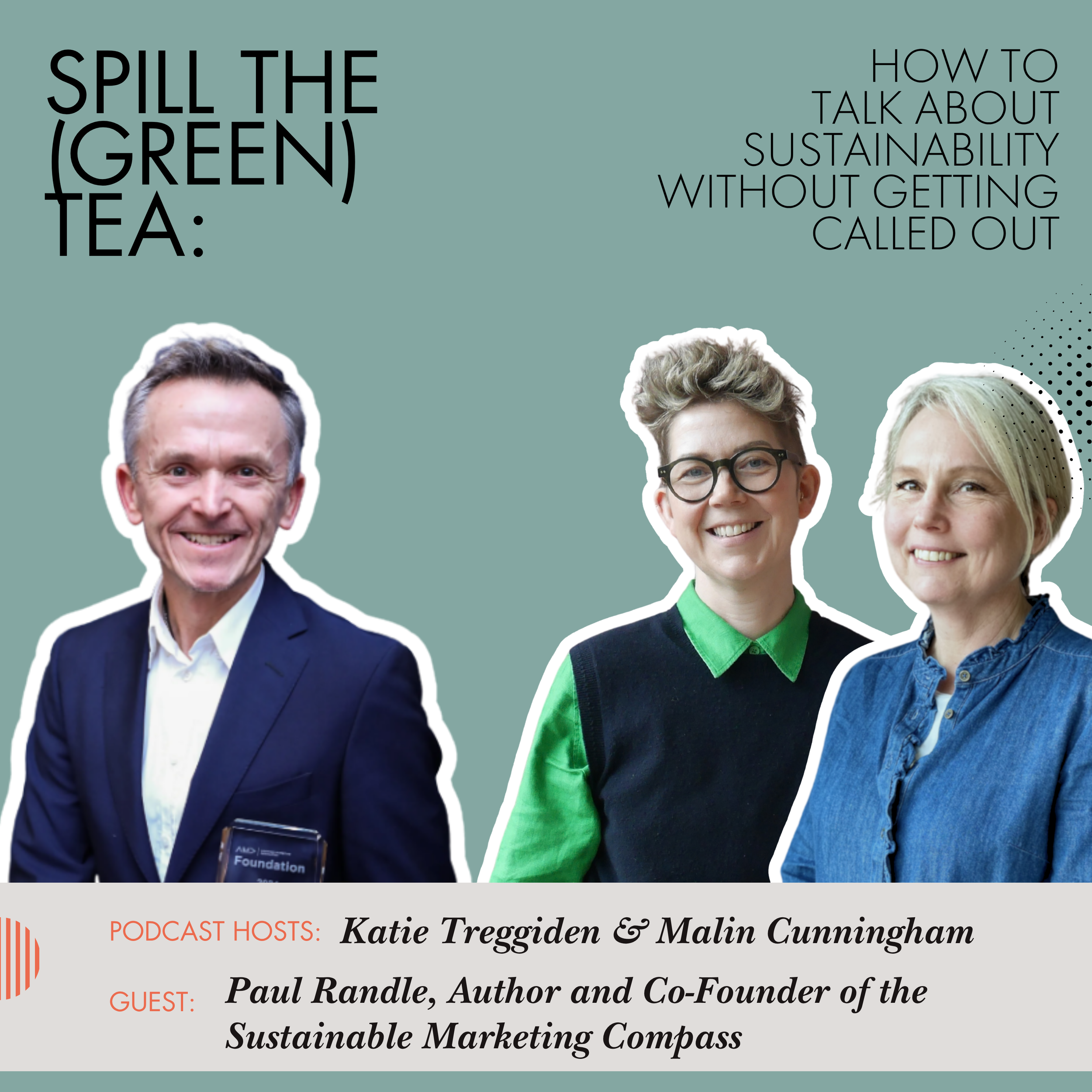
Spill The (Green) Tea with Paul Randle
This is an auto-generated transcript that has not been edited or proofread and therefore may contain errors.
Malin Cunningham
Welcome to Spill the Green Tea, the podcast where we dive into perhaps the most controversial part of sustainability, how to talk about it.
Katie Treggiden
That's right, we're exploring how to talk about your eco-efforts without getting called out. Join us for straight-talking, behind-the-scenes insights and practical takeaways that will help you gather the courage to shine your light in these volatile, uncertain, complex and ambiguous times.
Malin Cunningham
It's a serious topic and we don't shy away from that, but we will bring you uplifting, positive and pragmatic conversations with brilliant guests and in-depth discussions between the two of us, all to give you the confidence to talk about your imperfect efforts towards genuine sustainability.
Katie Treggiden
Because it's not just showing off, sharing your progress helps you connect with clients and customers and inspire others to be more open about where they are on their journey. We need your stories now more than ever.
Malin: So, um, so in this podcast, we champion progress over perfection. That's how we talk about it. Um, so we open with the same question every time. So, what is your eco-confession, i.e, what's the one thing that you do that might not seem super sustainable?
Malin: And why?
Paul Randle: My eco confession is gardening, which on the face of it should, could sound, you know, quite, quite sustainable, quite eco friendly, just not the way I do it. It's, I just don't seem to have any natural ability at all when it comes to gardening.
Malin: Yeah.
Paul Randle: comes to keeping things that are green alive in my garden, and I really wish I could, but I seem to be, you know, grossly incompetent and at any sort of gardening, and you can kind of my other half refer to me as incompetently rewilding our garden.
Paul Randle: Um, but the only things that are growing are kind of, like, bramble. You know, there's nothing exotic or anything like that, and it's, um… I just wish I could grow things you could eat. I wish I could just grow things, to be perfectly honest, rather than look at them and they die. Um, which…
Malin: Right, yeah, yeah.
Malin: Next.
Malin: Okay.
Paul Randle: appears to be my only inherent skill when it comes to gardening. Um, so yeah, my… my kind of, like, guilt and embarrassment is a lack of gardening skills, yeah.
Malin: Yes.
Malin: Yes, gardening is good. I mean, I kind of, kind of with you, I'm into my gardening as well, but it's hard. It's a lot harder than they make out, I would say.
Paul Randle: It is very much, although I do give myself a bit of a get out of jail free card because we're very lucky where we are in the countryside. So my argument is that things are dying because I'm testing what the farmers are spraying.
Malin: Okay.
Paul Randle: Uh…
Malin: Right, okay.
Paul Randle: And actually, the sad reality of that is that we have no insects around our house at all.
Malin: Oh, gosh. Wow.
Paul Randle: Uh, you know, I suppose… I mean, we've been in the property about 15 years, and we used to have a huge amount of butterflies and things like that, and we haven't…
Paul Randle: Despite my best efforts, we haven't killed any trees or anything like that. But the volume of insects that we used to see around our house has just declined massively, you know, really, really tell the difference.
Malin: Yeah. Yeah, it's sad, isn't it? I would say the similar thing for us. And I guess that's a good tangent into what we're talking about today. It leads in nicely to that. So obviously we're here and we're going to talk about your new book.
Paul Randle: Yes, indeed.
Malin: Ta-da! Hey! Competitive sustainability driving change with value.
Paul Randle: Hey! Ha ha!
Malin: Um…
Malin: But before we dive into all of that, uh, it would be great to understand a little bit about how you and Alexis Ayer, who you've co-written the book with, sort of how you, uh, came together, and sort of what… what's taking you down this road?
Paul Randle: Yes, so Alexis and I have kind of a shared pathway in that we were both career marketeers and we actually met on a sustainability management course.
Malin: Of authorship.
Malin: Mm-hmm.
Paul Randle: University of Cambridge Institute for Sustainability Leadership, which I will call CISL from now on in, because it's the world's longest name for an institution.
Malin: Yeah.
Malin: Yes.
Paul Randle: But we met on that course, and.
Paul Randle: We tell the story about.
Paul Randle: Sitting there as marketeers with all our colleagues.
Paul Randle: increasingly feeling like we had devil's horns growing out of our foreheads, because we were hearing all this horror that we knew we were being given the tools with which to interrogate what we were doing. And we suddenly realized how complicit marketing was.
Malin: Yeah.
Paul Randle: in a lot of challenges that we face from a sustainability point of view, both environmentally and societally. And, you know, we'd be introducing ourselves to our fellow students and going, hey, I'm Paul, or hey, I'm Alexis, I'm a marketeer, and you'd get that…
Paul Randle: you know, **** through the teeth, sort of like, aren't you the problem, sort of thing. And, um, yeah, so we ran off and cowered in the corner, um, where thankfully we were found by one of our professors, and he said, look, you know.
Malin: Yeah.
Paul Randle: Marketing has a role to play. It's just currently pointed in the wrong direction.
Paul Randle: And that wonderful kind of conversation changed both our trajectories. You know, we both latched onto this idea of how do we make marketing a force for good?
Malin: Yeah.
Paul Randle: And that became the pathway we went on. We started first of all by saying, okay, what could be a different way to approach marketing? And we launched something called the Sustainable Marketing Compass. When we launched that.
Paul Randle: 4-plus years ago now, um, we really hit a nerve in the industry. We had 750,000 people look at it in the first 24 hours on LinkedIn.
Malin: Wow.
Paul Randle: it was like, oh, blimey, what have we done? Out of that, we started doing some consulting work, we started working with academic institutions like CISL to bring the module… the framework, sorry.
Paul Randle: into some of the courses and some of the modules. Then we were asked to write a book, and we wrote our 1st book, competitive sustainable marketing. Sorry. And again, we seem to be really on the right moment at the right time. With that we won the American.
Malin: Yeah.
Paul Randle: Marketing Association's Leonard Berry Book of the Year Award, just at a time when the American Marketing Association was really doing its own interrogation into what the sustainable impacts of marketing were. So we were really fortunate.
Paul Randle: happened to have some thinking that started to resonate with individual at the right time it was needed.
Malin: Yeah, I think there's a lot more than look there, because I feel like when I heard about the new book, The Competitive Sustainability, I've got the other one as well, and I had read that, and I just felt like…
Paul Randle: I…
Malin: it's like a… it just felt like the perfect book for the time, again, because it feels like we need something positive, which is obviously part of the premise. Um…
Malin: for your book. So you talk about the fact that or actually says on the back of your book, it sets out to help businesses adopt sustainable practices while maintaining their competitive advantage. And obviously, you know, you talk about this concept of shared doorways.
Malin: And I've got to say, for me personally, that really resonated. I'm Swedish, you may or may not know, but I grew up in Sweden, and that whole concept of collective thinking, or more of a, like, a consensus.
Paul Randle: Hmm.
Malin: Consensus approach to decision making, etcetera. It really feels like it feels natural to me, but.
Malin: It's not obviously something that's part of the system as much here.
Malin: It certainly doesn't feel like it.
Paul Randle: And I think I mean, some cultures are far better than that than others, as you say, but I think in in the business culture. You know the way that.
Malin: Yeah.
Paul Randle: the sustainability community had typically gone into the business community was how we start the book. You know, we're a little bit pokey at the start of the book, you know, we basically start by saying the planet's screwed and you screwed it. You know, because that was…
Malin: Yeah.
Paul Randle: Pretty much, you know, if you encapsulate the whole approach of the sustainability community when approaching commerce and business.
Paul Randle: it was pretty accusationary, you know, it was pretty damning, and quite justifiably, I'm not undermining any of that, um, you know, it did a really… that doom narrative, that kind of, like, look what you're doing narrative, really raised.
Malin: Yeah.
Paul Randle: Awareness.
Paul Randle: but then that's all it did. It raised awareness, it, you know, it empowered certain individuals, like ourselves, like Alexis, and, well.
Malin: Yeah.
Paul Randle: But for others, it didn't motivate. It didn't change. It became, okay, got you. I might agree or not agree this is an issue, but it's something.
Paul Randle: But I'm not going to make it part of my job. I'm not, you know, we kind of came into those conversations almost with this religious fervor, saying you have to come and adopt.
Paul Randle: my dogma and not everybody was going to. So I think that spirit of shared doorway felt particularly relevant when it came to sustainability in the commercial organization.
Malin: Mm-hmm.
Malin: Yeah, definitely. So can you just explain a little bit of what this concept is?
Paul Randle: Well, I mean, I actually first stumbled across it myself when I was reading Bono, the singer from U2's autobiography. I'll leave my comments about that book aside. But he's done obviously a huge amount of work, you know, phenomenal.
Malin: Yes.
Malin: Yeah.
Paul Randle: individual. But he was talking about, um, the Civil Rights Movement back in the US, back in the 1960s, and at the time when Bobby Kennedy had been elected Attorney General, and that Civil Rights Movement was, you know, Martin Luther King and everything, were really struggling to make any progress.
Paul Randle: And a lot of people don't realize that the famous singer and crooner, Harry Belafonte, was also a very powerful political activist.
Paul Randle: And he actually said, you know, Harry Belafonte said to, um, MLK, um, you've got to find the shared doorway that you can work with Bobby Kennedy.
Paul Randle: And that was a real lightbulb moment for me in this book about being a rock star. It was like, oh, wow! Okay, it's kind of that… that's, you know, if it works in civil rights in America at such a fraught time.
Malin: Yes.
Paul Randle: Let's bring that in to the way we think about sustainability in the commercial world, and what can we do with that?
Malin: Yeah, I mean, I love it. And I love the quote, like the Bono quote is actually in the book as well, isn't it? And I really like it, you know.
Paul Randle: Yeah, yeah, it is.
Malin: so I was going to quote her, that you don't have to agree on everything if one thing you agree on is important. It's so powerful, isn't it? You know, it's just…
Paul Randle: Absolutely.
Paul Randle: Yep.
Malin: And.
Malin: Really, Lancets. And it felt like, uh, actually…
Malin: Reading about it, and obviously you go into quite a lot of detail in terms of how you get there, and I was going to ask you about that in a minute, but I felt that actually that framework could, as you say, it could apply to anything. I was thinking, this is a very good tool for parenting, you know, it's just about finding things where.
Paul Randle: Yes.
Malin: You know, you can, you know, you can agree on something basically to move forward.
Paul Randle: Yes, I probably need to apply it more in my own parenting actually now you've mentioned.
Malin: So do I. Definitely. Is that one of those that you miss, you get a bit entrenched? Picking your, you know, picking your battles and all that, you talk about it, it's a similar thing.
Paul Randle: Yeah.
Malin: So, um, and obviously, in the book, then, the way it's set out, um, and it kind of made me smile, because you spend quite a lot of time up front.
Malin: talking about all of the different things that are playing out that are influencing why the shared doorways thing is hard and why it's so hard to reach the consensus. And the thing that made me smile about it is that you actually acknowledge, well, once you get that, you kind of acknowledge that like, why have we spent all this time talking about all this other stuff?
Paul Randle: Yep.
Malin: We were going to talk about the shared doorways, but yeah, could you just explain a little bit about that setup and why you thought that was so important to start it in that way?
Paul Randle: Yes, it's something that, um…
Paul Randle: I think without really realizing it, it's the way that Alexis and I write, you know, in our first book, we went back to say.
Paul Randle: why, why does marketing exist? And you know, what is that raison d'etre of marketing that's therefore informing the way it behaves. And we we kind of said, Okay, let's do a similar thing with with this, with the new books. But looking at competition.
Paul Randle: And looking at the way commercial organizations work and the way that competition is treated within the organization. And actually, when you take a step back and you look at the origins of competition, you look at how competition behaves in nature.
Paul Randle: often misconceptions we have about what competition is. You know, a lot of us still badly understand Darwinism and, like, survival of the fittest, which actually.
Malin: Yeah, yeah.
Paul Randle: Darwin didn't say, it came from his economist mate. You know, so we went… we said, let's go back and let's look, you know, and let's look at what are the foundations of competition and how it's got twisted and morphed.
Paul Randle: over time, but actually competition can still work towards sustainability. And, you know, and it was a fascinating journey of discovery, you know, realized that actually.
Paul Randle: Back in the '80s, "The Economist" magazine actually ran an article apologizing for misusing the Darwinism thing of competition and survival of the fittest. Back in the '80s, they said, "Sorry, we got that wrong." And actually, when you look at competition.
Malin: Okay.
Malin: Wow.
Paul Randle: The conditions for competition, having a scared resource, having part… multiple parties that are interested in that scared resource, and somebody wanting the value of that scared resource.
Paul Randle: Those conditions for competition are exactly the same conditions for collaboration.
Malin: Yeah.
Paul Randle: And which, when you say that to a lot of people, they go, no, they're not. And it's like, well, let's think about Silicon Valley then. It's kind of like in Silicon Valley, you have all those amazing brains, all that finance and all that research and all that research intelligence and research capability.
Paul Randle: you know, yes, they compete Hammer and Tong, but the reason why Silicon Valley is so successful.
Paul Randle: is because they've got all that in one place, and that collaboration can come to make them such a powerful part of the world in and around that technology space. Um, so actually.
Paul Randle: what… what the learnings from that really highlighted for us is that, you know.
Paul Randle: The way you approach competition in your organization is a matter of perspective as much as anything else. And yet we often miss that perspective because we come in with this baggage, which is actually, it's about survival of the fittest and it's about beating the other person.
Malin: Yeah.
Malin: It…
Paul Randle: Um, and we don't have to behave that way, that's just the way we've got conditioned to behave.
Malin: Yeah, it's fascinating. Also, as I've mentioned before, we deliver carbon literacy training and we quite often do open courses, which means that you have people, businesses from within the same sector, because it's sector specific.
Malin: Talking to each other. And we talk a lot about exactly that point, like you don't all have to solve the whole problem, like some of these problems yourselves. Can you imagine how much more powerful it is if you solve them together and then focus on the other bits, you know, where you're different.
Paul Randle: Exactly. And sometimes, you know, industries can only move forward if there is that pre-competitive collaboration. You know, you've seen definite evidence of that taking place in the pharmaceuticals industry. I'm doing a lot of work in.
Malin: I mean, how much faster?
Malin: Yeah.
Malin: Yeah.
Paul Randle: MedTech at the moment, you know, and you can see the whole recycling challenge that that industry faces.
Paul Randle: it… you need scale, you need collaboration across countries, so… companies, sorry. Um, so… collaboration is very much needed to be successful, but you can still have competition with it. Um, there's a brilliant example of some of the work that, um, it kind of…
Paul Randle: you know, the infamous Tony's Chocolonely are doing with the Choco chain and their blockchain solution for traceability of bean to mouth.
Malin: Oh, yes.
Paul Randle: That's their proprietary technology.
Paul Randle: And yet now they've open sourced it, allowing people like John Lewis's partnership in the UK to leverage it and work with it.
Paul Randle: You know, it's like, it's that spirit of collaboration still means they can compete. They've still got their own separate brands of chocolate.
Paul Randle: But they're all doing it better because they're on this new set of technology rails.
Malin: Yeah, absolutely. And I just think, you know, obviously a lot of people talk about them, but they're such a great example because it wasn't like anybody thought that we needed more chocolate brands or, you know, it didn't feel like a market with lots of gaps, did it? At the time.
Paul Randle: Yep.
Paul Randle: It did not at all. No, no, but they proved everybody wrong. Yeah.
Malin: Yeah, well, exactly. And I think that's part of the reason why it's so good. And I think the other interesting thing that you tackle head on is the premise of the customer is always right.
Paul Randle: Yeah.
Malin: And the fact that, you know, because I hear that a lot as well, you know, as I'm sure you do, oh, we would love, you know, we have these sustainable solutions, but nobody wants to buy them because they're too expensive, or, you know, we're doing this and we're doing that, but actually.
Malin: there's no appetite for it in the market. And it's kind of part of that whole premise, isn't it, that the customer just knows exactly what they want all the time, and they're always right.
Paul Randle: Yeah, you know, it's this idea in economics that, you know, you have this infallible human, you know, with perfect knowledge And it's completely rational.
Paul Randle: And it's like, I mean, you can never point those 2 fingers at me. And it's like, I don't think there's many people around the world that you can do that too. But equally at the business level, if you're in a B2B market, you know, it's like, you can definitely see examples where.
Malin: Okay.
Paul Randle: even in with sustainability, where customers are saying, I need this to be more sustainable, and it's like, actually, no, that's not right, and it's an education challenge.
Paul Randle: Um, to bring the customer to the level of insight on what the vendor's challenges are. Um, which is another type of collaboration, you know, a better collaborative relationship between the customer and the vendor.
Malin: Yeah, yeah, absolutely. So…
Malin: Just going to introduce another of your concepts from the book. So you talk about, so we talk a lot about helping marketeers and people in comms share their imperfect progress with more confidence. So helping them tell transparent stories.
Paul Randle: Sure.
Malin: Basically, and I think that's, you know, there's obviously all this conversation about greenhushing and greenwashing and the tension between the two, etc.
Malin: And then, and how they can be more inspiring in the storytelling. And you introduced this, what you call the ladder of good. I think part of that is aimed at tackling that particular issue, isn't it, if I understood it right? So could you just explain what it is and how that works?
Paul Randle: Yes.
Paul Randle: Yes. Again, part of this approach was to take a step back and kind of look at what's going on in industry around sustainability.
Paul Randle: We're looking at, you know, there's a huge amount of effort and investment going into sustainability, you know, huge volumes of individuals with all the best women in the world trying to drive change, and yet we're not getting the…
Paul Randle: the transformation and the change that we want, that imperfect world you just described, and it's like, well, why is that the case? There's lots of great thinkers out there, amazing thinkers out there, and it's like, why aren't we…
Paul Randle: moving forward. And some of the bits of insight we got from that was, you know, there's a bit of a disconnect between.
Paul Randle: having a vision of what good looks like and the roadmap to it.
Paul Randle: And.
Paul Randle: And sustainability individuals are often very, very good at the doom narrative, and saying what's bad right now, and what the horrible future could look like.
Paul Randle: When you ask them to paint the what good could look like.
Paul Randle: It gets a bit vague, you know, it gets a bit kind of Garden of Eden, utopian sort of thing, and it's either like something from some sort of sci-fi book, or it's just going back to caves, and it's not that compelling when you're trying to bring that to a business.
Malin: Yeah, yeah, yeah.
Paul Randle: audience. Or if there is a strong vision, then the roadmap to it is lacking. So we've read a lot of James Bellavie Foster, who's kind of a sociologist out of the US, who's written an amazing book called Capitalism in the Anthropocene.
Malin: Yeah.
Paul Randle: And he paints this kind of utopian future vision of where we need to get to, and says we just need a societal revolution to get there.
Malin: Only.
Paul Randle: And it's like, I'm not sure what we've done through one of those. So the ladder of good was kind of bringing it more into a business world and sort of saying, okay, so what are the steps of progress? How can we actually, you know, if we start just by being regulatory compliant.
Malin: Okay.
Paul Randle: Let's all get there first because not everybody's that good and gradually ending up to a place where we get to where we get to the fact we're being circular to the point where we get being net positive. And then we started saying, okay, that still.
Malin: Mm-hmm.
Paul Randle: not an exciting destination, is it? It's kind of like, you know, what does net positive mean? It's not a vision. And… and I…
Paul Randle: And bizarrely started doing a lot of research into Disney.
Paul Randle: Walt Disney, the individual who was a fascinating in individual. And actually, if you look behind, you know what he was trying to achieve with the the Epcot Amusement Park. Originally it was an experimental community of tomorrow.
Malin: Oh yes, yes, yes.
Paul Randle: It was supposed to be a place where people would live, would work, that had no cars, um, and everything was kind of automated and within walking distance, um, that…
Paul Randle: you know, could be a sustainable future. Unfortunately, he died before it could be built, and his brother kind of turned it into the amusement park, and we know the story that went on from there.
Paul Randle: But what Walt Disney was amazing at was actually exciting people about the future.
Paul Randle: And he used technology and animatronics, and the Carousel of Progress is something he first built for the World Fair in New York, which still exists in the Magic Kingdom in Orlando at the moment.
Paul Randle: Um, he got, at that point in time, people to invest in a sustainable future.
Paul Randle: By just exciting them about it. And it's like, nobody's doing that, are they?
Malin: No, definitely not.
Paul Randle: You know, nobody's creating that energy, that passion. And what Walt Disney was amazing at doing was bringing individuals together with such compelling thought that it answered the question, why wouldn't we?
Malin: Yes.
Paul Randle: And that's what we put at the top of the ladder, is kind of like, once you've answered the commercial question, the environmental question, the societal question, the physical questions, the technological questions, etc.
Paul Randle: If you've done that in a way that says, why wouldn't we?
Paul Randle: Then that's the vision you need to bring to what you're doing.
Malin: Yeah, I mean, it's so compelling, isn't it? And I've got to say, I didn't know anything. I mean, I knew a bit about Disney, but I didn't know that whole backstory, and it's a really captivating thing, and it's… I mean, it's so…
Malin: um, forward-thinking, thinking… I mean, I don't… I don't even know… when was this? Is it 50th or something? Is that right? No, is it…
Paul Randle: Yeah.
Paul Randle: He was doing. He did have a sell of progress in in just after World War 2. So after you got World War 2, and everybody was kind of like just coming out of that absolute horror. Him and other individuals, you know, were going to the world fairs just.
Malin: Yeah.
Malin: Yeah.
Paul Randle: Creating the… using technology, you know, which looks really antiquated to us now, but using these technologies to fly people over a diorama of what the future could look like.
Malin: Yeah.
Paul Randle: And these amazing experiences paved the way towards amusement rides, but were designed to actually kind of just excite people in what the future was now that we would be on these world wars. And he was just answering all these questions.
Paul Randle: And he had these management rooms, which I found brilliant. He had one room of kind of naysayers, you know, where the money people were. It's like, not gonna happen, gonna cost too much money.
Malin: Yeah.
Paul Randle: Then he had called the Imagineers, where they would say, wait, let's make a house float.
Paul Randle: Yeah, and just come up with the idea. And then there was another room where they kind of figure, well, how the **** do we do that? But having all those, but answering the why wouldn't we question across those three rooms was how we managed to move people forward.
Malin: Yeah.
Paul Randle: And we don't have that. And if the sustainability community could bring that.
Paul Randle: into the way it works in businesses would have far different conversations to the one we're having today.
Malin: Yeah, definitely. And it feels like the world is definitely ripe for that, isn't it? You know, obviously part of what you're setting out is the polycrisis that we're in and, you know.
Malin: as we're recording this, there are all sorts of horrible things happening in Europe, for instance, with these enormous fires, etc, and it just feels like that kind of narrative that people would be open.
Paul Randle: Yeah.
Malin: to that? Um, and… and just going back to the… the ladder of good, then, the ladder of good, uh, as a framework, so how… how, sort of, practically do you think people could use that.
Malin: Um…
Malin: And how do people work out what rung they're on? You know, so you know what rung you're on, rather than the one that you want to be on, that you think you're on, because that's where you're aspiring to.
Paul Randle: Yeah, I mean, you could definitely bring a team together internally. You know, I don't think you need to have, especially for some of the lower rungs, I don't think you need the world's best sustainability data sitting around you for some of these questions.
Malin: Yeah.
Malin: Yeah.
Paul Randle: For everybody else on the call, we go through six rungs, which are, rung one is what we call the legal and safety floor. It's like, if you're not legal and doing what regulations ask you to do, then you've got bigger challenges, to be perfectly honest.
Malin: Yep.
Malin: Yep.
Paul Randle: Um, but quite often, that is still a challenge for lots of organizations when it comes to new environmental legislation or new societal legislation coming through, and that's moving apace. So actually, you can get a view of that from your regulatory teams, from your compliance teams, you can… if you're a smaller organization, you can talk to, kind of.
Malin: Yeah. Okay.
Paul Randle: legal councils, you can look at what's going on in your geographies. Um, and interestingly, they're often geographically focused, you know, if you're in the EMEA region, or even if you're in a particular county with a small business.
Paul Randle: you might have a green scheme running or something like that. So you know, there's that legal safety floor is that you know, are we doing what we need to do? The next one we call transparent and comparable. And this is really where you get your handle around your own data. And it's kind of saying.
Paul Randle: can you surface your own performance at the moment to know exactly where you are, so you can communicate where you are, and you bring in that level of transparency, and a lot of marketing is focused on this. It's like we don't agree anymore. We don't get caught out from the new EU regulations. So how can we.
Malin: Yeah.
Paul Randle: be confident in our communications and be transparent and comparable in our communications. And that can be quite a bit of work. Again, you don't need to be a rocket scientist to figure that out if you've got gaps in what you communicate.
Paul Randle: And everything. Wrong three is what we call resilient and efficient.
Paul Randle: And this is where we start seeing organizations who are moving beyond.
Paul Randle: the law and the regulations and being able to talk about it to, you know what, if I'm more sustainable, I'm actually more efficient.
Paul Randle: and I'm saving money. And in this poly crisis I need to ensure I can get my product to my, you know, to my customers. Resilience is almost become a interchangeable word with sustainability in some places. So.
Malin: Yeah.
Paul Randle: How do I make sure of…
Paul Randle: bait that resiliency into my supply chain that requires me to have a whole number of environmental conversations and societal conversations just like a Tony's chuckle only would have actually done. Room 4 is where you start really morphing your business model is kind of like, okay, how am I getting more circular? And how am I using.
Malin: Yeah.
Paul Randle: circularity and regeneration as a competitive edge. You know, I think, look at what's happening in the electric vehicle space at the moment, especially what your Chinese manufacturers are doing like Byd.
Malin: Yeah.
Paul Randle: They're building closed loop circular models around the batteries.
Paul Randle: you know they haven't got to go and mine lithium in the future. They've already got it in their circular system, you know, who's got the competitive edge then in in the future. So actually, you know, taking that step back. Run 5 is something we borrowed from kind of Paul Polman, and all the work he did with Unilever, which is actually where net positive advantage where you actually.
Malin: Yeah, exactly.
Malin: Yeah.
Paul Randle: positively contributing into the world. Uh, and then next, room 6 is where you start answering that legacy question, why wouldn't we? You know, when you've built your Epcot.
Malin: Yeah.
Paul Randle: You know, and you've been successful, and you've moved that way, and it's kind of like, yes, that's a visionary, kind of, holy grail sort of place to go before, but it's…
Paul Randle: personal to the organization, it's personal to the individual driving change in their organization, yet it's kind of consistent across everybody. It was quite a hard…
Paul Randle: Concept to find, to be honest.
Malin: Yeah, I'll bet.
Paul Randle: Yeah, as we were digging around.
Malin: Yeah, I think one of the most interesting bits about that when you, you know, when I was reading about it and thinking about it is so, I mean, you even call it out in the book. So I should say that, like, personally, I work mainly in B2B and so does Katie. So that's kind of the head I've got on, really.
Malin: Um, but I would say that most businesses are probably on one or two, you know, step one or two on the ladder. You know, there are, obviously, there are examples.
Paul Randle: Yep.
Malin: Further up the chain, but I think if we're just looking at the majority, that's probably true. But that also means that at each of those steps, there's loads of competitive advantages to be had, isn't there? Like, there's so many different ways in which you can, if you work through that, that you can see.
Paul Randle: Okay.
Paul Randle: Lately.
Malin: How you can get real stand out and.
Malin: And, you know, but still apply all of that thinking, so thinking about it in the round, as you're suggesting, you know, in terms of bringing the sustainability and everything together.
Malin: And I thought that's quite…
Malin: That in itself is quite exciting, and not necessarily what you normally get, you know, when you're thinking about sustainability and how to communicate about it, you know, a tool that can help you unlock some of that.
Paul Randle: Okay.
Paul Randle: It is, you know, but the…
Paul Randle: Alexis and I have quite a bit of fun when we're trying to write our our books and and as everybody else, we used a bit of AI to help us kind of validate resources and do research and everything, and we created a little bot a bit of insight here, and how we and how we.
Malin: Yeah!
Paul Randle: Um, I don't know if you've seen the DreamWorks movie, Home.
Paul Randle: Um…
Malin: I haven't actually, but it's on my list to watch after reading your book.
Paul Randle: It's… it's… I love it. I… you know, I'm a sucker for, kind of, like, kids' movies, but, um… basically, you've got this little alien from a race of aliens that come and invade Earth, and, um…
Malin: Oh, yeah.
Malin: Yeah.
Paul Randle: Uh, and he's one of these characters that when he pops up in, um… and his name is O, sorry, that's the name of the character, and he's called O because when he pops up in a room, everybody else in the room goes.
Malin: This is so good.
Paul Randle: And it's like, and it's like, sustainability people have become, oh.
Malin: Yeah.
Paul Randle: you know, kind of in the court. You walk into the boardroom. It's like, oh, sort of thing. And yeah, he's lovable, and his heart's in the right place, and he wants to do the right thing. And of course he ends up saving multiple planets, you know, in in the story and thing. So.
Paul Randle: You know, we wanted to bring that sense, recognize that it's kind of like, how can we change the dialogue? How can we acknowledge we're in this kind of, oh, space and equip us with a new dialogue, equip us with new tools and new things to say, new shared doorways.
Malin: Yeah.
Paul Randle: That could allow us to kind of reframe our conversations.
Malin: Yeah, and be a bit more energizing. And that's, I think that's what, you know, it really helps to see it like that. And obviously, so in the book then, so you've talked about the shared doorways, we've talked obviously about this, the ladder of good, and it sort of builds up to.
Paul Randle: Yeah.
Malin: your carousel of progress, which is like the ultimate framework. So can you just help, and you have sort of nine Rs, and I can't imagine just how hard it is to find nine Rs, because they all have to start on R, obviously.
Paul Randle: Yes.
Paul Randle: Yes.
Paul Randle: Yeah, it was a lot that kind of, like, circularity's got the R ladder as well, and it was like, oh, can we find better words? But R words did seem to work better, um…
Malin: Yeah.
Paul Randle: Strangely, yes.
Malin: It definitely works. So can you just talk through for obviously, if people haven't read the book like, how does that the sort of ultimate? It's a tool, isn't it? It's a framework, but it's a tool for how to unpick all that, and how people can use it.
Paul Randle: But basically it's nine shared doorways, you know, that we're trying to give.
Malin: Yeah.
Paul Randle: each doorway is something that a sustainability lead can see would deliver the value they want to, yet could be recognized and seen as value by a CFO, by a CEO, by a salesperson. It's kind of like… it's a shared doorway to bring multiple parties together.
Paul Randle: around, kind of, topics where I can say, I could put a project there, or I could have a workshop there, or I could actually build a new team here, or something. It's kind of like…
Paul Randle: rather than trying to solve everything and say you've got to do all of it, you know, and the idea came from the Carousel of Progress that Walt Disney built back… and you can still ride the Carousel of Progress, like I think I said, so go and ride it. Yeah.
Malin: Yeah.
Malin: Yeah, right.
Paul Randle: it's old and ancient and breaks down and falls apart all the while, but it's got some lovely history. So, we took that metaphor.
Paul Randle: And we identified the nine Rs, which are relevance, resources, resilience, responsibility, reciprocity, reputation, reward, reduction stroke, regeneration, and reinvention.
Paul Randle: And then we built out a shared doorway behind each one, you know, what would it mean to go into a room where you've got chief sustainability officer, you've got the CFO, you've got the chief exec, and say.
Paul Randle: How are we looking at resources? Are we looking at resources, you know, as rather than a strategic input as something that you could get as cheaply as possible? You know, what happens when those resources start to kind of like dry up as is quite.
Paul Randle: literally happening in Europe at the moment, we think from food resources and things of that sort of nature. How are we actually adopting a kind of an approach that means we're keeping more value in those resources? Resilience, we've already talked about, you know, how do I make sure I've got a resiliency of supply and.
Malin: Yeah.
Paul Randle: Resilience is a very defined concept. It's not that we're creating it. You can go and study resilience and it's like If you hit a system shock, it's like, how far do you move away from the norm? And then how quickly can you get back to the norm? But it's taking that concept and acknowledging some of the environmental and societal things that are coming together about that. But actually.
Malin: Yeah.
Paul Randle: A CFO, an operations director, a chief exec are really engaged in that topic because they can see supply chain shocks. They can see what happens when you're getting wildfires across Spain and France that are stopping the deliveries of your products. What does your organization do when it's dependent on supply in those scenarios?
Paul Randle: What are your planning? This isn't a hug-a-tree conversation, this is a business conversation. And we try to do that across each of them. Some of them are more obvious than others. You know, one of the things, um…
Paul Randle: we put in there that we we had a bit of fun with was reduction and regeneration. where we said quite deliberately, you know, some organizations now have.
Paul Randle: Especially in marketing, they have growth engineering.
Malin: Yep.
Paul Randle: You know, a growth function, which, like, looks at how they can change the product to actually make it more compelling, make it more sticky, and actually grow the organization.
Paul Randle: What if we created the reduction function as a counterbalance to that?
Paul Randle: So actually, here's the team that's actually driving the efficiencies, taking the waste out of the system, putting thresholds on where we can't exceed in terms of that growth to counterbalance it. What would that function look like, could look like?
Paul Randle: You know, sometimes they're thought leadership, thought pieces and things like that, but they're, you know, they're doorways that can bring in those different parties to say, right, let's have a conversation about what this might mean for us.
Paul Randle: And it drives the environmental and the societal benefits we want, but it still drives those commercial.
Paul Randle: objectives that the organization wants as well.
Malin: Yeah, absolutely. And the one that I was particularly interesting as well was obviously reputation, thinking from a comms and particularly comms perspective.
Paul Randle: Yes.
Paul Randle: Yeah, yeah.
Malin: And obviously that ties back so much to the whole green hushing and greenwashing and why people are feeling so worried about.
Malin: Sharing anything.
Paul Randle: Yep.
Malin: I mean, you know, the context of that is massive. We talked about that quite a lot on the podcast.
Paul Randle: Thanks.
Paul Randle: Okay.
Malin: Yeah, so how did you approach that one? It's just interesting to…
Paul Randle: Well, I mean, reputation…
Malin: Yeah.
Paul Randle: you know, a really fascinating subject. Obviously, as marketeers, you can come at it from a brand, and, you know, product reputation, and things of that sort of nature. But, you know.
Paul Randle: what are the new dimensions that are that you're the pillars. You're building your brand and your reputation on anymore, you know. Is it purely just the quality of your product?
Paul Randle: Yeah, you know, in a B2B world, is it actually, yeah, you've got brilliant products, but you can never get them because your supply chain falls down all the while.
Malin: Yep.
Paul Randle: You know, it's like, you know, there's new pillars of what reputation are built on now, and you know, there's that real sense in today's world that actually.
Paul Randle: They can crumble alarmingly quickly.
Paul Randle: and having that ability to understand where those pillars are built.
Paul Randle: across all your stakeholders, not just your customer stakeholders, but all your stakeholders. You know, it's like, how does your reputation manifest through your supply chain? You know, if you're exploiting workers in the back end of Bangladesh or something like that.
Paul Randle: and you're suddenly asking them to be more resilient, you know, why would they bother? Why would they, you know, why would they risk thinking of reciprocity?
Malin: Here.
Paul Randle: Why would they go that extra mile for you?
Paul Randle: at that critical juncture. They're not going to.
Paul Randle: Yeah, and, you know, so actually taking that broader view of reputation across all your stakeholders, across different dimensions of building your kind of reputation. Um, so you have that…
Paul Randle: more holistic brand sense than your kind of more traditional brand.
Malin: Yeah, exactly. And I think…
Malin: particularly because there's such a trust deficit in general, in terms of, you know, both for, you know, any kind of institution, isn't it? If we call, you know, politics, you know, the NHS, whatever it might be, I think people are…
Malin: they're challenging narratives around all of them, in terms of how they're holding up, and the stories that they are telling people, and how true they are, and then obviously add into that all the AI stuff.
Paul Randle: Yeah, yeah, reputation. Yeah, you know, reputation is as much the experience I have of you rather than what you've put in a piece of comms. you know, and obviously that they need to dovetail, you know, and that kind of experiential reputation has been around.
Malin: And, you know, deepfakes and all of those kind of things.
Malin: Yeah.
Paul Randle: You know, for donkey's years, there's nothing new in that. It's far more critical.
Malin: Yeah.
Paul Randle: At this moment in time, I think, and it's far more compressed.
Malin: Yeah, exactly. And like you said, it touches a lot.
Malin: many more people in terms of, you know, everything from employees to your customers, and I think businesses are not necessarily… not all businesses, anyway, are joining the dots between all of those things that actually has to make sense across.
Paul Randle: No.
Malin: All of those. You can't you can't just.
Malin: Talk the talk, you have to do it as well, you know.
Malin: So then one of the things that you call out, and this is going towards the back end of the book now, you talk about that you don't want to be another cathedral of change management. In other words, you want this to be useful.
Paul Randle: No.
Paul Randle: Yeah.
Malin: And so how are you?
Malin: hoping to enact that? How are you hoping that people will use it? And yeah, you just expand on that.
Paul Randle: Yeah, I mean, sustainability became the realm of the management consultancy. I've done a fair share of that as well. So it becomes — that can be an industry in its own right, which is in sustainable.
Malin: Yes.
Malin: Yeah.
Malin: Yeah.
Paul Randle: I spent, you know, pre-sustainability decades in digital transformation and, you know, there was a horrible stat from the early days of digital transformation where kind of 80% of all transformations failed.
Malin: Mm-hmm.
Paul Randle: You know, so like huge amounts of energy and effort and time and money and never quite getting to anything and it's like you know where some organizations have quagmired in their own transformation is through that kind of scenario is that kind of like transformation is.
Paul Randle: hard. You know, when you're trying to change the big ship, you know, it's like, by the time you've stirred it a little bit, everything.
Malin: Mm-hmm.
Paul Randle: moved. Um, so we wanted to bring it down a level a little bit, and we really thought long and hard about the carousel, and it was more a case of, like, rather than.
Paul Randle: You can treat it as your big language for a major transformation. At the same time, you can pull off an R and go and have a play with it in a workshop.
Paul Randle: Um, or just do it as an offsite or something like a little pilot exercise you can run and actually put some genuine change and evidence behind it. And it's like, how do we give, you know, some tools that actually you could just go and have a play with and actually get a bit of change.
Paul Randle: going with, and not create that big wall of transformation, um, and change management that's needed. Um, one of the, the R's is reward.
Paul Randle: For example, which is actually a really hard one to tackle, because you just get…
Malin: Yeah.
Paul Randle: you get into revenue, yeah? It's kind of like that. One of the big barriers to change, and it's like, you know, we're not monetary or fiscal-esque experts, we're not going to change economic policy or something like that, but it's like…
Malin: Mm-hmm. Yeah, yeah, of course.
Paul Randle: we looked around what's happening with the way people are treating money, and, you know, there's some lovely examples. So the city of Bath in the UK used to… sorry, the city of Bristol in the UK used to have the Bristol pound.
Malin: Oh, yes, of course.
Paul Randle: Which was unfortunately killed off by COVID. But actually, you know, you could only spend your Bristol pound on local goods.
Paul Randle: You know, so that… well, that's lovely! That's really sweet! And it was like, well, what if we kind of just came up with this idea of graded money?
Paul Randle: Which is kind of like, you know, is that euro? Is that dollar? Is that pound? Is it a green one? Is it an orange one? Is it a red one?
Paul Randle: So it becomes part of the vernacular in the budget, you know, and it's like, yes, you could go all the way to what, like, a Philips has done with its environmental profit and loss accounting and everything. Love everybody to do that, but that's huge transformation, takes a lot of management consulting cathedrals to get there.
Malin: Yeah.
Paul Randle: But actually, what if you could just get the vernacular going in the marketing team that actually is this a green budget, an orange budget, or red budget?
Malin: Yeah.
Paul Randle: So it becomes part of the conversation because part of those cultural norms and the way you communicate in the organization and through that you start to drive a bit more change and you could put more rigor behind it. Of course, you start budgeting on green, orange and red and reporting on it, but it becomes part of.
Malin: Mm-hmm.
Paul Randle: your vernacular.
Paul Randle: So, you know, we wanted these tools to be…
Paul Randle: Less the big levers and more those, I can grab hold of this as an individual.
Malin: Yeah, absolutely. And I think one of the things that I really liked is that you liked is that you have.
Malin: lots of quite detailed questions to help people. So, for instance, even around.
Malin: Uh, this part of it where you're practicing some self-awareness, isn't there? You know, in order to find these shared doorways, you have to do… I mean, actually, as a marketeer, they're very common tools, aren't they? You have to think about who you're talking to, you know, what, you know, what are they…
Paul Randle: Next.
Paul Randle: Yes.
Paul Randle: Yeah, yeah.
Malin: You know, what do they like? What are their needs? You know, all of those things, as a marketeer or communicator, that's what you have to do day in, day out. However, what you don't have to do day in, day out is think about where you sit as well.
Paul Randle: Yep.
Paul Randle: Exactly, yeah.
Malin: And what you bring to the party. And I thought that's, that's very different.
Paul Randle: How you show up. Exactly. You know, I think, you know, which is why we put a whole chapter on diplomacy in there as well as, you know, on self-awareness. It's like, you know, because, you know, our entry point into the book was, you know, the planet's screwed and you screwed it, you know.
Malin: Yeah.
Paul Randle: Great way to make friends and influence people, you know, not not.
Malin: I see that.
Malin: Exactly.
Paul Randle: How you know how you show up, how we show up. And you know, I love the people in the sustainability community. Sometimes they're not the most motivational people. Sometimes, you know, they're quite introverted, and I'm stereotyping like mad, of course, but actually being alert to how you show up.
Paul Randle: and drive change is hugely important.
Malin: Yeah, absolutely. And letting go of, you know, me and Katie always joke about, you know, we talk about, you know, progress, not perfection, probably because we are slightly perfectionistic ourselves. You know, you're trying to really lean into that because it's really hard, isn't it?
Malin: If you're used to that being how things are, it's really hard to break those patterns, but it's recognizing that actually.
Paul Randle: It is.
Paul Randle: Yeah, it's actually… I became self-aware of it when I think I'd done my… I was… also do lots of presentations and things, and I think I'd done my Doom narrative slides, you know.
Malin: You know, we…
Paul Randle: 200 times or something, and it's kind of like…
Paul Randle: should I be changing this? It's kind of… now, of course, I was updating the figures, and, you know, what the carbon rates were, and where we were from hitting 1.2 degrees, and I was updating that, but it was still…
Paul Randle: We're screwed.
Malin: Yeah.
Paul Randle: And it was like, well, hold on, I've been doing this for five years now.
Paul Randle: Loads of people told me that's fascinating and then carried on doing what they've always done.
Paul Randle: You know, so how do we, you know, so we kind of got stuck in our own.
Paul Randle: kind of modus operandi of doing things, so making yourself alert, giving yourself new tools, but thinking about how you're coming in. Um, I do know from, um, own personal experience that.
Paul Randle: that's actually really hard, because if you turn up with a strong… and I've seen this in a number of cases, and through some of the tutoring work I do with CISL, I've heard of lots of cases of this, where individuals.
Malin: Mm-hmm.
Paul Randle: with a sustainability objective, I've gone with a really strong business case for why they should drive change.
Paul Randle: But their stakeholders still say, you're only doing this because of your sustainability sentimentality.
Paul Randle: So we've created a baggage for us and arguably we have to work even harder now.
Malin: Yeah.
Paul Randle: than somebody in a normal context presenting a business case. We have to say, here's a business case, and it's nothing to do with my heritage as a sustainability…
Malin: Yeah.
Paul Randle: Um, and I'm… and I'm worried about that.
Malin: Yeah. Okay.
Paul Randle: Um, because I think, A, it shows just how much of…
Paul Randle: tension there is around our topic, and, you know, and political, and all those sorts of things. Um, I am worried about that, and… and it can't just be the sustainability community that has to do all the bending here.
Paul Randle: At some point, the other parties need to bend as well.
Malin: Yeah, absolutely. And that's, I think…
Malin: that's why I think they said doorways are such a powerful tool, because.
Malin: It's about meeting people and meeting people where they are, isn't it? And talking to them in a language that they are recognising. And by doing that, you're much more likely to actually have a conversation rather than, you know, the shutters coming down and that's it. I'm not going there, you know.
Paul Randle: That hurt.
Paul Randle: Yeah, but it is.
Malin: You know, they're an eco warrior.
Paul Randle: It is shared. Both people need to step into the doorway. Yeah.
Malin: Yes. Yeah. Of course. Absolutely.
Paul Randle: Yeah, okay.
Malin: Great. That's really exciting. We've come to the end of the questions. Yes, it's nearly three o'clock. We always end with a quick fire round.
Paul Randle: Thank you. That was fun. I enjoyed that.
Paul Randle: Okay.
Malin: So the first one is hope. Is that a cop out or vital?
Paul Randle: Oh, vital. Completely vital. Yeah. As long as you enjoy with it as well.
Malin: Great.
Malin: Yes, sorry, as long as it's what?
Paul Randle: Bring joy with it as well.
Malin: Joy, yes, yes, 100%.
Malin: What book are you reading at the moment?
Paul Randle: Um, this is a bit oddball, but it's an awesome book. I'm reading Perilous Times by Thomas DeLee.
Malin: Right, okay.
Paul Randle: So this is a Climefy fiction book as opposed to science fiction. We've got climate fiction now. Solitaire Townsend's book Godstorm was in this genre, and she launched her book Godstorm at a launch event with Thomas Delee.
Malin: Oh, wow.
Paul Randle: Um, it's brilliant. Um, super quick synopsis. So, um, it's in England. It's in the UK a couple of decades from now. London, large parts of the UK are underwater. Essex has been sold to the Chinese.
Paul Randle: the military are now privatized to G4, and basically, those people whose towns have been flooded by rising sea waters are living in refugee camps, and the Welsh and the Scottish are defending their borders from illegal immigration.
Paul Randle: And because England's in peril, the Knights of the Round Table and King Arthur are resurfacing to save the realm.
Malin: Oh, wow.
Paul Randle: Um, so you've got armies, bones, fighting knights with swords and chainmail, and it's very silly, it's very funny.
Malin: That's it.
Paul Randle: But there's so much truth, and there's so… I mean, Thomas Dilley's done so much research into this that sometimes you're going.
Paul Randle: Apart from the King Arthur bit and Galahad and the Holy Grail, this could happen.
Malin: Right. Okay. Yeah. We'll have we'll definitely we'll we'll.
Paul Randle: Um…
Paul Randle: I would highly recommend it.
Malin: Yeah, we'll find that, and we'll put that in the show notes, so people can have a look if they fancy it.
Malin: Right? An example of great sustainability comms that you've come across recently.
Paul Randle: You've got a slightly weird one here as well. It's a little bit old now, too. It comes from, kind of, Valentine's Day earlier this year. Um, and it's not a developmental one. It was actually… I don't know if you ever saw it, it was done by Specsavers.
Malin: That's not at all.
Paul Randle: And, um, they did a whole piece of, um, creative, very cheeky piece of creativity about relationship aids.
Paul Randle: and what they might be in the Valentine's time. So you can imagine what a very evocative kind of risque people communications could be put into social media around a relationship aid.
Malin: Okay.
Malin: Okay.
Malin: Yep.
Paul Randle: They're actually talking about a hearing aid.
Paul Randle: but they show all these provocative angles and suggestive angles of this device, and then right at the last minute, and say, hey, why don't we talk to each other? Um, and it's got this real genuine…
Malin: Right.
Paul Randle: you know, human insight at that societal level that we need to talk.
Malin: Yeah.
Paul Randle: Um, but it does it in such a way that you think you're in a totally different place when you're watching this thing, then right at the last minute, it spins you out, and I think that sort of comms that…
Paul Randle: just genuinely gets you off guard, that lands that message really powerfully, and brings a bit of fun and joy to it as well. I really have a lot of time for them, and I think that was a great example.
Malin: Let me.
Malin: Yeah, that sounds amazing. I'll definitely, I'll find that again and share it.
Paul Randle: Yeah.
Malin: Then a favourite podcast that you listen to regularly, if you've got one.
Paul Randle: Um, don't actually…
Paul Randle: I've written a lot of business books. I'm actually kind of trying to get my head around my first kind of novel as well. So I'm actually listening to a podcast at the moment by a chap called Jim Thayer.
Malin: Okay.
Paul Randle: Uh, which is all about storytelling and novel writing.
Paul Randle: And… and I've been in marketing, like, 30 plus years.
Paul Randle: And I've learned so much about storytelling.
Paul Randle: And it's like, and it's like, why didn't I, why didn't I think about this years ago? You know, simple tools like show don't tell.
Malin: That sounds amazing.
Paul Randle: You know, if you're telling a story, it's not compelling. If you show your characters doing it, it's believable. You know, don't rely on summaries and the sustainability community is brilliant at relying on summaries and things like that. And it's like, and there's a brilliant bit I took out of it.
Paul Randle: Which was like, start your story on chapter 2.
Paul Randle: And actually, you know, the sustainability community, chapter one has always been the planet screwed.
Malin: Ah, yeah, yeah.
Malin: Mm-hmm.
Paul Randle: And chapter two is when we start doing something about it.
Paul Randle: And I had a mind blown moment a couple of months ago when he first started talking about that concept and it's like, oh yeah, we need to change that.
Malin: That's amazing. Yes.
Paul Randle: Yeah. So yeah, Jim Thayer, THAYE. It's sort of about writing a novel, but there's lessons to learn outside of our community.
Malin: Yeah, definitely. Amazing. I'll definitely put that in as well. And then the final one, then.
Malin: Your top tip for communicating imperfect progress towards genuine sustainability.
Malin: With confidence.
Paul Randle: Wow.
Paul Randle: it comes back to the ladder of GERD, it's make sure you know why you're driving your comms, and you know what actually went out of your comms, and it's kind of like…
Paul Randle: Not doing the stand alone. Oh, this is, you know, eco-friendly, all the sort of stuff that legislation is going to kill in a matter of weeks. You know, it's integrated into that value proposition like the hearing aid that rebuilds your relationship.
Paul Randle: You know, there's a societal message in there, but it's a human message at the same time, and it's kind of like…
Paul Randle: You know, that answers that question, why wouldn't we?
Malin: Yeah.
Paul Randle: You know, why wouldn't we rebuild our relationship?
Paul Randle: Sort of thing, you know, and I think that for me is the best advice we can give from the book is kind of like make sure you're.
Paul Randle: comms, no matter how imperfect, no matter how much data you're missing and stuff like that, even if you're promising we're getting there, it's like, make sure you're answering that question, why wouldn't we?
Malin: Amazing. Thank you very much, Paul. That's great.
Paul Randle: Thank you. That was brilliant. Thank you.
Katie Treggiden
We have been Katie Treggiden and Malin Cunningham, and this has been Spill the Green Tea. Please leave us a review and share this episode with anyone you think might find it helpful. And let's get people talking about this stuff.
Malin Cunningham
Thank you my co-host, author, journalist and consultant, Katie Tregidden. Katie is on a mission to share true stories of imperfect progress towards genuine sustainability, and to help purpose-driven brands talk about their eco-efforts for clarity, credibility and confidence. Katie has a brilliant resource called Green, Not Greenwashed, that will help you do just that.
You can find a link in the show notes.
Katie Treggiden
And thank you to my co-host, Malin Cunningham is the founder of B2B comms consultancy, Hattrick. They help businesses build commercial credibility and a competitive edge through standout PR, thought leadership and carbon literacy training. And Malin has a fantastic guide for sales and marketing professionals called Green or Greenwashed?
Great minds think alike, what can I say? And you can find a link to that in the show notes too.
Malin Cunningham
And a final thank you to all our brilliant guests and to Kirsty Spain for editing and producing this and every episode.