

Clay with a conscience (Mix Magazine)
From reclaiming waste clay and glazes to packing kilns more efficiently, potters minimising their impact has become the norm, but given finite resources and four figure firing temperatures, Katie Treggiden asks whether it’s time for a more radical rethink.
You might be able to find clay in mud, but that doesn’t mean it’s a renewable resource – it’s formed over millennia, and mechanised mining strips landscapes, harms biodiversity and displaces communities. To overcome the ethical and environmental quagmire surrounding commercial clay, a growing number of small-scale potters are taking matters in their own hands – literally – and digging their own. But just because something is local doesn’t mean it’s sustainable. ‘All tile manufacturers work with locally dug clay because plants tend to be built near to a natural resource,’ explains Jason Bridges, procurement director of Johnson Tiles. The difference is in scale – independent makers working with ‘wild’ clay tend to take small quantities and do so with respect for their local environment and communities.

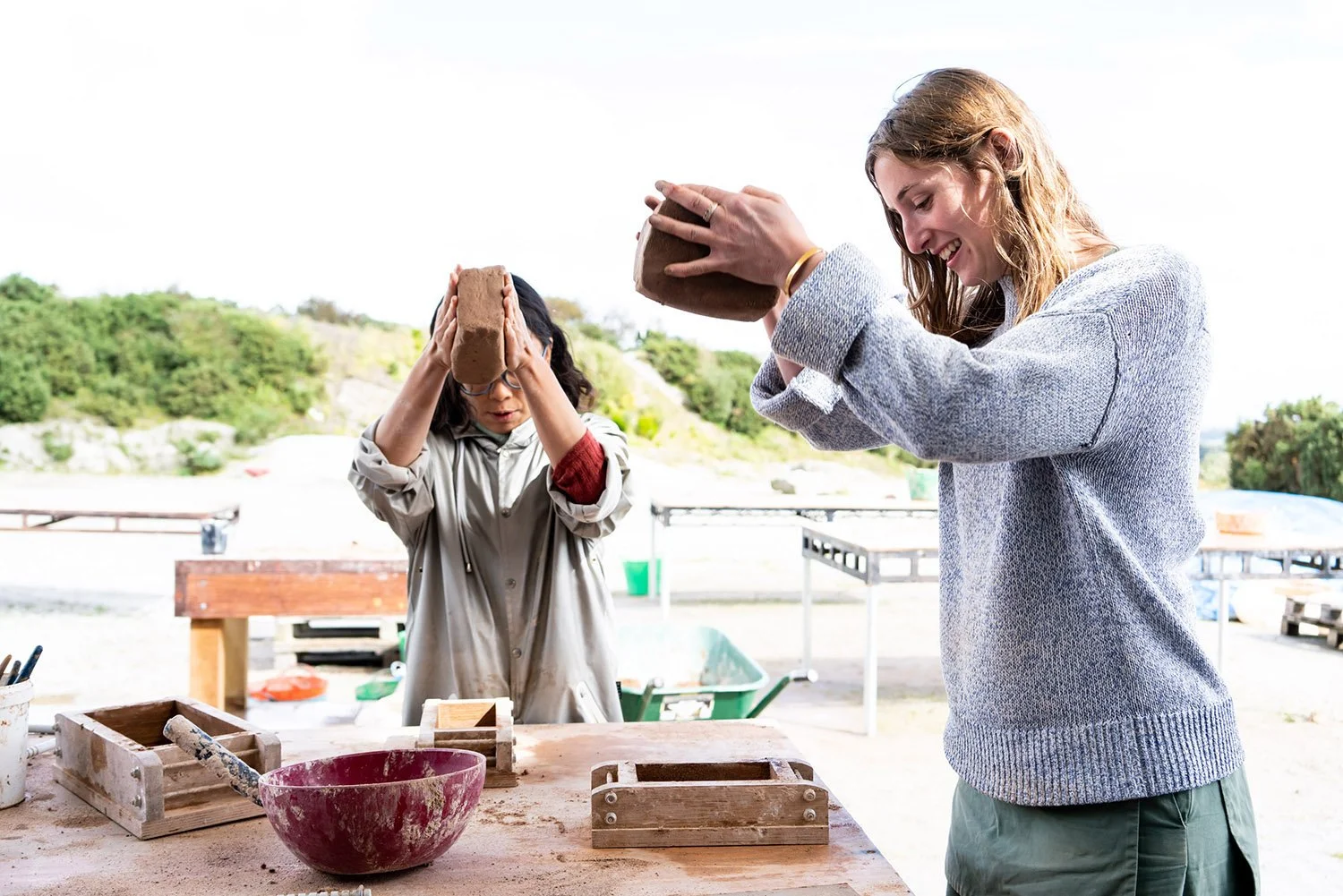
 One such maker is Rosanna Martin. Having spent her childhood ‘exploring, skating, sliding and slipping across the white mud that sparkled with mica’ on the riverbanks of her grandparent’s Cornish farm, Martin co-founded the Brickfield project with Dr Katie Bunnell. ‘Our aim was to teach people how to make bricks using waste materials from the china clay industry, and in doing so bring people closer to the landscape,’ she explains. Kaolin or ‘china clay’ has been mined in Cornwall for almost 300 years. Inspired by brick workers who would dig waste clay from the riverbanks surrounding the mines, making and firing bricks in ‘beehive kilns’, Martin and Bunnell worked with hundreds of participants, wood-firing more than 2,000 bricks over three years. ‘Working with this clay felt very personal – a way for me to connect to the landscape and material of my childhood,’ says Martin. ‘Through a creative practice that engages with these materials I hope to enhance my understanding of the life-worlds we all live with, be they human, plant, animal or geological.’
 Clay is, of course, also naturally occurring, and co-author of Wild Clay (Herbert Press, 2024) Hitomi Shibata likens foraging for it to growing heirloom vegetables. ‘It’s the same as how we select what we eat every day and how we pursue happiness in our life,’ she says. ‘We know there are many necessary steps to get the answers we are looking for and also there is a choice in our hands.’ She co-founded STARworks Ceramics with husband Takuro Shibata to give other potters the choice to work with foraged clay too.Emmie Massias and Elena Genesio – whose exhibition Tools of Rekindling appeared at Dutch design Week in October – argue that this sort of approach and the resulting reconnection with ‘life-worlds’ is a form of activism. ‘Reframing the act of harvesting as an activist practice transforms extraction into a thoughtful and regenerative process that reshapes our relationship with local environments,’ they say. ‘This perspective emphasises collaboration and working with nature, rather than against it, respecting its cycles and acknowledging the interconnectedness of ecosystems.’ The designers they showcased demonstrated how waste and by-products could become valuable materials though ‘pushing the boundaries of creativity by blending craft with emerging technologies,’ say Massias and Genesio. ‘The ceramics industry can draw inspiration from the principles and methodologies of small-scale practices, particularly in their approach to materiality.’Large-scale producers are catching on. Johnson Tiles classifies its environmentally friendly ranges as those with the highest recycled content – examples include Bellagio (up to 60% recycled content) and Ashlar (up to 50%). However, this is their own waste and Bridges – also environmental lead for the company – cautions against recycling as a measure of sustainability. ‘In the ceramics sector, “recycled content” usually refers to broken or defective tiles off the product line’ he says. ‘If we focus instead on improving efficiencies and quality, so that there’s less waste in the first place, that results in carbon reduction – and that’s the more informative number.’ And, by investing in heat recovery technology and green hydrogen among other initiatives, it’s a number that Johnson Tiles is committed to reducing but, as Bridges readily admits, the only way to meaningfully reduce the carbon impact of such a high-energy process is to eliminate fossil fuels altogether. ‘The lack of renewable energy sources will continue to be the ceramics industry’s biggest environmental challenge until the infrastructure and capacity is in place,’ says Bridges.
 In the meantime, perhaps the solution lies in moving away from clay altogether. Jacqueline de la Fuente makes sculptural objects from ‘paper clay.’ Similar to papier-mâché, it is made from her own paper and cardboard waste and sets hard at room temperature. For colour, she uses non-toxic, water-based emulsions that also air dry. ‘The joy of working with paper clay is that, just like fired clay, it can be made into decorative objects, furniture, lighting and artworks.’ The only downside is that her vessels aren’t watertight, so they are limited to decorative use. However, paper clay is not the only alternative.Puerto Rican designer Ana Cristina Quiñones transforms local waste – coffee, plantain, bread and wood – into highly functional products and surfaces. ‘I saw an opportunity to reimagine discarded matter as a valuable resource,’ she says. She makes large-scale products from tiles and countertops to furniture and lighting. ‘Instead of extracting raw materials, we transform waste streams. This not only diverts materials from landfills, reducing greenhouse gas emissions, but also minimises the need for virgin resources,’ she says. ‘And unlike traditional ceramics, we cast and cure our materials, significantly reducing energy consumption.’
 From independent makers harvesting wild clay to large-scale manufacturers investing in alternative energy sources, the shift towards more sustainable practices is gaining momentum. More radical change is coming – whether it comes from a wholesale transition to renewable energy or rethinking the use of clay altogether remains to be seen. anacristinaquinones.comdelajardin.comelenagenesio.com emmiemassias.comjohnson-tiles.comrosannamartin.comstarworksnc.org