

Just be, says the sea (The Southwester)
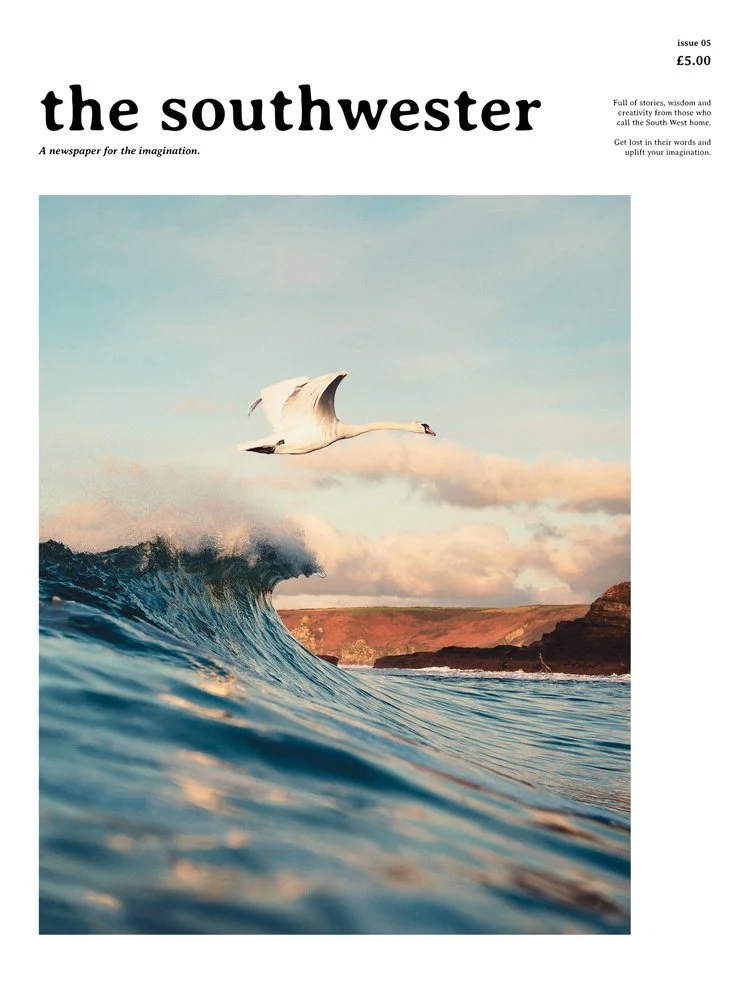
Katie Treggiden explores how to avoid getting ants in your pants by listening to the wisdom of nature.
I am dragging my feet along my local beach the day before a talk I am giving at a big conference. I am riding high on a toxic combination of anxiety and imposter syndrome and it’s not helping. I make a conscious effort to lift my gaze from my boots and look at the waves coming towards me, silently pleading with them for help. Five simple words enter my head. “Just be, says the sea.”We are so used to living in hierarchies that put science and ‘head knowledge,’ above indigenous wisdom, heart and head knowledge, and even cities and buildings above villages and nature connection, that asking the sea for advice might seem a bit new age or ‘woo.’ But in fact, humans have been in conversation with the wisdom of nature for millennia – it’s only more recently that we’ve turned a deaf ear to our more-than-human companions on this planet. And that’s to our detriment. Many of us now live in low-level ‘fight or flight’ (or even ‘freeze’ or ‘fawn’) mode – the anxious energy I was overwhelmed by on that day has become all too common. Your brain can’t tell the difference between a snarky email from your boss and a predator on the horizon. Getting cut up at a junction or cat-called on the street can trigger your central nervous system’s ‘sympathetic state’ – which causes tunnel vision, releases hormones such as adrenaline and cortisol, and raises your heart rate and blood pressure. And living on streets that never quite get fully dark or quiet can mean that your central nervous system rarely gets chance to reset.This disconnection from the more-than-human world is also to the detriment of the planet and all who call her home. The idea that we’re somehow separate from nature has enabled the exploitation of her resources to the point of depletion. In Indigenous ways of knowing – and increasingly among many nature advocates and environmentalists too – there is a practice of asking nature for permission before you take something. “Know the ways of the ones who take care of you, so that you may take care of them,” says Robin Wall Kimmerer in Braiding Sweetgrass. “Introduce yourself. Be accountable as the one who comes asking for life. Ask permission before taking. Abide by the answer.” There’s no way that common industrial practices such as fracking, trawling or deforestation feel consensual, in line with this way of thinking.Conversing with nature might sound unfamiliar, but if you’ve ever been blackberry picking, I bet you’ve tugged gently on a blackberry to see if it’s ripe enough before pulling it off the bramble fully – what’s that if not asking permission? Buoyed by my own blackberry picking experience, I recently decided to take the practice a little further. I was walking along the North Cornish coast path and spotted a sandy clearing perfect for a spot of journaling. I leaned down towards it and, somewhat afraid of being overheard, whispered, ‘Hello. I’m Katie. May I sit here?’ I looked and listened, but didn’t discern any obvious response, and so, suddenly feeling ridiculous, plonked myself down. As I reached into my bag for my journal, I could immediately feel tickling and prickling. I stood up and could see ants running in every direction – including up and down my legs and in and out of my bag. I had sat on an ant’s nest! ‘Okay, I hear you!’ I said, louder this time, brushing them off gently. ‘I’m guessing that’s a “no”?!’ Nature’s response is not always subtle!In my nature-informed coaching and facilitation practice, I don’t just take meetings that might otherwise happen over Zoom or in an office or boardroom and move them down to the beach, I invite nature into those conversations – I like to think of them as a three-way dialogue, between me, my client or clients, and the more-than-human world.Research shows, that spending time in green and blue spaces can shift your energy and bring your central nervous system back into its parasympathetic state. It’s not only a more pleasant state to be in – it’s sometimes called ‘rest and digest’ – but it’s the state in which you can access the parts of your brain that you need for creative thinking, to be open to new perspectives and ideas, and to tolerate risk – all crucial for the conversations I am having with my purpose-driven clients, who are all navigating the challenges of our times, whether those are environmental, geo-political or deeply personal.And time and time again, nature shows herself when you are open to her wisdom. I will never forget one client telling me that she just needed a bit of a push to take the action we had decided upon as her next step, moments before a gust of wind nudged her forward with such force that she had to take two or three quick steps to avoid losing her balance – it turned out to be just the push she needed!“Just be, says the sea.” Back on the beach, my energy shifts immediately. I take a deep breath, stride home purposefully, and promise myself to take the sea’s advice – to just be myself and not overcomplicate my task. The next day, with a pebble in my pocket for luck, I knock the talk out of the park.
the southwester is a newspaper rooted in the south-west, available only in print and with no content posted online. It is a paper for anyone, anywhere.
At its core, it seeks to reignite the imaginations of those who desire change, by telling stories and sharing wisdom from the many artists, designers, makers and creators who call this place home.
Many of us feel daunted by the world we live in and its multitude of problems. This constant narrative of fear can overwhelm and starve our creativity, preventing us from leading our best lives - for both ourselves and the planet.
By nourishing our minds and bringing focus back to our shared sense of place and love of the natural world, we hope to create the best conditions for our imaginations to flourish.