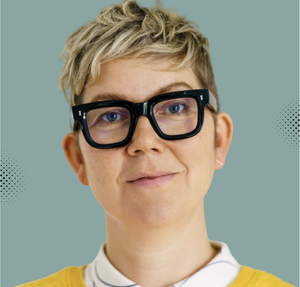
Happily Ever After (Mix Interior Magazine)
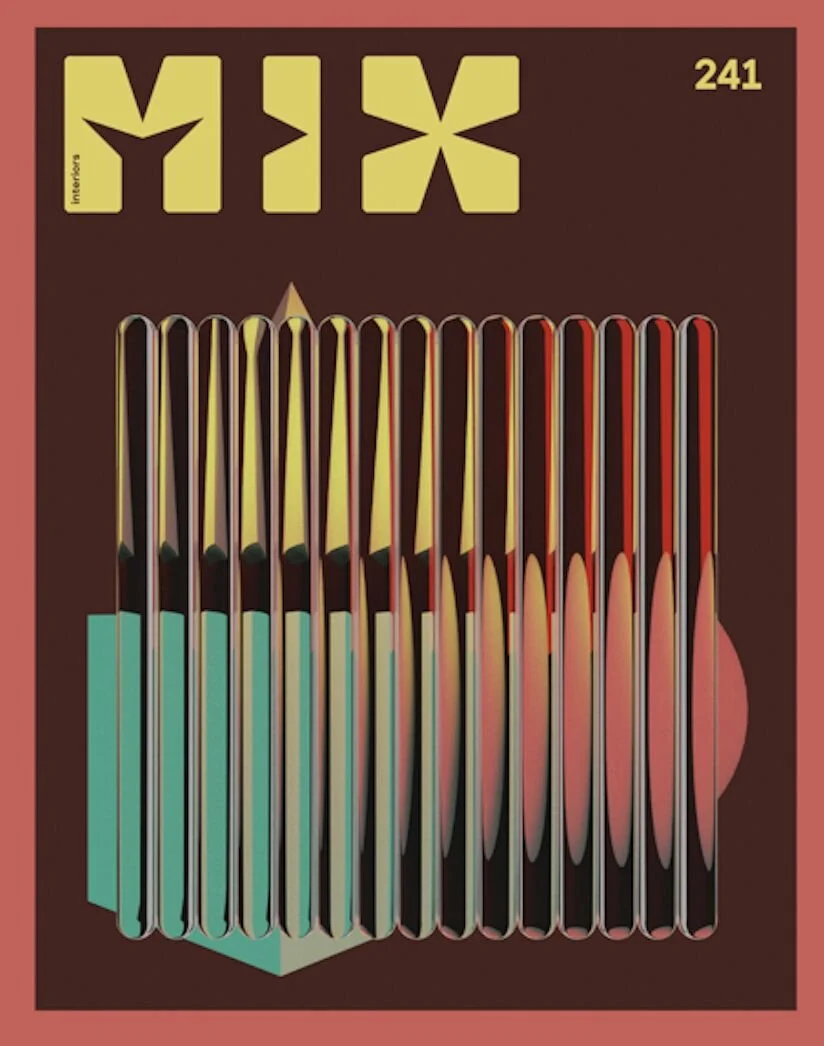
Linda Boronkay on modelling, meeting your heroes, and the importance of not resisting what life has planned for you.
I’m not sure what I’m expecting when I reach the third floor of a shared workspace on London’s Gray’s Inn Road but it’s not what I see as Linda Boronkay welcomes me in. The former design director of Soho House is now founder and creative director of her own interiors practice, Boronkay Studio. Her signature style is place-based, richly layered, and populated with antiques and drama—and yet, I don’t see that here. Computers, sample racks and the odd coffee machine populate a clean and functional office. Boronkay leads me to a glass-walled meeting room, where coral tones and textured artworks offer a glimpse into the mind of this brilliant, young, Budapest-born designer. I’m still not quite connecting the dots, but she’s squeezing me in between client meetings, so we get right down to business.
Boronkay grew up in between city and country homes both filled with contemporary art and vintage finds. ‘My mum’s passion was going to every antique shop or market to find treasure,’ she says. ‘She had amazing, experimental taste. She didn't study design, but she was brave and confident.’ People often assume Boronkay followed in her architect father’s footsteps but, while he has certainly been supportive, she credits her mother—an art teacher turned fashion journalist—as her biggest influence.’ Ever since I was little, I have loved drawing,’ she says. ‘I wanted to be a fashion designer and would doodle dresses in the margins of my school books.’ Aged 15, she went along to a modelling competition to support a friend and was scouted by a Parisian agency. She turned them down to complete her education, but moved to Paris with them as soon as she’d finished school, realising that modelling would give her unparalleled industry access, travel opportunities and a way to fund her ongoing studies. She lived in Sydney, Tokyo, Taiwan, New York and Milan before becoming disillusioned. ‘I wanted to use modelling as a passport, but that world soon swept me up,’ she says. ‘I loved the travel, but I saw a side to the industry that I wasn't comfortable with.’ Modelling exposed Boronkay to fashion but also to interior design. ’I got the chance to see cities not just from the outside, but from the inside, and from a very privileged point of view. As models, we got invited to parties in the most amazing homes and hotels.’ She decided to change course and applied to study interior design at London Metropolitan University.
In the next of what is starting to feel like a fairytale series of events, she won the British Institute of Interior Design (BIID) award for Britain's Best Emerging Interior Designer in her second year. ‘That was incredible because, coming from Eastern Europe, I always felt I had to justify my worth. It gave me a huge amount of confidence.’ With her model looks, glamorous lifestyle and illustrious career, it’s hard to imagine Boronkay ever doubting her place in the industry, but she still sounds star-struck reflecting on this time. The award was judged by Tom Dixon—who she describes as her hero—and resulted in media coverage that launched her second career before she’d even finished her degree. London Metropolitan released her from day-to-day studies to set up her own studio and accept the opportunities that flooded in, allowing her to just sit her final exams. She and Dixon stayed in touch—he was working on projects in Budapest and she was a useful source of insider info—but one day, when visiting his studio, everything changed. ‘I clearly couldn't contain my excitement, because he asked me if I’d ever consider working for him. I mean, are you kidding me? I would have died to work there, so I closed my studio and started an internship. Without that award, so many things would have gone differently.’
From Tom Dixon, she went on to work for Martin Brudnizki, Tara Bernerd & Partners and Woods Bagot, before receiving an out-of-the-blue, two-line email on her birthday: “We're looking for a design director for Soho House. Would you be interested?” It was such a dream opportunity that she assumed it was a joke; a fantasy birthday gift from one of her friends. She tentatively replied in the affirmative and a date was proposed for her to meet global design director Vicki Charles. However, she already had plans—a backpacking trip around India—so she declined, assuming she would miss out on the role. To her surprise, they appointed her on her return. ‘Within six months, I was promoted to UK design director, then it was UK and Europe, then they added Asia. They wanted to give me America too, but I put the brakes on that one! I worked closely with the founder Nick Jones—another visionary. He would tell us what he wanted in terms of energy, and it was up to us to translate that into colours, textures and lighting. That was really formative. We were a team of 15 when I started and, within four years and 20 projects, we were almost 100. Some people don’t get to work on 20 projects in their whole career, so you can imagine how much I learned.’
In 2020, she was on maternity leave in Sydney, with every intention of coming back to Soho House, when the world went into lockdown and she watched project after project grind to a halt from the other side of the world. ‘Sometimes life has a plan for you,’ she says. ‘All the signs are pushing you towards something and all you have to do is not resist it. There was all this uncertainty and suddenly I got the opportunity to design a hotel in Australia. I had no plans to re-open my own studio, but it was one of those now-or-never moments.’
In the five years since, she has designed a ‘speakeasy’ for Claridges in London, rooms for the historic Palais de la Méditerranée in Nice, and Beirut’s Beihouse. ‘I love the theatre of interior design and transporting people to another world through, not just the design, but the uniform, the music, the scent…’ In commercial design this enables people to step outside their day-to-day reality, but she also works on residential projects. ‘There, the designer’s role is about empowering people and their sense of expression—your home is an extension of your identity. It’s like a mirror. Getting that right can be really powerful.’
While Boronkay might once have felt self-conscious about her Hungarian roots, her global outlook—informed by such extensive travel at such a young age—gives her a unique perspective. ‘I have such vivid memories of place, so I always want to create something singular that wouldn’t make sense anywhere else,’ she says. The team achieve this with a narrative-driven approach in which stories are created for each of three pillars—architecture, FF&E and the ‘muse’. ‘We have just finished a hotel project in Prague where our muse was Libuše, the folkloric princess who ran away and prophesied that the land she stumbled upon would become the most majestic city in the world—Prague,’ she explains. ‘Whereas, our architectural pillar was Czech cubism and so that juxtaposition gave us a unique design language. It wouldn’t work in London, it wouldn’t work in Paris or Mumbai, but in Prague, it's a layered and nuanced story for a traveller who really wants to understand local culture.’
I ask her about the role of antiques and vintage furniture in creating narratives such as these and, as she answers, she runs her finger along the stitched leather seam of the chairs we are sitting in and I notice, for the first time, that these are not just any boardroom chairs, but exquisitely handcrafted vintage pieces. ‘People just don't make these kind of details anymore,’ she says. ‘There's a continuity in them; a humanity; a story. Inside of me is still the little kid who used to talk to elevators, stones and toys—I see the story in everything.’ And suddenly, I see this space through entirely new eyes.
We start to talk about what the future holds; what her dream project might be. ‘Of course, I would love to do a Palazzo in Venice, or a project in Tokyo, but really I just want to carry on working with visionary clients and my amazing team, to challenge people about the way they think about design. I will be grateful if we can carry on doing what we do best and see what the future brings.’ For all her accolades and accomplishments, it’s not hard to imagine the inner child she describes: still doodling in margins, listening to the stories objects tell and trusting the universe to lead her in the right direction. It’s an approach that has brought her this far—and it’s one that, I have no doubt, will ensure that this fairytale has a happy ending.
All copy is reproduced here as it was supplied by Katie Treggiden to the client or publication.
Katie Treggiden is a craft, design and sustainability writer, a nature facilitator and the author of Broken: Mending and Repair in a Throwaway World (Ludion, 2023).