Feast For The Eyes (OnOffice)
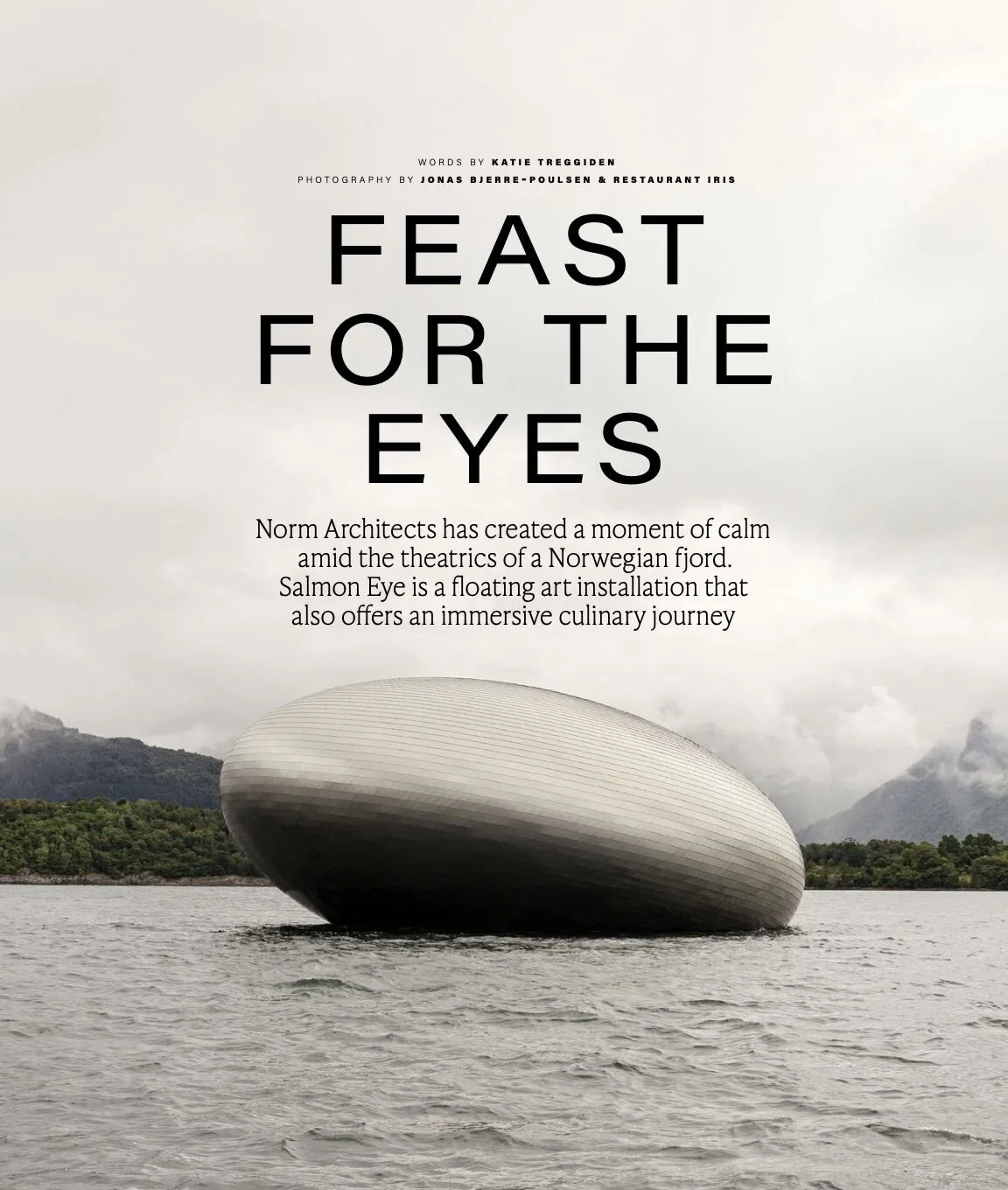
Norm Architects has created a moment of calm amongst the theatrics of a 111-mile long Norwegian fjord, a floating art installation and an immersive culinary ‘journey’.
‘Journey’ is a much-overused word, but in the case of Restaurant Iris, justified. Book a table and first you must travel to Rosendal, on the West Coast of Norway. Next, one of two electric speedboats—‘Malm’ or ‘Melder’—whisk you to chef Anika Madsen's boathouse on Snilstveitøy for the first two of 18 courses: the beginning of a six-hour culinary ‘expedition’ in the heart of Norway’s second-longest fjord, Hardangerfjorden. Surrounded by breathtaking glaciers, sky-scraping mountains and the ever-changing sea and sky, it’s on to Salmon Eye—conceived by third-generation salmon entrepreneur Sondre Eide as ‘the world’s largest floating art installation’ containing an exhibition centre and a Michelin-starred restaurant. His mission? “To inspire and inform the world on how to better feed the planet with sustainable seafood.” Kvorning Design created its stainless-steel scale-clad ellipsoid structure to draw diners to the ingredients rather than the other way around. And that’s all before you set foot inside.
Norm Architects’ brief for the interior was simple, but far from easy—to reflect Restaurant Iris’ dedication to local, sustainable gastronomy, while reflecting its striking surroundings and complementing its arresting architecture. “We wanted to create a space that felt warm and welcoming despite the structure’s raw steel exterior, allowing guests to experience intimacy and calm amid the dramatic natural setting,” says the design team.
On arrival, diners step into the next phase of their journey and a space that contrasts the raw power of nature with understated refinement. “Every element of the interior caters to this transition, from the intimate lounge that welcomes guests to the softly lit dining area overlooking the fjord,” says Norm Architects. The colour palette is drawn from the deep greys of the fjord, the muted tones of the mountains and the soft Nordic light. The spatial flow—gently signposted with bronzed brass dividers and custom carpets that mirror the curves of the architecture to subtly define zones—invites a slower pace. The culinary experience unfolds as diners move through an immersive multimedia show before continuing their meal at one of just seven bespoke walnut dining tables. They might be served invasive cuttlefish ‘tagliatelle,’ reindeer tongue or wild-caught halibut—all with a side of sustainable food education.
If the weather allows, one course is grilled over an open flame on the rooftop, for diners to enjoy in the fresh fjord air before returning to the soft curves, warm walnut and textural details of the lounge. “We wanted to translate the sensory qualities of the fjord – its shifting light, deep stillness, and organic forms [and] transform this futuristic setting into a deeply human experience,” says Norm Architects’ design team. “The result is a space that feels both grounded and ethereal – a calm retreat that allows guests to fully immerse themselves in the surrounding landscape.”
While the setting may be unlike anything they’ve worked with before, Norm Architects’ approach remains rooted in their ‘soft minimalism’ philosophy. Walnut—from bespoke coffee tables to detailing on custom-made service stations—adds depth and rhythm. Bouclé-upholstered furniture creates a visual and acoustic buffer, enhancing the sense of refuge from the drama outside. “Together, these materials reinforce the sensory qualities that lie at the heart of the project – creating balance between nature and craft, warmth and restraint, strength and softness,” says the design team.
After a chocolate replica of the surrounding landscape concludes their meal, guests once again board ‘Malm’ or ‘Melder’ and complete their journey back to Rosendal with one last look over their shoulders at the gleaming jewel in the heart of Hardangerfjorden.
All copy is reproduced here as it was supplied by Katie Treggiden to the client or publication.
Katie Treggiden is a craft, design and sustainability writer, a nature facilitator and the author of Broken: Mending and Repair in a Throwaway World (Ludion, 2023).