Spill The (Green) Tea with Caroline Till
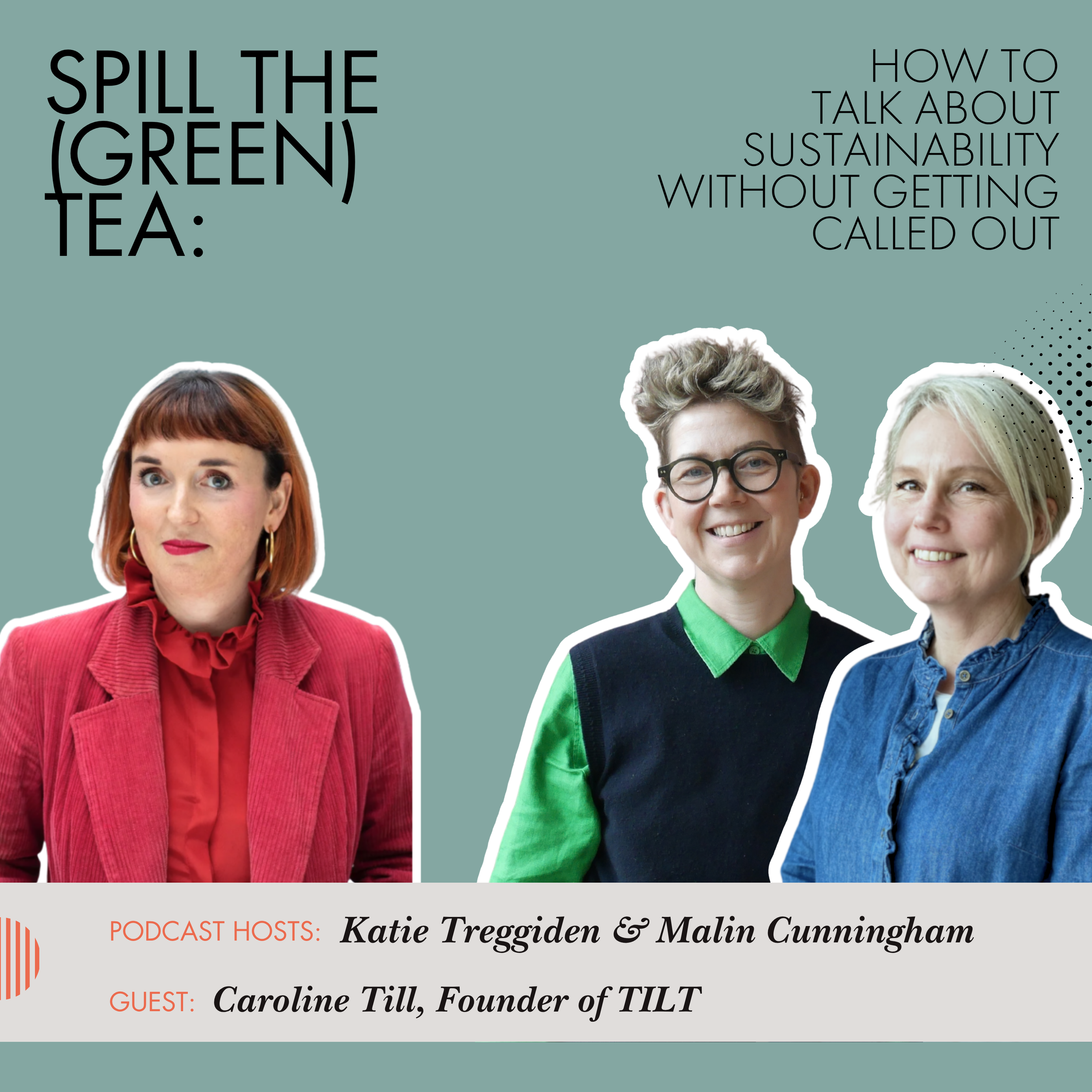
This is an auto-generated transcript that has not been edited or proofread and therefore may contain errors.
Malin Cunningham
Welcome to Spill the Green Tea, the podcast where we dive into perhaps the most controversial part of sustainability, how to talk about it.
Katie Treggiden
That's right, we're exploring how to talk about your eco-efforts without getting called out. Join us for straight-talking, behind-the-scenes insights and practical takeaways that will help you gather the courage to shine your light in these volatile, uncertain, complex and ambiguous times.
Malin Cunningham
It's a serious topic and we don't shy away from that, but we will bring you uplifting, positive and pragmatic conversations with brilliant guests and in-depth discussions between the two of us, all to give you the confidence to talk about your imperfect efforts towards genuine sustainability.
Katie Treggiden
Because it's not just showing off, sharing your progress helps you connect with clients and customers and inspire others to be more open about where they are on their journey. We need your stories now more than ever.
Caroline Till
I think one of the mistakes that a lot of companies make is to change their narrative every month, to talk about things in a different way all the time, to think, okay this is a new product, we need a new marketing initiative, like and my god people's heads just are spinning. We're all overwhelmed, we've all got information overload and just being consistent in the way that you give your messaging, particularly in relation to circularity, sustainability, I think is so important and I think that's one of the biggest mistakes that a lot of companies make.
Katie Treggiden
Welcome to this episode of Spill the Green Tea, where Marlin and I talk to the brilliant Caroline Till, founder of Tilt, formerly known as Franklin Till, and in this episode we cover all sorts from why sustainability needs to be uncoupled from innovation, the fact that instability and uncertainty are not temporary, they're the new norm, so we need to work out how to operate within this sort of VUCA environment, which stands for volatile, uncertain, complex and ambiguous, the fact we need bold voices to inspire action, what Marlin and I have termed brave brands, and how we can seduce people into a positive future through immersive design. Enjoy.
Malin Cunningham
Welcome Caroline, so as you know our podcast is all about championing imperfection, so progress over perfection, so our very first question is always then, what are you doing or something that you've done perhaps that lives up to that mantra about progress over perfection, so we might be imperfect from an environmental point of view, but you can still be in this movement, you can still do great things.
Caroline Till
Yeah, this is interesting because it's something that I think a lot about, like on an individual level and I guess on a family ecosystem level, like sort of beating myself up about how can we do more or should I be doing more, there's lots of imperfect things I do, I guess the thing that springs to mind initially is I still fly, and I guess we'll talk more about this as our conversation progresses, but for me sustainability and this whole conversation has to be seen as a trade-off, so I still do fly, it's something that I do think about and try to limit, but I particularly do for family reasons, so I still have young kids and I try very hard not to be away for more than three nights, and that extends to our whole team, so probably 90% of our team have young children and so we don't expect them to be away for more than three nights if it can be avoided, and so at this point in time it's very difficult to, you know, do train travel for extended visits, for example, so I guess this is just an example of where it's, and this is the thing about sustainability, you know, having worked in this area and sort of studied in design and sustainability for like 25 years now, it's always a trade-off, you know, and it's a minefield and you think that you're doing something positively and there's going to be an impact somewhere down the line, and I think it's important that it remains a really holistic conversation, so for me personally, you know, my familial sustainability is, you know, is important and that social side is part of the conversation and being there for my children and taking full responsibility in that and bring them up as good citizens and humans, so yeah, flying is something and that's obviously the reason. Then there's other things I guess that I like about financial means.
I drive a hybrid car at the moment, we, you know, when we last changed the car I tried to keep it for as absolutely as long as possible and we, at the point at which it needed changing, we weren't in a financial position to go fully electric, so again there's that, it's all about kind of what is possible and I think obviously for many people, you know, financial limitations or reasons are a strong primer.
Katie Treggiden
Yeah and I think that flying thing is interesting because probably by the time this episode goes out, Milan Design Week will have been and gone, but I think there's always a kind of flurry of chat online about how one is getting to Milan and, you know, the idea is that for me I should get the train from Cornwall to London and then London to Paris, probably do an overnight in Paris and then from Paris to Milan and then Milan and then the kind of, and that means I personally would be away for about 10 days and it would be a lot on my body.
I have various kind of chronic health issues and neurodivergences that that much travel I would need some serious rest days which would make the trip probably more like two weeks and then you just sort of think financially that's beyond my means. I don't want to be away from home that long, I mean I'm actually not going to Milan this year which is far more sustainable than going by train, but it's a difficult one isn't it because it's about trying to, I fly a hell of a lot less than I used to, I won't fly in the UK which means I spend a lot of time on trains in this country, but yeah it's interesting I don't drive an electric car but, you know, my cars die, that's the only point at which I get a new car is when my car has died, so yeah is replacing an electric car every three years better than driving a diesel car into the ground? You know these are, I think some of this stuff can be quite performative and I think as you say they're kind of really making considered choices and making those trade-offs is what this stuff is about, but I think that that kind of leads us quite nicely into the bigger theme of the conversation today which is kind of about this idea of the great green hush, I think people have started to understand some of the complexities and the nuances and the trade-offs involved in this stuff, but the conversation particularly on social media is still very simplified, very based on kind of that performative environmentalism and or calling people out and these kind of takedowns, and I think all three of us as a result have noticed companies in particular really pulling back from talking about sustainability at all, and I think that is about a fear of getting called out, but I think again it's bigger and more complicated than that, and what do you think is driving this reluctance to share very good, very genuine sustainable progress from businesses?
Can you give us a bit of context to kind of what's causing, what's being called the great green hush?
Caroline Till
I'm coming from the context of running a design futures agency and working with some of the world's largest global brands to help them hopefully shift towards a more sustainable future, and we've been doing this yeah for nearly two decades now, and I think seeing you know over the past decade there has been a huge increase in awareness both from a citizen perspective and from a brand perspective, and like you say we have seen this kind of worrying slight rollback within probably the last two to three years, and from the perspective of these large corporations that we're working within, I think a lot of it is coming from it being a time of economic and political uncertainty, and within the designer lifestyle sectors they move to be more risk averse, you know in instability, and I guess you know many sectors do the same, but basically what that leads to is a sort of a cutting of innovation, and interestingly sustainability is still, in all senses of the word, yes in all sense of the word, but particularly you know perhaps more risk led or experimental, and which sustainability interestingly falls within innovation still for many many large corporations, which is interesting, it is, and that I would argue is something that definitely needs to change, it needs to be decoupled, and to be understood that sustainability imbues everything, and needs to come from a bottom-up perspective in terms of, because we're literally talking about what their products are made of, how they're being made, and what are they you know, what are their next opportunities, what are the future lines that they're going to either products or services that they're going to be initiating, and I think one of the issues is that there needs to be more training, both at staff level and an executive and board level, to be able to understand how sustainability should and does imbue everything, rather than it being you know put with this innovation track, so that's one thing, and I think it's always helpful to talk in practical examples, so in the last five years we've seen, for example, IKEA defund space 10, which was their very innovative sort of hub, which was entirely funded by IKEA, only serviced IKEA, but it was an external innovation hub that was centred around sustainable initiatives, we've seen initiatives like ISPA within Nike, and a huge cull of the sustainability team within Nike, there's multiple examples of when brands hit that sort of, particularly economic turbulence, innovation is cut, and you know because of that coupling often that means sustainability is cut, I think one of the problems is that there's a sort of general consensus within big business that sustainability is not economically viable, and therefore they need to be in a period of kind of stability and economic flourishing in order to be able to focus on this, and the biggest thing I would say is that we need to see a dramatic mindset and cultural shift within corporations, that actually they can no longer afford to think like this, because the environmental, social and moral costs of extractive business models will increasingly have to be paid for by companies, and I think you know we run lots of different events and have the pleasure of working with lots of different academics, and one of the ones that really sticks with me is always Professor Ianis Ianu, who is the Associate Professor of Strategy and Enterprise at the London Business School, and he always talks about it with such clarity that he says like the transition is going to have to happen, we have no choice whether this transition towards you know circularity and sustainability is going to happen, but it's whether it's going to be orderly or disorderly, and businesses that have already made the choice that are really embedding sustainable innovation and investing in this and adjusting their supply chains to move towards you know circularity, they're going to reap the benefits, and to be a more profitable business is going to be intertwined, so yeah I think there are other factors as well, that for me is the primary factor, there are other things like fear of getting caught out, there is obviously such a more you know there's so many more routes for both your audience you know the general everyday citizen and your competitors to call you out on social media, but also we've seen a lot of very heavy lawsuits between companies calling each other out on sustainability claims that they've made, so I think we're in a culture of being risk averse basically.
Katie Treggiden
Yeah I think it's really interesting, I was at a global sales conference recently where the segue between the sustainability bit of the conversation and the kind of sales target bit of the conversation was framed as you guys are great at doing next, now we need to focus on now, which was a quite a pithy way of saying this is lovely but it's not urgent, we need to focus on quarterly profit, and I think it's really that shift in mindset isn't it, that we need to start seeing sustainability as as imperative and urgent, not just a kind of long-term nice to have.
Malin Cunningham
Definitely, it's fascinating because I have just had, we're working with some industrial clients and doing some research on their behalf and I'm seeing the opposite, so I'm having some conversations, so it's really interesting, we're doing a research project for them looking at like sentiment around sustainability and etc, and actually what they're saying now, the intuition we've had post the Iran war that we're currently in the middle of, hopefully not by the time this goes out, but it's certainly in front of mine now, is that they're saying that it's in short focus and actually they don't know whether they're going to have the energy, so thinking about energy in particular and fossil fuels etc, that's actually, it's making this whole conversation more urgent, not less, but not for sustainability reasons, for survival reasons, so actually you know coming at it from a completely different perspective, it's just so sobering and it's interesting how the conversation has changed like pre the current conflict to now, you know, a few weeks after.
Caroline Till
And I think that's such a pivotal point though that you're saying Malin there, because one thing I feel so strongly and trying to say to all the companies that we work with is you think this is, you know, like this is nothing and so we need to shift to a culture of the expectation that instability and volatility is the norm and actually, and I like, I agree with you with the words, I know we're going to talk probably as the conversation progresses about vocabulary, but security, you know, resource security and really what we're talking about is resilience, right, and it's got to be repositioned as resilience and good business sense and absolutely, because if, you know, if you're more sufficient, if you are, you know, for example closed loop circular and you're able to remake your next product out of your existing, you know, waste streams or existing products, then ultimately you're protecting yourself.
Malin Cunningham
Yeah, you're creating your own raw materials, aren't you? Yeah. Which you might not be able to get because the Strait of Hormuz is closed.
Caroline Till
Yeah, I did just want to mention if it's okay, I feel like even though I think that is the general picture of where we are, there is, I do think it is shifting, like you say, there's a couple of examples that have been, you know, particularly widely talked about in the media, a couple of companies that are putting their heads back above the parapet, like Bang & Olufsen, who are really going hard with circularity now and kind of acknowledging that, you know, the electronics industry is one of the sort of leading contributors of environmental pollution and resource scarcity.
And I don't know if you saw the recent spotlight on Gucci and their next generation materials lab, there was a really extended article in Vogue Business, which I think is particularly interesting because when we were in like, probably maybe like six years ago, this sort of like boom of like, yes, suddenly, everyone has to centre on sustainability. It was really when fashion got on board, they took a while to get on board. Because let's face it, like cool, the cool factor is such a massive, you know, primer to influence, you know, people's behaviour and people's sort of desire.
And so the fact that Gucci is going getting back on board and, and I know that they have talked about sustainability in the past, but you know, how, how watertight that's been is sort of questionable. But this, you know, they have a dedicated material research and developing testing lab in Italy now, that's feels like a sort of meaningful commitment and an important signal to the broader industry, that, you know, sustainability and material innovation is no longer a peripheral conversation, particularly when it comes to rethinking some of the most impactful material categories that they're using, you know, time and time again.
So I do actually, I kind of hope that we're back into a tipping point of actually, we are going to see, you know, companies come back to really talking about the sustainable innovation initiatives that they're doing.
Malin Cunningham
Yeah, absolutely. I agree. I feel the same.
And I'm exactly, I hope it's not just wishful thinking, but I think there are some kind of early signs of it. But then just going back to sort of the comms piece a bit more. So we talked about, like, you talked about like, why companies are hushing?
And you've already kind of partly answered this question already. But what are the risks then of companies staying silent? So you talked a lot about, because in your, the people you're working with, they're obviously connecting it to innovation.
So there is a risk around innovation and falling behind, I guess. But what are the other challenges around it, as you see them?
Caroline Till
Yeah, I think the problem with going covert in communication is often the marketing budget is the one that unlocks the innovation budget. So if, you know, or they're deeply interconnected, so if it's not something that you're willing to talk about, or you're not saying that you're going to go, you know, use it in your external comms, then often, that's a slashing of budget in terms and therefore that, and we've seen that we've seen that a lot in the past five years, particularly the projects that we've been working on, that clients have said, well, actually, we're not going to externally communicate this. And that has, at times resulted in a reduced budget. And often we're working on long term projects, you know, if you're talking about things like biological manufacture, and, you know, really rethinking a material supply chain and process and manufacture, it's not one to two years, it's often five to 10.
Malin Cunningham
Yeah.
Caroline Till
And so yeah, so if there's no marketing spend, sort of allocated to this, it often means that the initiatives themselves are cut, which obviously takes you kind of back to zero. And the other thing I think, is the problem is the sort of lack of precedence it gives, like we need these sort of bold voices into, you know, we need that thought leadership we need. And this is how big business, you know, comfort themselves that, oh, it's okay, because so and so is doing it, or somebody else has said that, or somebody we respect, or one of our competitors is doing it, we need to match that.
So if everybody's quelling their voice in relation to sustainability, then, you know, it really does lack that sense of kind of leadership. And, and I think that's a really, that's probably the biggest problem.
Malin Cunningham
Yeah, it's interesting. I've actually had a call today about something like that. So somebody has seen the competition doing some stuff.
And some of our sustainability stuff has been on hold. And all of a sudden, it's like, all systems go, you know, we're going to have to jump on this, because actually things are happening. And we're going to be seen to be left behind.
And I think the other thing is, it kind of ties back into what we just talked about in terms of when nobody's saying anything, it feels like nothing is happening. But obviously, that's not necessarily true. And, and also, you know, nobody is then inspiring or spurring each other on or, or it's giving the wrong kind of impression.
And I think that's what we're seeing the early signs of, isn't it? We're picking up on actually some of these conversations are starting to...
Katie Treggiden
Humans are social creatures, right? We are designed to live in, and I think people forget that about businesses, that businesses are just made up of a bunch of humans. Yeah, they like that, that kind of reassurance.
So Caroline, if that's the case, how do we encourage companies to be bolder and to kind of follow the lead of, you know, you mentioned Gucci and Bang & Olufsen, who've kind of stuck their heads above the parapet again? How do we encourage... Marlon and I have come up with this term brave brands, which came out by accident in the first episode.
How do we kind of encourage that in brands?
Caroline Till
I think, and this probably isn't the most exciting answer, but let's meet people where they are. Let's acknowledge that we exist in a capitalist system. And yes, it's deeply flawed, but the thing that people are, you know, the parameters at the moment are economic.
So let's tell stories of where sustainable initiatives are impacting the bottom line positively. And I guess to give an example, one of the clients we work with, Tarket, you know, they've managed in a, they're a flooring company in a very crowded marketplace, they're increasing market share while being very bold and clear about that they are, you know, really pushing circularity and kind of holding themselves to account. And I think it's a good example of it needs to be coming from the very top.
It needs to be trenched at, you know, the most senior level and to be a very clear and understood initiative. So I think that's one way is tell stories of how it, you know, it is not that sustainability and the economic bottom line are not mutually exclusive. I think the other thing is consistency.
The thing that we bang on about so much with the companies that we work with, so some of what we do is sort of creative communications, which is more about, okay, if a company's doing some really exciting sustainability work, or particularly around material innovation, how do we bring that story to life? Especially if it perhaps results in a higher price point, how can we tell their audience? How can we communicate what why that's, you know, there's more benefit either to people or planet, or more performance benefit or both.
And I think one of the mistakes that a lot of companies make is to change their narrative every month, to talk about things in a different way all the time to think, okay, this is a new product, we need a new marketing initiative, we need like, oh, my god, people's heads just spinning, like, we're all overwhelmed, we've all got information overload. And just being consistent in the way that you give your messaging, particularly in relation to circularity, sustainability, I think is so important. And I think that's one of the biggest mistakes that a lot of companies make.
Malin Cunningham
Yeah, absolutely. And this leads us perfectly to the next question, thinking about the language that we use, and you touched upon it already, really. And I think, after the first question, in terms of the terms that we use, and there's so much conversation constantly, particularly environmental circles, I think, because people get sick of certain words, and it feels like, and I guess, there is an element of some of them being politicised as well, you know, the feels like they're really loaded.
And so, you know, so the question is, what kind of language should we use? And obviously, things like resilience, mitigation, etc. are coming up.
So, what do you think? Do these hinder or help these words? And, you know, where is the language at, at the moment? If that makes sense?
Caroline Till
Yeah, I think there's a lot of disillusionment and a lot of confusion. Like, for example, we've seen the rise of a word like regeneration and regenerative design.
And we did a project with Home Textile, the world's largest interior textile and home trade fair that has sort of, you know, about 50,000 visitors a year. And they're very sort of mass market level audience. And people are going, well, you know, should I be talking about sustainability?
Should I be talking about regeneration? And so we were trying to sort of create a shared definition. So to create a set of eight principles as to what what is regenerative design?
And indeed, what is a regenerative material? Because I think coming together, and this is something I talk about a lot within the design industry, we need to come together to it to align around the definition of vocabulary. And right now, I feel that the vocabulary we use needs to match the urgency of the situation, if I'm honest.
So I think, I think everybody should be sat down, like every adult, not child, because it's slightly terrifying and sat down and watch that national emergency briefing. And, you know, that's just been released and starting to do the rounds in my locale in through here in Somerset, we've just organised a big collective screening in a sort of 700 seater venue trying to get as many people as possible to actually really understand how the window for maintaining a livable future pretty much has closed. And so with that level of urgency in mind, I do think that the words we would, you know, when you mentioned security earlier, Malin, like I think that and we did an event at the Design Museum at the back of last year.
And Sophie Thomas, the expert in circularity was one of the speakers. And she said, we I've been in this game for 20 years. And we didn't talk about circularity.
We talked about resource efficiency when I first set out. And I kind of I'm there to do this. I'm with her, like, I think we need to go back to a much more like, technical, you know, talk about efficiency, talk about security, talk about the reality.
We were with a major client in the US, just at the end of last year. And I remember the team, it was like really struck me, one of the team sat down, we've done a big piece of research. And they said, so, in terms of like the top three materials that we're using, when when do you think they're going to run out?
Like what is the actual time scale? Like when is and it really fascinated me, because it was like, they needed to have a finite door, which was like, okay, we've got to have switched by then or and it's, it made really sort of clarified for me that, okay, these people do need some kind of numerical, like data to be to be like, right, this is real. And let's get ahead of the deadline.
Yeah, yeah, yeah. Wow. And so yeah, so the language, I'm, I think it's resilience.
I think we need to understand that as I mentioned we're in, you know, the times of volatility and instability is only going to get greater. It's something I bang on about in my community. I'm really passionate about okay our company has a lot of impact globally and I feel like I need to also explore what's my impact and our impact locally.
So I've got involved in various initiatives and it always amazes me like that the majority of people don't get involved in community-led initiatives. It's kind of like it's an othering, it's not, but actually our local communities are going to be the places that we are going to turn to for the distribution of very basic utilities like energy, like water, like food.
And so I, and I'm not a believer in make people shit themselves to get something done but, but yeah this, this is urgent now. Yeah, absolutely.
Katie Treggiden
Yeah and I think you're right about community and we saw that in lockdown. We have a horticultural centre in my village that's run as meaningful day service with people, for people with intellectual disabilities. So it exists to kind of provide a space for those people to be but as a by-product of that they grow food.
And during lockdown within a matter of days if not weeks they had set up a food delivery service for our village so that we all had fresh veg delivered to our doors and they created a little two-side piece of paper that went through everybody's front door that had the phone numbers of kind of fit healthy adults. So Leighton and I were on that list so if an elderly person needed a prescription collecting or whatever they could phone us and it amazed me how quickly these people who knew each other to say hi to from walking the dog, you know that was kind of the extent of our relationship, how quickly these people mobilised to take care of each other. Yeah.
And then how quickly we all went back to shopping at Tesco's afterwards. Yeah. I think we thought something had genuinely changed.
Yes. But it really, it really brought home to me the importance of community and the same as I'm trying to figure out what I can do locally and I think it's interesting that you arranged that viewing of the national emergency briefing collectively and in community and I think it's more than just words and broadcast language isn't it? It's about, you mentioned creative storytelling and I think it's something that you're very good at is not just the words but creating a kind of experience using visual language too, and I guess this is a two-part question, is one is what role do the visuals and the immersive experience play but also how do we balance that urgency with painting a picture of the future we're moving towards rather than the future we're moving away from and trying to make,
Caroline Till
I think the space programme's been so interesting because for the first time in a long time it's given us something that is hopeful and competent even and so how do we use that kind of rich creative storytelling to kind of create a picture of a future that people are motivated to work towards rather than or perhaps as well as kind of using fear as a motivator?
Malin Cunningham
Yeah and I think you talk about visuals there and that for me and for everything that we do is like the absolute core, the most important thing. We talk about that actually we're sort of in the business of seduction and that it really does have to be you know ultimate seduction that look this is what the future could be like and how incredibly beautiful and like isn't it like mind-blowing that we're a living breathing being within a living breathing planet and like just to remind ourself of that kind of simple fact and visual means are so important.
We talk all the time about showing rather than telling. We know that people's attention span have massively depleted since the rise of social media. We used to probably spend as much time copywriting as we did on visuals and the amount that of copywriting that we do and actually even the length of reports everything has been distilled a lot more because the writer in the room is very aware of that.
I know I'm sorry.
Not you personally but just generally.
Caroline Till
Well yeah we used to commission you all the time didn't we and we're constantly being told by clients like oh we need to be careful not to overwhelm the teams and so yeah we're constantly working on dynamic succinct ways of simplifying information not like removing complexity because these are complex but making them accessible and digital we're doing you know so much of our work is and dynamic like we're making a lot of animations these days because the primary means of work being disseminated is digital but how can we make it feel different and I think that is our one of our USPs actually is that we get lots of repeat business because people see either films or I don't want to use the word report because it sounds dry but they it is a report that we've been commissioned and they go wow we've never received anything that looks like this before and we make them really tangible you know our design team are like scanning in like hand-done textures to you know there's still a craft to it so I think it's about dynamism as I said animation and film is really important in that and tactility even and I believe even the digital can feel tactile particularly in you know this realm of AI so yeah like really as seductive and kind of mouth-watering and as accessible as possible.
Katie Treggiden
That was going to be my next question around like because we're living in such a digital world and I mean AI is supercharging that like every day and it's changing you know like week to week isn't it so how can you do that and it does feel a bit like there is almost a bit of us in them you know particularly if we you know if we're thinking about ourselves with one heart as you know part of an environmental community and that feels very tactile real nature all of those things and then on the other hand you've got obviously a world that's hugely digital and increasingly AI generated and there seems to be quite a big gap between that I don't know how you see that.
Caroline Till
I think I don't see them as I think they they tend to be sort of sometimes a mindset gap so I think one of the problems we see is that like visual communication and branding becomes even more seductive and like you look on the leading branding agencies websites and you know when they've rebranded anything from a digital banking system to a cat food and you're like my god how could people not fall for that like it's incredible like skincare for example there's no wonder that 10 year olds are starting to use skincare that they don't need because if you look at the packaging in boots these days like it's beautiful it's incredible so I think it was Alan de Botton talked about like design as the merchants of seduction and there does tend to be a little bit of a disconnect between that kind of really like aspirational and that cool factor of that sort of branding world and what is a sort of systems change you know deep sustainability approach like for example I just love listening to podcasts like um Accidental Gods or Education and and you listen to the incredible people on that and and you know the incredible presenter but then you think god this feels so disconnected from my 11 year olds world and reality and so they have to we have to use the tools of 21st century and beyond seduction but with those system change ideas and at the moment one is feeling too earthy and and worthy still and yeah it's getting the streets ahead in terms of you know digital communication and and and use of AI and so but I believe they can merge and we've seen like you know I think of our work that we did with the Barbican on the exhibition Our Time on Earth and think of people like Marshmallow Laser Feast who are an immersive technology company that exists to tell the stories of nature and technology can be an incredible filter through which we can connect with the stories of the natural world that we just didn't know you know their exhibitions are wildly popular for with all age groups because they're so um kind of mesmerising these massive scale digital projections that are bringing to life invisible factors you know that are going on the phenomena of the of the the kind of of the natural world but kind of opening it up to a broader audience using the the sort of a law of technology so I don't think at the moment generally speaking we tend to have these things at two ends of a spectrum but but it's where they and there are great examples of where they cross but we just need to do that more
Katie Treggiden
yeah yeah and I think there's a another sort of dichotomy we're seeing is the sense of the people who want to go back to the past versus the people who want to go to the future and I think the people who want to go back to the past exist in multiple different ways right there's a there's a sort of right wing feeling of let's go back to kind of the old British ways and I think there's also you know as Malin said that sort of nature earthy environmentalist who's sort of thinking let's let go of all this technology and live on a farm and be self-sufficient and and I and I think you know that goes back to that sense of because we haven't painted a picture of the future that is attractive so everybody is kind of I think I can't I mean there there have been times in history of course they have over and over again when the future has looked frightening but I it it kind of just feels like there isn't one now you know and I think especially for young people um we were talking to somebody the other day about the difference the the similarities between trying to sell environmentalism and pensions in that they both feel very way and not really relevant yes and I think because the environmentalism movement has done such a good job and it was important of telling us about how horribly wrong this is all going yeah the future is almost just black now like further than 10 15 20 years away nobody really wants to look so kind of how can we make a positive future well how can we make a more positive future how can we give people
[Speaker 1]
something to look forward to yeah and you'd mentioned some really interesting like we are being polarised right and and so much of the information we get fed is is negative and holistic and and we're sort of fed this this impetus to focus on individualism and um I think when you were speaking it was just making me think that so much of what needs to happen is like connection that actually there's there's I've read countless studies recently that say you know there's this this sort of really unifying factor that if people are asked what future do they want what's most important to them they actually all say the same thing they all say that they want their families to be happy and healthy um they want to have enough money to live there's there's a real time and time again studies have shown that on a basic level humans um regardless of of geographic or cultural background pretty much want the same thing and so I wonder and I think there's examples of this that how we can just focus on that connection that and bring out stories of of of the of the similarities and and again I think bring out stories of the positivity where we're fed so much negative media these days and I think that's that's kind of scary yeah
Katie Treggiden
I've been doing a deep dive into this book or by Thatcher Keltner for another writing project I'm working on and there's some really interesting research that shows that when we experience or not only is that very good for our mind and body individually but we also feel more connected to other people we're more altruistic we're less narcissistic and I think it's interesting when you were talking about I tend to think of or as you know being out in nature big trees dolphins all the cool stuff I get to see living in Cornwall but but you're right the exhibition that you guys did at the Barbican and there are very impressive digital ways of bringing or to people who can't necessarily walk the Cornish coastal path so I think there's something there's some interesting thoughts there in how we bring about connection obviously getting people together in a village hall is one way but yeah kind of enabling people to experience or maybe another
Malin Cunningham
yeah absolutely I've not seen the exhibition and the listeners might not either so would you both bring this like you just tell us a bit about what that was and how people could do that as an example of how you do it
Caroline Till
yeah so the whole premise of the Barbican exhibition so they came to us invited us to be the guest curators they knew they wanted to do something about climate emergency and our first approach was to say well we feel like art design and culture has had a big role to play in visualising the scale of the problem which can be really paralysing it's sort of and so we wanted to try and do the opposite to sort of give you as I mentioned before the starting premise we had was like oh my god I'm a living breathing being in a living breathing planet like isn't that amazing and if indeed we can know more about our natural world maybe we can care more and so we were trying to project people into a future which was beyond climate emergency so we had basically 10 provocations imagine a world in which and they were made up with a series of commissions I think there were two existing works and eight commissions and so it really was doing what we're talking about trying to make a potential future tangible to place somebody in it because we you know coming from a material background we really strongly believe that if people can feel something either physically or emotionally and place themselves in it then suddenly they get it and they can understand it and perhaps we could all aim for it together and so yeah there were different pieces of work which were exploring so people like super flux who created them uh the table landscape which was inviting all species to dine together so it was a kind of thing that actually lets adopt a multi-species thinking and it was a really what I love about super flux is that they're futurists like in in quite an academic level but all of them is is has a tangible output and they're using you know it was a massive wooden table that could be in somebody's farmhouse kitchen now and they're kind of and often we project visions of the future to be so like white and shiny and I'm always saying the future isn't white and shiny you know we've used wood as a material for something that's not suddenly going to disappear so it's a kind of relatable vision of a future they also had this digital window that projected you it was like a sort of um digital animation of a rewilded city so there's a really nice tension between like past current and futures in in all their work but it was also it's beautiful so it does that sort of seductive thing and then each different like table setting had a different um was designed for different species and they were all keystone species but particularly ones that we consider to be pests um so it was sort of trying to challenge the human definition of of a multi-species dining um so yeah lots of sort of little visions of what a future could be and I think that has I almost feel a bit sad that I think that exhibition was a little bit too early like it was in I think it was 2021 and I think it probably I mean hopefully it resonated for the visitors it's it's tour it's still touring actually so it's it's been in uh three different cities in Canada in the US and it's currently moving to I think somewhere in Asia and it's um there's a there's a real sort of I think it's called imagination activism or like Rob Hopkins in his new book sort of creating visions of a future so there seems to be more work around like projecting into a future so that people can start to see it um I think it was the um the presenter of the accident of gods podcast said it really clearly she was like look if you're only given white lego bricks the models you can build will only be made of white lego bricks whereas if you give people other visions or positive information or you know what what could a holy um you know solar neighbourhood look like suddenly their models are going to be built with with a variety of bricks kind of thing
Katie Treggiden
yeah we have we have Rob on the podcast coming up so very excited about that interview I think there's gonna be lots of uh points of linkage between that conversation and this one which will be really nice I am going to jump us to our quickfire round so first question Caroline is hope lazy or vital
Caroline Till
vital, I get really really angry when people say that um I just think it's the only mindset that we can be in because it feels irresponsible to to to take a negative approach because I just believe so strongly in proactivity and I feel without hope we you know it gives you licence to do nothing I think so and I think it has to be coupled with action right we can't just sit here and hope it's all gonna be okay but
Katie Treggiden
which is why I talk about defiant hope but um yeah absolutely how dare we not have hope um what book is on your nightstand at the moment
Caroline Till
I mean it sounds like this is uh that I've I've making this up but it is actually true and I'm trying I'm not so good at non-fiction but I'm trying to be better so at the moment it's um all about love new visions by bell hooks um which explores because I'm just interested in like that just feels so much kind of anger within yeah individuals and um it's sort of 13 chapters that each discuss a different aspect of love um from the individual sense but also like an analysis of society's teaching of love there's a lovely quote by Andrea Gibson when she said something like um how about you take whatever you're feeling and name it love which was so beautiful because ultimately you know a lot of our quote-unquote negative feelings come from a basic place of love don't they
Katie Treggiden
yes um you've given us loads of great examples already so I feel like I'm asking a little too much here but give us an example of some great sustainability comms you've seen recently
Caroline Till
yeah I mean it's not necessarily sustainability comms I'm slightly subverting the question but I wanted to mention um tipping point east it's um a new project that various different partners are involved in in east London in Newham which is uh by uh sort of a very very deprived area but there's um a new um hub which is particularly exploring circular building techniques and the reason I wanted to mention it so material cultures are one of the people involved which are an incredible um sort of collective exploring um particularly what we can learn from historical or past material innovation for sustainability but the reason I wanted to mention is because I'm really interested that there's this emergence of of tangible um uh sort of communications around sustainability so in short they have built um a full-scale circular workplace so showing how you can either use only bio-based or recycled circular materials in to to design a workspace and it's really beautiful but what I think my point is about that tangibility like in an age of AI and in an age of um information overload um putting people you know talking them through that space they're doing lots of tours so I'm really interested in that tangible communication
Katie Treggiden
nice Malin that question goes to you too what have you seen
Malin Cunningham
So um I attended the climate creatives I think they're called um green shouting event or like a webinar last week yeah green shouting which is absolutely amazing so all the opposite of green hosting basically being loud and proud about um what you're doing and they talked about they've got seven different dials of green shouting and I'm just gonna I I really loved um the abundance one so this is where everybody wins and and one of the examples they had was too good to go which I love anyway and my kids or students particularly love it so um if you don't know what that is it's basically the likes of um coffee shops and shops and restaurants uh selling goodie bags at the end of the day so basically they can um offload stock they haven't sold and basically consumers can get uh nice treats for for a smaller or for a smaller bill basically at the end of the day so it's like everybody wins and it's I love that I tell you the other thing I've seen I've been travelling in my motor home around Devon and Somerset recently and I've seen lots of community ladders which is just a space where people just put like leftover food and my husband and I were just having a look out of interest and this kid came up behind us and there was a big kind of see-through Tupperware box full of pastries and this little boy came up behind us and was like lid off hand in you know absolutely delighted which was yeah really nice to see um Caroline you've mentioned Accidental Gods a couple of times is that going to be your vote for favourite podcast or do you have a different one?
Caroline Till
Yeah that's a hard one I mean obviously I'm sure this is going to be one of my favourites um Accidental Gods I do I think um Grant Gibson does a really lovely job with material matters and really enjoy I was going to do a cheeky little um trail for we're actually launching more of a video sort of more of a visual podcast yeah we're we're doing um obviously with our new kind of relaunch of two decades in in futures so um Tilt Shift is going to be what we're calling our sort of visual podcast and exploring the tilts and the shifts that we think that we need to be seeing in order to move towards a flourishing future so I'm excited about that when does that launch um it's a good question by the time it says it may have launched or it may not okay we'll put a link to it in the show
Katie Treggiden
notes if it has and if not we will definitely link to your website so folks will be able to find it um and finally what is your top tip for communicating imperfect progress towards genuine sustainability with confidence
Caroline Till
I think it would probably be like something simple like really find your genuine authentic voice um because I think that's one of the problems we see when um either individuals or brands are trying to be something that they're not and put your stake in the ground understand that it's a deeply complex very you know huge kind of quagmire but you know where is the thing or the the two or the three things that you're really focused on and how can you do that with authenticity yeah and on a very kind of pragmatic level I think it's interesting how often you see brands lose their brand tone of voice when they talk about sustainability all of a sudden they think they've got a little serious it's like you can still talk in your normal tone of voice it's okay
Katie Treggiden
Absolutely people see through that don't they I think we even know now what an AI written voice sounds like so so yeah the more authentic the better amazing thank you so much Caroline that's been an absolutely brilliant conversation, I wish we could carry on talking thank you very much
Caroline Till
No pleasure thanks for having me
Katie Treggiden
We have been Katie Treggiden and Malin Cunningham, and this has been Spill the Green Tea. Please leave us a review and share this episode with anyone you think might find it helpful. And let's get people talking about this stuff.
Malin Cunningham
Thank you my co-host, author, journalist and consultant, Katie Tregidden. Katie is on a mission to share true stories of imperfect progress towards genuine sustainability, and to help purpose-driven brands talk about their eco-efforts for clarity, credibility and confidence. Katie has a brilliant resource called Green, Not Greenwashed, that will help you do just that.
You can find a link in the show notes.
Katie Treggiden
And thank you to my co-host, Malin Cunningham is the founder of B2B comms consultancy, Hattrick. They help businesses build commercial credibility and a competitive edge through standout PR, thought leadership and carbon literacy training. And Malin has a fantastic guide for sales and marketing professionals called Green or Greenwashed?
Great minds think alike, what can I say? And you can find a link to that in the show notes too.
Malin Cunningham
And a final thank you to all our brilliant guests and to Kirsty Spain for editing and producing this and every episode.