This is an auto-generated transcript that has not been edited or proofread and therefore may contain errors.
Malin Cunningham
Welcome to Spill the Green Tea, the podcast where we dive into perhaps the most controversial part of sustainability, how to talk about it.
Katie Treggiden
That's right, we're exploring how to talk about your eco-efforts without getting called out. Join us for straight-talking, behind-the-scenes insights and practical takeaways that will help you gather the courage to shine your light in these volatile, uncertain, complex and ambiguous times.
Malin Cunningham
It's a serious topic and we don't shy away from that, but we will bring you uplifting, positive and pragmatic conversations with brilliant guests and in-depth discussions between the two of us, all to give you the confidence to talk about your imperfect efforts towards genuine sustainability.
Katie Treggiden
Because it's not just showing off, sharing your progress helps you connect with clients and customers and inspire others to be more open about where they are on their journey. We need your stories now more than ever.
Dean Connell
Doing the work each day is progress. It's a way of, for me, confronting the present with humility, but acknowledging that there is a past, but also accepting that I don't know the future. And so work in progress is this kind of, I'm not trying to kind of present you this perfect version of myself, and it ties into what we were just saying about my ignorance.
I'm trying to present just myself, and myself is good enough for me. And so therefore, I need to kind of just do the work, and doing the work itself is a work in progress, because I haven't figured it out. I'm just doing the work, and that's it.
Katie Treggiden
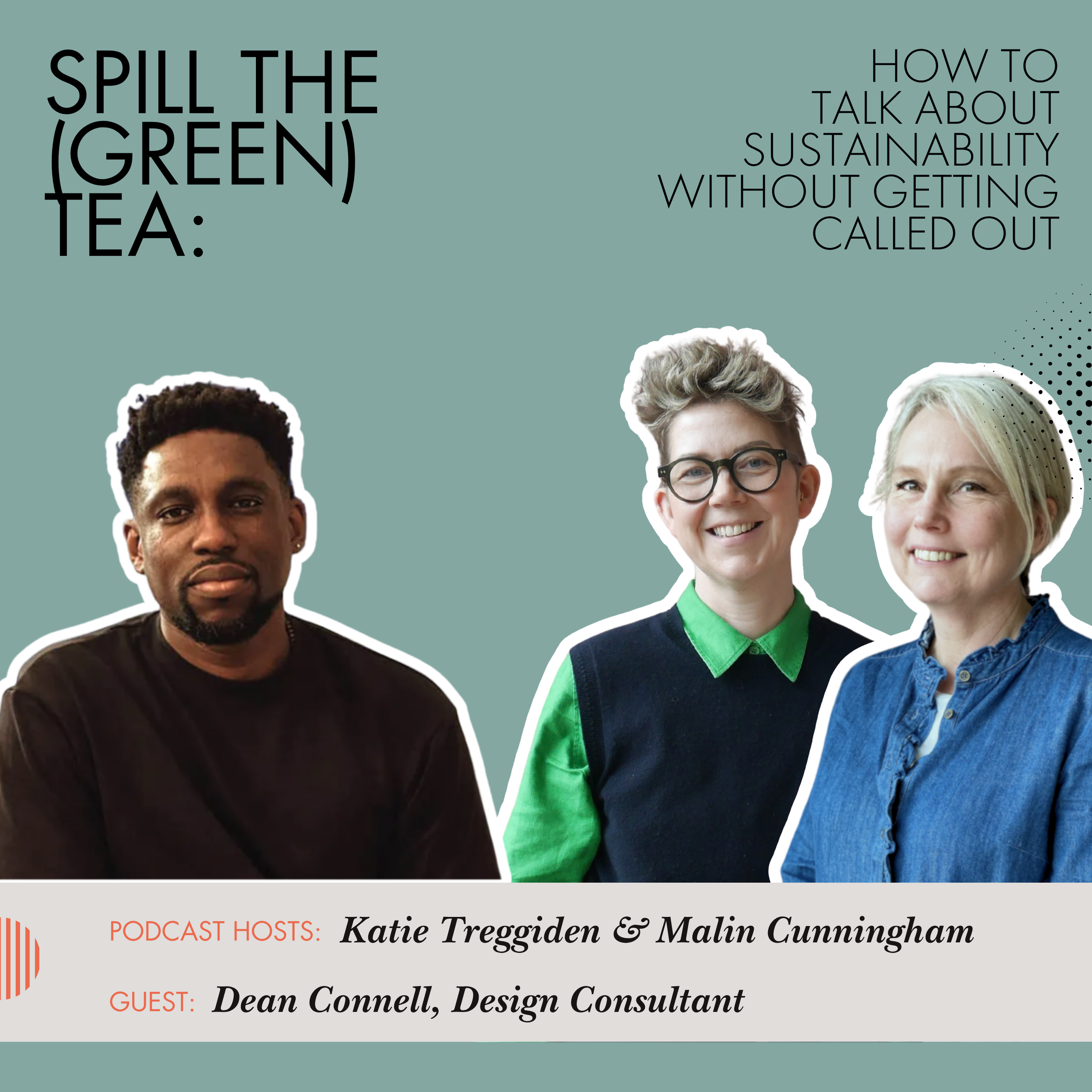
Welcome to this episode of Spill the Green Tea, in which I am interviewing the brilliant Dean Connell. I had Dean on a panel at the Surface Design Show at the beginning of this year, during which he uttered the words, environmentalism needs a new narrative. So from that moment on, Marlon and I knew that we had to get him onto the podcast.
We talk about the difference between actions and opinions. We talk about meeting people where they are, and using their language. We talk about why the idea of fighting the climate crisis is perhaps the wrong language, and ditto saving the planet.
And we go super deep and talk about the hero's journey, and why dancing to the music, rather than fast forwarding to the end, is the perfect analogy for what we're trying to do. Enjoy the episode. It's just me this time, me and Dean, and I will see you on the other side.
Thank you. Dean, thank you so much for joining us. I'm so excited to have you on the podcast.
I am flying solo this week, as Marlon is not feeling very well. This is the bonus of having a co-host, is occasionally she and I can do this. So the question we always start with, is asking our guests for a confession.
What is one kind of eco unfriendly thing that you do? We're all about progress over perfection in this space. So this is just to kind of break down some of the barriers.
What's something you do that might surprise people?
Dean Connell
So I think about this question, and I was asking myself, how do I answer a question around what is the most environmentally unfriendly thing that I do? And I came to the realisation and the conclusion that ignorance is the most environmentally unfriendly thing that I do. Not some, because I sat thinking, okay, if I say to you, I eat a lot of meat.
And it's like, for me, it's like, that sounds like a soundbite. It sounds like something that you would say if you have an opinion on someone eating meat, basically. And I, in all good conscience, I can't sit here and go, I'm aware of that thing that I do.
Like, for example, okay, look, shameless. There's a news agents right down by my studio. I needed some water, you know?
And so I bought a Highland Spring and I told myself it's spring water. So therefore it's good, you know?
Katie Treggiden
But the point- The fact it's wrapped in plastic. We'll just forget that.
Dean Connell
But then if I sit here and go to you on your podcast, oh, the most unfriendly or environmentally unfriendly thing that I do is I drink from plastic bottles. It's like, okay, probably 98% of the planets still do that. And so for me, I thought deeply about it.
And I came to the, like I said, the realisation that I can't, I don't know what I don't know. And so for me, my ignorance, and I don't take that as a negative as such. It's like, for me, it's an opportunity to learn, right?
But ultimately I saw it as what I don't know that could be unfriendly to the environment is probably the most unfriendly thing I can do.
Katie Treggiden
Yeah, and I think that's so important, isn't it? Because we all sort of think, oh, I know plastic's bad. And I try not to eat meat.
I don't fly as much as I used to. We're all kind of aware of the things that we're conscious of. I don't think anybody's kind of flagrantly just going, oh, screw it, I don't care.
We'll all buy a plastic bottle when we're caught in a pinch, but most of us have a reusable bottle that they'll try to use. And I think we're doing things imperfectly, but you're right, there's this whole sway that we don't know we don't know. And there's a lovely quote which comes from a book I can't remember the name of right now, but I will dig it out.
My dad bought it for me when I was about 12. And it's, wisest is she who knows what she does not know. And I think being aware of the fact that we've all still got so much more to learn is really important.
And on that subject, your sub stack, which I follow and I will get to in the show notes because I think other folks should follow too, is called Work in Progress. And I'm fascinated by that name and by that approach. Why did you choose it and what does it mean?
Dean Connell
Well, it's fascinating what you just said about the book that you can't remember that hopefully you will find. But it's kind of, it means that, what is it?
Katie Treggiden
Wisest is the person she- Wisest is she who knows what she does not know.
Dean Connell
There you go.
Katie Treggiden
I think the book was called Sophie's World by Justin Gardner. There you go.
Dean Connell
Okay, there you go. Also for the listeners as well. Like for me, Work in Progress, it isn't a brand.
I don't have a brand identity for it. I didn't do a logo. And for me, it's more of a mantra about showing up as yourself and accepting that you're, the phrase flawed human being, sometimes I don't really like to use it, but this idea that there's an acceptance that there is no goal at the end of this, that I'm trying to not reach the top of the mountain.
For me, Work in Progress is this constant iteration of showing up as yourself daily and doing the work as a way to kind of explore and travel on this journey. And so for me, it's this doing the work each day is progress. And it's a way of kind of, for me, confronting the present with humility, but acknowledging that there is a past, but also accepting that I don't know the future.
And so Work in Progress is this kind of, as you say, imperfectly imperfect, or I can't remember exactly the slogan, but it's similar in the sense that I'm not trying to kind of present you this perfect version of myself. And it ties into what we were just saying about my ignorance. I'm trying to present just myself and myself is good enough for me.
And so therefore I need to kind of just do the work and doing the work itself is a Work in Progress because I haven't figured it out. I'm just doing the work and that's it.
Katie Treggiden
And I think that connects so beautifully to a lot of some of the really interesting work that's happening in environmentalism around this idea of emergent strategy, which Adrianne-Marie Brown came up with. And this idea that there is not gonna be a day when somebody announces, well done, you saved the planet, we're done. Like that's not gonna happen.
And I think this idea of progress not as you gave the analogy of trying to climb a mountain, but progress as the whole thing. Like it's not progress towards something, it just is progress. We are always going to be in a space of trying to make things better and understanding that it's not a one and done.
We don't get to the end and then we're finished. Like we will always have to. I mean, I hate the phrase saving the planet because I don't think the planet needs saving.
I think it's us that needs saving. But we're always going to be in the work of trying to co-thrive with the natural world and constantly balancing the kind of scales of equilibrium. You and I were both on a panel recently and afterwards, I overheard you having a debate with a brilliant Sophie Thomas, who I must also get on the podcast.
And I just thought it was quite interesting because you both had quite different opinions and I wanna hone in on this. And this is kind of linked to the first question about whether it's better to focus your efforts on where you can have the most impact and not sweat the small stuff, which was your argument. You were sort of saying that, if I'm an architect, there's no point me worrying about what cup I've got my coffee in when I can have a huge impact in the buildings I'm designing.
Whereas Sophie was saying, yeah, but if you cared about this stuff, you'd care about all of it right down to the coffee cup. I'd love to just dig into that and we'll get Sophie on the podcast and we'll get her to talk about her side of that. But I'd love to just dig into it because I think that's something people struggle with is this idea of, do we have to get every little detail right?
If we truly care, are we hypocritical if we don't? Or should we be trying to figure out where each of us can have the biggest impact and focussing our efforts there. I'm not worrying if we pick up a plastic bottle of highland spring water on our way to do that work.
Dean Connell
Yeah, yeah. Well, it's funny. I'll go back to the first question as my anchor here or the first answer where I said ignorance is the most environmentally unfriendly thing that I do.
And for me that as an anchor point, I don't see actually see an either or in the question with regards to kind of not sweating the small stuff and focussing on the impact. I look at it more as, and if we think about what I just mentioned about work in progress, what does it mean? It means showing up each day and just doing the work, right?
And showing up as your whole self. And for me, it's like a triple entendre, if I could say, like I'm a workspace designer. So the whole work in progress is about me exploring work.
I mentioned to you what my thesis is around work. So there's that layer to it. There's a deep personal layer around me and my professional masks that I've worn over the last 20 years of my life.
And who am I really having children, my marriage and all of these things that we all go through. I would just kind of, my whole work in progress is me saying, is that actually me? And questioning that and being vulnerable enough to say, I'm not that sure.
And then the third layer is around what we're talking about here and sustainability and kind of how do I show up within this environment and the environmental question and kind of this talks about the impact versus sweating the small stuff. So my frame is this idea that, cause I don't wanna knock the concept of say compounding. Cause the argument is I go to the gym every day and I do a few press ups, that will compound over time.
And I align with that and I can agree and accept that as a way forward. So in that sense, the small stuff matters. So making an impact, you can do little things and over time they will compound.
But then the way I really frame it is that, okay, I see myself as a microcosm of a macro whole, of a bigger situation, a part of a bigger human family, a universe, et cetera, et cetera. And so for me within that, it's like the small stuff has to kind of fit in that microorganism first before it can compound for the whole. So when I say focussing on the impact, it's like saying, okay, as a designer, my small stuff is really doing something that I can actually control and I can bring immense value to.
I can't control how highland spring bottle their water. So it's not saying that if I don't care about it, it's me saying, well, we have a finite amount of time on this planet, where best should I direct my energy? And I think the best way for me to direct my energy is to say, okay, I'm part of a larger macro organism that is contributing to this idea of sustainability.
So if I can do my small bit and do it well within what my sphere of influence is, to me that compounding is more impactful than saying, oh, I have a strong opinion on every aspect of this. Because if I go again, kind of go back to the first question or my first answer, I don't know everything and I don't know what I don't know. So if I spend all of my energy focussing on trying to learn everything that I don't know about this challenge that we face, I'm spending a lot of time not doing the work.
And so then I'm not necessarily really contributing, I'm just kind of adding to, if you like, the noise. So again, hopefully that's clarifying. It's like, I don't really see it as a like evil or, I see it as a little bit, like kind of a bit of both.
Katie Treggiden
Yeah, yeah. And I love that distinction between action and opinions. Like we can spend a lot of time sharing opinions, but less for actually doing anything about them.
And I think we can all have the same impact by trying to fly less, trying to eat less meat, trying to use less plastic. But there is an area in which each of us can have a disproportional impact. And that is in our unique sphere of influence, right?
And I think having companies and brands and designers understand where their unique sphere of influence is and saying, okay, yeah, we're trying on these hygiene factors like everybody else, but this is the bit where we think we can really make a difference. That I think is really exciting because I think then it takes off this pressure of we've all got to save the planet single-handedly and actually moves towards a more collective understanding of how this is gonna get done, which is that we each have a part to play. And if we can each play our part well, that will add up to something bigger than all of us spreading ourselves too thin.
So I think that's really interesting. I always also really love it when someone challenges a binary question. So thank you for that.
Dean Connell
It's okay, but it's fascinating in what you was just saying around if we can all individually do our part, it contributes to a whole. Look, there's a lot of energy out there in the world today which suggests the collective is more important than the individual, right? In terms of an ideological frame.
And for me, I subscribe to the concept. Again, it feeds through like my work. This concept of work in progress is really me saying, hey, I need to show up.
If I can show up whole, hopefully instead of telling someone else that they should show up, it's I show rather than tell, right? And so for me, it's individualistic in a sense, but I fundamentally believe that that's the most rational course to kind of really have a change across a macro sense is you get people to firmly believe that what they are doing is right rather than we use marketing, propaganda or any other form to kind of convince you through fear or whatever that you should do something because, oh, that's the right thing to do for the greater good.
And so I kind of challenged that narrative a little bit. And for me, it ties into this whole thing of, we're all a small part of a big, big planet and a big universe. And if we take on those ideas where we are all connected, which I believe and feel, then we can only do our part to kind of magnify that connection and which will compound.
Katie Treggiden
Yeah, and I think that taps into something you said on that panel that we were both on, which is what made me think, oh, got to get Dean on the podcast. You said we need a new narrative in environmentalism. And you were talking about the fact that the current narrative requires us to be activists.
It requires us to be kind of perfect evangelical people who are getting it all right and kind of bashing other people over their heads. Talk a little bit about what the new narrative looks like. So if we're not showing up as activists, how are we showing up in this space when we talk about sustainability?
Dean Connell
I think for me, the key thing, and I can give context behind this thought, but I'd rather do things or show up or do things particularly because they're better, not because of any other reason other than the fact that it's a better way to do something. It's an improvement on the status quo. And that comes from, for me, me believing, and it ties into the previous kind of question discussion, me believing that the current narrative is quite binary and it's quite fear-based.
So, you know, and I'm going to go out on a limb and say it really appeals more to middle-class Westerners because not everybody is in the luxury position of activism, right? So if we broaden this out a bit, just from a conversational standpoint and say, all right, let's go, I don't know, South America, middle America, or the global South or wherever, and start saying to someone who's working two jobs, just trying to put food on the table, it's like, now you start to bring, for me, the narrative breaks down, the current narrative, because it's like, okay, you know, what do you think about climate change and stuff?
And it's like, I will completely, see, get out of my face, I'm just trying to feed my kids, right? Because their reality, they don't have time to care about something. I'm not saying that something doesn't exist, but it's the frame of what they should care about.
It's this notion that we have to be activists. We have to all agree that this is a thing that we have to fight, and it's quite adversarial.
Katie Treggiden
Whereas- Yeah, I think even that language of fight, isn't it? Like, we talk about fighting the climate crisis, and I struggle with that term as well, because there's a sense of, aren't we trying to move towards a future where there is less fighting? And so shouldn't we be using language that is more aligned with that future?
Dean Connell
But I, and I think, so to your point, and obviously, you know, without derailing our conversation into world current, world events, and what's going on around fighting, and, but the, for me, the language, that's why I said it kind of appeals to the middle-class Westerner, because it's that same tone. It's the fear-based, you're either on this side, or you're on the bad side. It's one or the other.
There's no nuance. There's no nuance. The nuance is kind of cut out of it, that, well, actually, I'm actually, like, deeply in debt.
I'm, haven't got any time on my hands. I'm suffering from mental health. I don't know.
I'm not eating well, or whatever. Basic stuff that- Yeah, those kind of today problems. Right?
When I, none of that matters, because the climate is where, you know, the world's gonna end if we don't do this, like, really? Like, my world's gonna end at 12 tonight if I don't get paid, or something like that. So, for me, you know, individual responsibility, not collective mandate.
Do things because they're better, not because you're afraid.
Katie Treggiden
Yeah. And I think also this kind of fear-based narrative, you know, the psychology shows that fear only motivates action in the short term. We can't hold that in our bodies for very long.
So, at some point, you stick your head in the sand, right? Whereas if we can, and I think the environmentalist movement has done a brilliant job of explaining how terrible it's all gonna be if we don't sort it out. What we haven't done a good job of is painting a picture of what it could be like if we do sort it all out, right?
What are we moving towards rather than what we're moving away from? And we've kind of talked a little bit about this. You know, you mentioned this idea of this kind of fighting spirit being quite middle-class and quite Western.
I know you live in London. You've travelled all over the world with work. Your heritage is Caribbean.
How does that kind of perspective shift in different cultures that you've spent time in?
Dean Connell
It ties into what I was just saying around, like, go into different places. And even when I talk to my mom, and there are different priorities in people's life. And I try at the very best to just acknowledge that and not judge it and not speak to them in a way like, oh, you should know this.
You remember I said at the beginning, my ignorance is my most environmentally unfriendly thing that I do. And I think it's for other people as well, especially when you travel and you go to different parts of the world, especially parts of the world that are not as affluent or whatever as, say, certain parts of the West. You realise that actually there are other priorities that are just as important if not more important to them than climate change.
And it doesn't make them wrong and it doesn't make someone else right. What it means is that's just their perspective. And so that becomes, their perspective is their reality.
And so for me, I just like to acknowledge that. And so everything I've learned over the years, and I want to stay true to that because I didn't grow up caring about climate change, right? So I don't want to sit on podcasts and be on panels and talk to people in a genuine sense and be fake, right?
Because I don't, I have no, there's no business there. There's no, I don't gain anything. So all I can do is from a designer and from a design thinking standpoint, try and communicate through my, using my experience and say, look, I've gone through these processes and here's what I think about the subject matter rather than, and here's what I've done and here's how I'm acting in this space rather than I think this from a distance, you know?
Katie Treggiden
Yeah, and I think kind of the flip side of that is, I get you to tell the story every time I have you on a panel, so apologies, but you were at WeWork kind of post a massive expansion and then kind of as the organisation was coming into lockdown. And I think what you did there was similar or be a very different, was kind of talking to shareholders and talking to people who are primarily focused on profit in their language and acknowledging their perspective, but still enabled you to get an outcome which was better for the planet. Can you talk us through that story briefly?
Because I think it makes that point in a very different way.
Dean Connell
Yeah, so I'll try and keep it as concise as possible. It was pre-IPO 2019. And at the time we had warehouses filled with furniture and FF and E items all across the globe because it was part of the expansion plan.
WeWork was gonna grow here and open buildings every month and take over the world. But they were preparing for the IPO and they were obviously doing inventories on operational costs, et cetera. And the leadership came to the realisation that we had these huge warehouses in regions all across the world that was burning a hole in the pocket of the business.
And so they were looking at the balance sheet and the cost of having these warehouses open with all of this stuff in it, this volume, cubic metres of volume was too much to bear. So they said to us, I was creative director of the FF and E team globally. So I worked with all the creative directors from the interior side to help them get furniture in their projects.
That was my role. And so they pulled a bunch of us together. So me and the sourcing team, procurement team and supply chain team said, look, these warehouses need to go, get rid of them.
You've got X amount of time to do it. Now we knew that we couldn't just kind of campaign as activists to bring that reference back. We couldn't do that and say, oh, but yeah but this is gonna become waste, et cetera.
We knew that wasn't the tone. So we needed to present a business case. And so we agreed that we would get an understanding of what's in the warehouse first.
So we got an inventory list of everything in the warehouse and put it into a master schedule. And it was approximately like close to, like a hundred million, $98 million worth in terms of total asset value. And this is like lots of stuff.
This is like partitions that they were storing, doors and just things that they would negotiate big contracts on so they can get the cost down. And then as you're growing it's more efficient for the business. So in that sense, it made sense.
But now faced with this challenge of getting rid of the warehouses we need to get rid of all this product. And so they were like, just sell it to the market and or get rid of it basically so that we can close that number on the balance sheet. And what we ended up doing was we took four strategies.
We said, there are existing projects over five years old. We will mandate or soft mandate. And my job was to convince the designers to use the stuff but we would say, you can use this product in these older projects to refresh them.
Great. We had a pipeline of projects going forward. So we would, again, soft mandate that these products should be used on this project, these projects going forward.
We did sell some to the market. So we got 60, 50 cents on the dollar in terms of for the product. And then there was about, and it was only about 10%.
So it wasn't a huge amount but there was this section of products that was just waste. And it was defined as waste because it was like mismatched products. It was items that was kind of damaged.
It was stuff that no one wanted. It was poorly fast furniture type stuff that we had accumulated over years because it was cheaper to buy at that time. And it was items that didn't really recycle easily.
So in the end, we just had to sell that to liquidators and they would then, and it was kind of like outside out of mind solving. And that was a way that we can communicate back to the business. We went back into the boardroom and we presented that business case and we basically got the runway to execute that plan over the next six months.
Katie Treggiden
And I think that's so interesting, because I think, as you said, what you didn't do was go in as environmental activists and say, this is wrong. This is, you know, this stuff's going to be wasted. It's bad for the planet, because you knew that would fall on deaf ears.
So you came up with a business case, you appeal, you spoke their language, you met them where they were, kind of spoke to their perspective. And you came up with four different plans, which I also think is interesting, because often there's this sense of what's the one right answer, whereas actually, there were four right answers. And I just think it's a kind of masterclass in internal communications, right?
When you're trying to bring out, trying to bring about an outcome that's more sustainable, without mentioning sustainability, that you managed to find homes for the vast majority of that furniture. And I think partly inspired by that, inspired by other things as well, you've developed your own circular furniture collection, which could be seen as a communications tool in itself, I might be stretching, stretching the point to fit the podcast a little bit there. But can you tell us a little bit about that collection, how it came about and kind of what it what it says as a as a piece of communication as much as kind of functional objects of furniture?
Dean Connell
Yeah, so that 10% that I mentioned, this was in 2019. And I left WeWork end of 2020. And 20, so 21, was I spent the first six months of 2021, exploring this idea of, okay, but if that 10%, where I said it was fast furniture type fun, it was mismatch.
I was like, is it is there a way that we could create furniture, or create products in general, that kind of designs out waste, or said another way, was inherently circular. That was kind of my initial thought. And it was so it wasn't, again, it wasn't me trying to, you know, I wasn't a sustainable designer, I've never been, you know, you know, so it wasn't me trying, it was me saying, as a kind of it almost as an intellectual pursuit, it was like, okay, but if you could create objects that are inherently circular, then the your, your product will be circular by design.
And then therefore, you could just focus on the desirable aspect of why people want stuff. Because my huge inspiration and for that piece of work, as well as just my ideology around this whole stuff, circularity is Jonathan Chapman's book, emotional, durable, sustainable design, something like that. Yeah.
And he wrote that book, and that book is pre Ella MacArthur. So there's no mention of like circular economy. It's fascinating.
And I love that book. I love the tone. And he speaks about ideas such as, you know, getting a human to stop consuming is like trying to stop a vampire from drinking blood.
And he's on the idea, the frame was that the products just need to be better. So because people are always going to want to consume. So, you know, I took that kind of thinking and extended it to mean, instead of me trying to communicate and market and create something and communicate my product, hey, this is circular, you want to buy it because it's biodegradable, you want to buy that.
For me, you just say, Hey, do you like it? And once someone engages at that level, oh, I like it, because oh, it would work well in my lounge, or it would work well at home, or I think my brother would like it, my sister would like it, etc. Then it starts to become a conversation.
And then you say, Oh, actually, the story behind this is inspired by the idea of circularity. So there are four principles that is designed to align with, and it models the butterfly diagram from the Ellen MacArthur Foundation, where in the centre, you have the kind of linear chain. So you have at the top, you have kind of the raw material from the earth, right?
And then second down that linear chain, you have how those parts are kind of manufactured and made into different parts for the producers and the manufacturers. And then you have the third layer down that chain is the how does that that product then get out into the world. So I characterise that through furniture dealer networks and people who sell furniture, retailers, and then finally get the user.
And then typically, in the linear chain, it ends up in landfill after the user. And so my idea was to say, okay, take those four principle areas and try and add circularity down the chain and back up the chain. So when so when you go back up the chain, you start with the user because they are the most important.
And you say to them, okay, if you had a product that was durable and repairable, you you reduce the amount of chances that it needs to get thrown away because it's durable. And if it does need to be repaired, it's easily repairable. And so that translated into a material decision, which was oak.
So I use solid oak throughout. And I'm giving you this kind of thinking process, because as I said, when you look at the product, it doesn't look like it's a sustainable product, it just looks like it's a big lump of wood. And it's not until I explain all of this that actually some of it makes it aligns with the narrative or the story of circularity.
And so then the and the reason why I chose oak, oak is very durable. And you could if you have this solid tabletop, for example, it goes anywhere in the world, somewhere in Argentina, somewhere in India, whatever, a woodworker, local woodworker would know what to deal with do that. Yeah, right.
So it's universal in that sense. So therefore, it stands a chance to survive. And then the second of the chain is the dealers.
God forbid we have a COVID situation again, and offices are out of action. And now you've got all of this office furniture that no one needs. What does that do create more waste.
So instead of my table being an office table, it's just a table table. And the idea is that I designed the table that could be functioning functional in the office at home in a restaurant and so on. And so by giving it that extra utility, you again, hopefully give it a greater chance to survive.
And then as you go up the chain, you have the producers, the people who produce and manufacture the object from parts. And then you say to them, okay, I want to make it efficient for you. I don't want to make it complicated.
I don't want to make it something that only you need to go to this part of the world to source this machine that this works, that takes this amount of energy to produce this. I want to make it so that it's interchangeable. And what we do is the products that we kind of create show personality.
So the best example of that I could give to give the listeners and viewers insight is Lego. Think of Lego. Sure, they have lots of individual pieces that I can testify to because step on them every day.
But the, but the core Lego brick is it shows immense personality. We all know what it is and it's interchangeable. So from a production standpoint, the producer can just set their tools and hit a massive run of those.
And they can save energy through doing that because it's an interchangeable product. Whereas if I have, if my designs or furniture was lots of different pieces, you know, it, it kind of adds complexity. So that's why the leg of my table is the same leg that we use on the coffee table is the same leg that we use on the side table.
It's just a different lens.
Katie Treggiden
Yeah.
Dean Connell
And, and then the final one in this kind of long explanation of how I use circularities or my furniture as a communication tool is just by embedding the story. So it's inherent is to say, make your products safe for humans, safe for the biosphere. And if all else fails, it's recyclable.
So, because, because to me, when you go back up the chain, that part of the extracting the raw material, it needs to be like, you know, like a banana skin. It's like, even though no one likes litter, if you see a banana skin on the floor, at the very least, you know, it's not, it's not going to persist, but it's going to biodegrade and it's just going to be food for ants and, and so on. And for me, my table or my, you know, the, the wood frames that I'm working with, you just leave them outside.
They will just become wood rot and add to the wood that we see everywhere. And so that's how I thought about it. And that's how I developed it.
So people don't like the product. It has no utility and it has no chance of being circular.
Katie Treggiden
So yeah, I think, I think that point about emotional durability, you know, you referenced Jonathan Chapman's books and I'll make sure I linked to that in the show notes so that folks can look it up because I think it's so important. And it's this sense of how do we create something that doesn't require a huge amount of behaviour change, but changes the outcomes of those behaviours, right? I'm going to share with you a quote that you shared with me by Alan Watts, which is, I know one of your favourite quotes and has become mine too, which is we thought of life by analogy with a journey, a pilgrimage, which had a serious purpose at the end.
And the thing was to get to that end, success or whatever it is, maybe heaven after you were dead, but we missed the point the whole way along. It was a musical thing and you were supposed to sing or dance while the music was being played. It's now one of my favourite quotes as well.
So thank you so much for sharing it with me. But I think that kind of speaks to some of what you were talking about earlier about this idea of progress being the point, not just the journey. Could you talk to me a little bit about that quote and why it resonates with you so much?
Dean Connell
Yeah, I, you know, shameless, but I love the work of Alan Watts and it's been eye-opening for me on this, along this journey and work in progress is influenced by this philosophical ideology that, and I had it, I did it, I did the test with my kids in the car the other day. They asked me to put, I was taking them to school and they asked me to put some music on, and typically it's like a Spidey playlist or Pokemon playlist. And so, and I did this test with them.
So I put the tune on, I put like a, I think it was a Pokemon song. My eldest is seven and I put the song on and then I let it play for about five seconds. And then I fast forwarded it right to the end.
And then my son goes, dad, why do you do that? We haven't listened to the music. And I said, and then for some reason, I don't know why I felt this way, but it was like some moment of to teach my sons a philosophical point about life, that life isn't around getting to the end.
It isn't around this ultimate goal of saving the planet. And no one can convince me otherwise of this. I've felt and meditated on this deeply, this idea that, and I've had it in the past, I think it cripples us.
We always want to win something. And I get that. I've, you know, grew up playing sports.
And so I get needing to win in a kind of a momentary game, but this concept, when you extend it to life, it doesn't really kind of hold weight to me. And I think, so I think that quote is, is quite profound that no one ever listens to music and get fast forwards to get to the end.
Katie Treggiden
Yeah. And yet we know so much of the rest of life. We're kind of like, oh, can we just get through this bit now so we can get to the bit where I quote unquote win, whatever it is.
Dean Connell
Yeah. And so, and so for me, that philosophy is the work in progress philosophy is no, you, you try and stay and live in the moment and you, and, and all it is, is you just dance. You just dance.
Katie Treggiden
What about when it's hard though? Cause I get dancing to music and that analogy, but, um, the kind of the hero's journey is your, your kind of typical sort of archetypal story arc, isn't it? There is a dark night of the soul in the hero's journey.
Katie Treggiden
And I feel like the world is perhaps in that dark night of the soul right now. How do you kind of stay with the progress when it doesn't feel like dancing?
Dean Connell
And this, this might descend into kind of a cult science and apologies to anyone. But I, when we were all in our, within the three trimesters of our mother's womb, where were we? We were in darkness, right?
The planet is spinning around what a dark space. All light comes from darkness, right? And this is, and this is not me trying to be clever with words.
It's just when you just actually think about it, if you have a dark room and then you, you flicker on a lighter, that lighter, that light just kind of makes the whole room become light. Right. So I think when you apply that to where we are, cause as you just mentioned, there's a whole lot of darkness at the moment.
I think the challenge that we face as a society, as a group of people is that we try and suppress the darkness.
Katie Treggiden
Yeah.
Dean Connell
We don't acknowledge it. And, and so then if I can use this as a reference and say, you know, and this, again, it might be a bit esoteric, but when you're breathing, that's why meditation is interesting because when you're, when you, when you try to meditate, you don't try and go to the light, you close your eyes and you go where? To the darkness.
You know, if you're driving and texting at the same time, which a lot of us can do now that we, you know, we're not learner drivers anymore. Who's still controlling the car? When, you know, when you're breathing without consciously trying to breathe, who's still breathing?
There's a darkness that's part of you that we, that we, we tend to only want to focus on the light. And so, so for me, the answer to the hero's journey is, and if you think about the hero's journey, if you think about how Hollywood plays on this archetype in all of the, in all of like superhero movies, like most of like Hollywood is organised around this archetype that the hit, the hero has to go through this turmoil, this darkness in order to get to the light. Otherwise they can't ascend and, and they can't get their powers or whatever the case may be.
And it's the same story, whether it's Simba in the Lion King, you know, he has to think that he killed his dad and blah, blah, blah. And so this, this, the hero's journey is light only comes from darkness. So the, the key thing for me is that we have to integrate it.
We have to, we have to acknowledge that it exists. We have to own it, accept it. And then only then can we kind of move forward.
And I think the, you know, the dark night of the soul, you know, that even that statement, it's like, it kind of sounds negative, but when you think about it, if the soul is in control, it's not negative. It's so, yeah, I, we can go on and on and on and on about this, but like, here's another one is, and it's really simple stuff. I try and think about this stuff in really simple ways because I have young children and sometimes I try and explain things to them.
I use the word, sorry, I'm going from the tangent here, but I use a word with my sons the other day. What was it? I can't remember.
But I use a word, which is, it was way too complicated for them. Like you would understand it. What did I use?
I can't quite remember, but it was something like concurrent or something. It was like a word, like, it's like Dean that they're not going to understand what that means. What are you talking about?
So like, I try and like tell myself and talk to myself, okay, you've got to kind of dumb this down and not, but not dumb it down, explain it in ways that's very simple. So I always explain to my children, it's like good and bad are effectively the same energy. They're just, it's just a matter of degree, right?
You know, hot where we do bath time, hot and cold. It's the same thing. It's just a matter of degree.
Katie Treggiden
Right.
Dean Connell
And, and I try and give that frame. And for me, that's the hero's journey.
Katie Treggiden
Yeah. I love that. And I think, I think we, we again, tend to fall into binaries.
Don't we, that it's all going to be awful or it's all going to be broken. And very little of life is that, you know, even in the worst, worst times of my life, there have been glimmers of joy and even in the happiness, you know, happiest times of my life, there have been glimmers of sadness. And I think being able to hold both of those things, and I'm going to try and bring this back to sustainability comms now.
Sorry, but I do think being able to hold both of those things, as you talk about sustainability is really important. And being able to understand that, you know, all of the stuff we've talked about, you cannot do this stuff entirely on your own. There are bits you're responsible for.
There are bits you're not responsible for. There are bits that you will find easy and joyful. There are bits that you will find hard, and kind of holding space for the complexity and the nuance of that.
I think a theme that keeps coming up on the podcast is the fact that we are entering a sort of new era of sustainability comms. We're coming of age, as you know, this conversation is having to get more complex and more nuanced and more grown up. And I think being able to hold space for all of that, whilst explaining it simply, yeah, simply enough that the kids in the back of your car on the way to school can understand.
Yeah. Yeah, really important. Right.
We have got the quickfire round for you now, Dean.
Dean Connell
Yeah.
Katie Treggiden
Hope, cop out or vital.
Dean Connell
For me, whether I understand it, am I supposed to pick one?
Katie Treggiden
Yeah. Oh, do you think hope is like, a really important thing we all need to hold on to? Or do you think it's copping out?
And we need to face up to how bad everything is?
Dean Connell
Based on everything that hopefully we've been talking about, hopefully my answer here resonates with you and others is hope without action is useless. Yeah. So you can have hope, but you've got to do something about it.
Katie Treggiden
Yeah.
Dean Connell
So that when we were saying earlier about, you know, your impact, your sphere of impact, so in the small stuff, it's this idea of, okay, what are you doing around about your hope, whether it's good or bad? And so for me, that's how I approach it.
Katie Treggiden
Hope plus action. I love the way we just had a whole conversation about the nuance of holding both those things. And then I just shot a binary question at you and made you pick one.
What book is on your nightstand at the moment? What are you reading?
Dean Connell
So I need to probably read more of it more quickly, but I'm reading Black and British, A Forgotten History by David Olusoga. Oh, we will pop a link to that in the show notes. Yeah.
He talks about just the, being black in Britain and growing up through the seventies and eighties in the UK and in London and just, yeah, that impact. And then it goes through a lot of history around just the diaspora and the relationship with Britain.
Katie Treggiden
And it goes back way further than most people think, I think, doesn't it?
Dean Connell
Oh yeah, it does. And he goes, and that's the whole point of his book, I guess, The Forgotten History, because it goes, it goes way back.
Katie Treggiden
Nice. Give me an example of some great sustainability comms you've seen recently. Who's doing this stuff well?
Dean Connell
I look, shameless. I really enjoy talking to you about this because I feel like we have open ended combos and you kind of allow me to descend into the esoteric realms of what I'm exploring. So I appreciate your comms and the way you talk about it.
And I always have done. So you've been a kind of inspiration, but it's more like a great foil, like a resource, if you like, because you've been at this a lot longer than myself. And so it's been really good to kind of like tap into your work.
And so I'll give you a bit.
Katie Treggiden
I really enjoy bouncing stuff off you. So listeners for context, the first time Dean and I met was for a coffee at 100 Shoreditch, used to be the Ace Hotel on Shoreditch High Street. And I think we had like, I don't know, maybe 45 minutes in the calendar and we must have sat there for three hours just chatting about the big, the small, the kind of esoteric, the everyday.
And so, yeah, we always have good conversations. Thank you.
Dean Connell
But then, but I will say, so I can't really recall a specific thing. I don't want to kind of try and, you know, I didn't research something and then just give that a plug. So because I'm a bit of a hermit, if I'm honest.
And this is something I wrote a spoken word piece the other day where I said I'm intentionally uninformed, calibrated six months behind events. And it's deliberate. And it's kind of this, it allows me to kind of sink into some of these thoughts, face some of these ideas without getting distracted on what such and such president of the United States is doing here or what this thing is the hot topic here.
And that I kind of, I'm wilfully, I'm actually ignorant of those things at the moment. And I'll kind of catch up to it later by reading a long form article down the line of what's happened.
Katie Treggiden
Depth rather than speed, isn't it? Yeah. Favourite podcast apart from this one, what's on your, what's in your AirPods?
Dean Connell
So definitely this one, but then more nuanced to kind of what I'm really interested in at the moment, as I was mentioning to you earlier around, I'm curious about AI and how to, how to integrate AI into my workflow without losing my humanity or my creative spark. And so I'm, I, I, I'm an information wanderer. I don't really have like a set of podcasts that I, I listened to as such.
It more is where's my, where's my curiosity. And then for some reason, I go and find something. And then obviously, as you know, the algorithm then shows me.
It's right. So one of them is this gentleman called Nate B. Jones, and he just talks about AI and he's very good.
In my opinion, I've learned a lot from how he frames it. He just talks about everything that's going on in AI. He does it in a way where it's kind of like, this is what's been happening, kind of like what you wouldn't have known.
And then it's almost like, how can you apply it in whatever it is you're doing? And so I find his content has helped me in my thinking around how to use AI and how to play around with it in my workflow.
Katie Treggiden
Interesting. And I think, I think that kind of point of how to respond to AI and keep your humanity as a creative is one that a lot of people are grappling with. So thank you for that.
We will link to him in the show notes as well. And finally, what is your top tip for communicating imperfect progress towards genuine sustainability with confidence?
Dean Connell
Accept your ignorance, do the work and meet people where they are.
Katie Treggiden
Nice. What a beautiful note to end on. Thank you.
Dean Connell
I think that's it. I think for me, just do the work, do what you can to contribute. Don't try and shout at anyone.
We've got enough people shouting at everyone. And then accept you just don't know everything. And so.
Katie Treggiden
Yeah. Yeah. It's a journey, isn't it?
And I love, I think my key takeaway from our conversation is that sense of being in the progress, not as a means to the end, but because the progress is all there is. I think that's a really important takeaway.
Dean Connell
And it's hard. It's hard. Don't get me wrong.
I'm not sitting here, you know, I'm not some monk who's figured it out. Believe me, it's really hard. Sometimes I can be part of my French, grumpy little.
Anyway, I won't swear, but it's hard, but it's something that I try, I work at daily and that's the whole point, work in progress.
Katie Treggiden
Yeah, I love that. Thank you so much, Dean.
Dean Connell
Yeah, no, of course. Of course. It's a pleasure.Katie Treggiden
We have been Katie Treggiden and Malin Cunningham, and this has been Spill the Green Tea. Please leave us a review and share this episode with anyone you think might find it helpful. And let's get people talking about this stuff.
Malin Cunningham
Thank you my co-host, author, journalist and consultant, Katie Tregidden. Katie is on a mission to share true stories of imperfect progress towards genuine sustainability, and to help purpose-driven brands talk about their eco-efforts for clarity, credibility and confidence. Katie has a brilliant resource called Green, Not Greenwashed, that will help you do just that.
You can find a link in the show notes.
Katie Treggiden
And thank you to my co-host, Malin Cunningham is the founder of B2B comms consultancy, Hattrick. They help businesses build commercial credibility and a competitive edge through standout PR, thought leadership and carbon literacy training. And Malin has a fantastic guide for sales and marketing professionals called Green or Greenwashed?
Great minds think alike, what can I say? And you can find a link to that in the show notes too.
Malin Cunningham
And a final thank you to all our brilliant guests and to Kirsty Spain for editing and producing this and every episode.