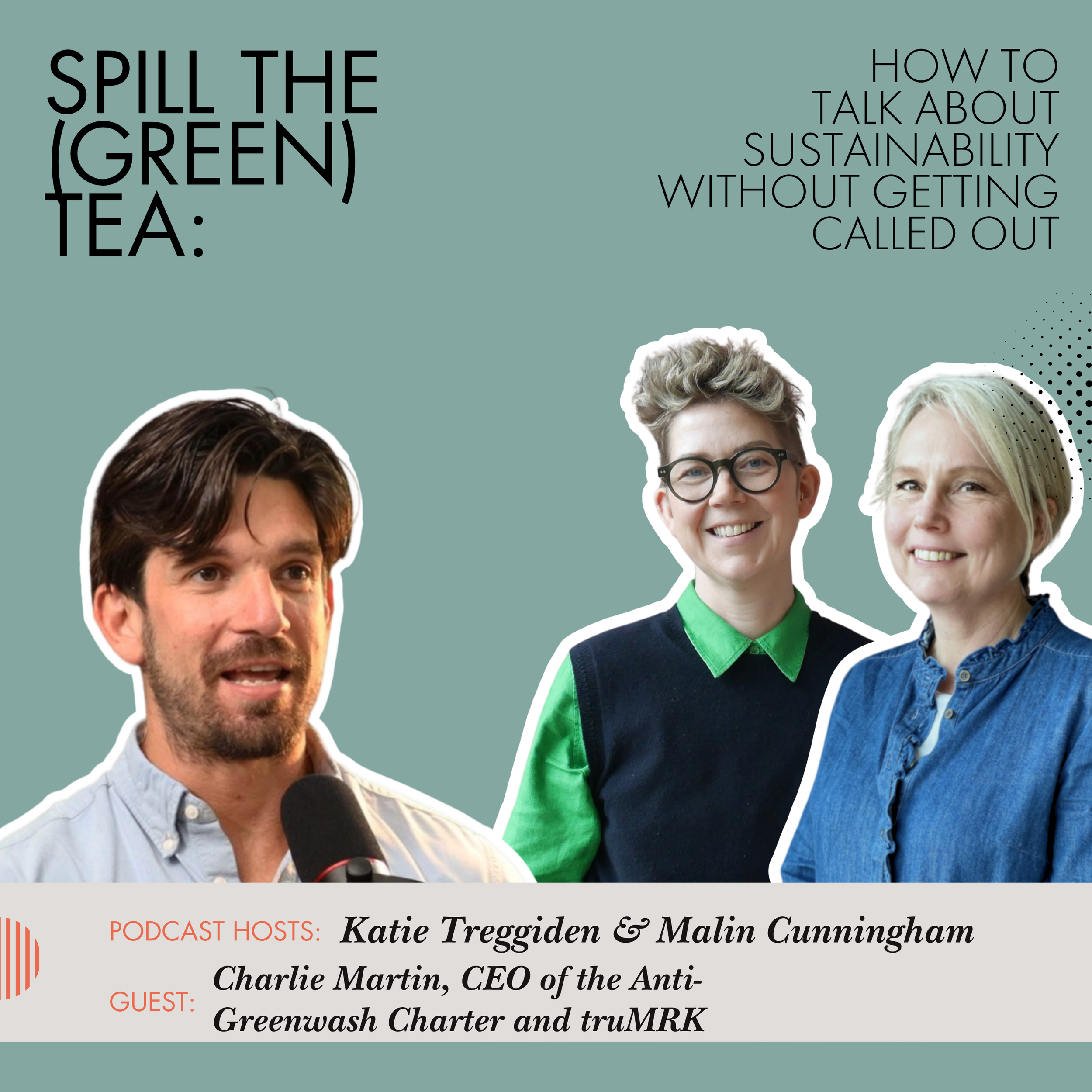
Spill The (Green) Tea with Charlie Martin
This is an auto-generated transcript that has not been edited or proofread and therefore may contain errors.
Malin Cunningham
Welcome to Spill the Green Tea, the podcast where we dive into perhaps the most controversial part of sustainability, how to talk about it.
Katie Treggiden
That's right, we're exploring how to talk about your eco-efforts without getting called out. Join us for straight-talking, behind-the-scenes insights and practical takeaways that will help you gather the courage to shine your light in these volatile, uncertain, complex and ambiguous times.
Malin Cunningham
It's a serious topic and we don't shy away from that, but we will bring you uplifting, positive and pragmatic conversations with brilliant guests and in-depth discussions between the two of us, all to give you the confidence to talk about your imperfect efforts towards genuine sustainability.
Katie Treggiden
Because it's not just showing off, sharing your progress helps you connect with clients and customers and inspire others to be more open about where they are on their journey. We need your stories now more than ever.
Charlie Martin
The most significant trend that's affecting organisations kind of umming and ahhing about whether or not they want to join the Charter is the fact that in the age of green hushing, which obviously we're going to come on and talk about today, and people perhaps communicating less in the sustainability space, it's that sense of why would we stick our heads above the parapet and why would we make it, put our target on our backs essentially by signing something like the Anti-Greenwash Charter and presenting ourselves as such.
Malin Cunningham
Welcome to this episode of Spill the Green Tea and this time Katie and I are speaking with Charlie Martin. He's helping businesses communicate around their communication commitments more responsibly. He's the founder of the Anti-Greenwash Charter, TrueMark and the podcast The Responsible Edge.
Coming up you will hear why trust is the overlooked strategic asset in business, what makes sustainability comms the strongest trust lever you have and why being upfront about your flaws can unlock comms and credibility. Super excited about this one, let's get straight to it.
Katie Treggiden
Charlie thank you so much for joining us. We always start by asking our guests to confess their eco sins. So what is one thing that you do that might surprise people?
Charlie Martin
Do you know what was incredibly painful about reflecting on this question was that it really wasn't just one thing and I think it was in the essence of the conversation that we're having around you know around transparency and the liberation that can come from being transparent about your your fallibilities perhaps as a brand. I need to apply it to myself so yeah there are many. Do you know one that's really naughty is we've got a soda stream so there is absolutely no reason for me to go and buy bottled sparkling water and I'm bad for it, I'm really bad for it.
There's something about a bottle of San Pellegrino when I see it and I'm just saying yeah I deserve a little San Pellegrino today so I'll go and get myself San Pelle so yes that would be my.
Katie Treggiden
My mum has a friend who buys Tesco fizzy water and then pours it into a San Pellegrino bottle and then serves that on the dinner table so that's that's worse. Yeah that's another level.
Charlie Martin
Is the bottle though that they serve it in is it one of their glass bottles or one of their plastic bottles do you know?
Katie Treggiden
I have no idea.
Charlie Martin
Yeah I think if it was if it was glass I'd be like it's slightly on the okay strand but yeah no I that that's and don't get me wrong like there are many others but yeah that was the one that sprung to mind when when I was reflecting on the question.
Malin Cunningham
Thank you that's good good good sharing so let's get straight into the weeds of this one so what are the biggest stumbling blocks for organisations that want to become signatories of your wonderful anti-greenwash charter?
Charlie Martin
Great and by the way can I just say I've always had the questions before these were sensational questions that you guys have put together so I'm just going to flag that up front but you know I think and I'm going to I'm literally I'm speaking to the converted here and telling you guys to suck eggs but I think the most significant trend that's affecting organisations kind of umming and ahhing about whether or not they want to join the charter is is the fact that in the age of green hushing which obviously we're going to come on and talk about today and people perhaps communicating less in the sustainability space it's that sense of well why would we stick our heads above the parapet and why would we make and put our target on our backs essentially by signing something like the anti-greenwash charter and presenting ourselves as such.
Katie Treggiden
So people are worried if they sign that people are going to apply more scrutiny to them?
Charlie Martin
I think that is that is a concern um and I think it's it's very much as alluded to I think in the age of green hushing I think it's it's sort of uh you know it's it's perhaps seen as a discomfort if you like to perhaps put that target on your back but what's interesting I think is for the brands that do want to join the anti-greenwash charter and see the value in doing so it's almost that that sticking your head above the parapet showing a bit of courage showing a bit of leadership and ultimately taking a stand against I guess one of the most you know concerning uh phenomenons of the modern modern age which is misinformation and in particular in this uh you know issue uh green green claims I think that is that's sort of the counter to it.
Katie Treggiden
Could you just tell folks who haven't come across it what the anti-greenwash charter is just give people like the real the real basics um and then I have a follow-up question for you.
Charlie Martin
Yeah of course of course so maybe just to like give you a kind of I guess a brief kind of origin story if you like which will I think give context to kind of what the charter now is um we used to run a comms and marketing agency called Gusto predominantly working the built environment sector here in the UK and we had two really proactive clients come to us literally just after the green claims code was published by the CMA back in I think January 2021 or you guys might tell me if it was February it was sometime around the beginning of 2021 and they came to us with what turned out to be like a transformational brief and the brief essentially was guys we've seen the green claims code but they basically said guys we've seen it and we we're a bit scared we're shit scared essentially um and we want you guys as our agency to come up with some sort of campaign that we can run to reassure all of our stakeholders both internally and externally that we are practising our marketing and communications responsibly and mitigating all forms of misinformation and in particular greenwash right and you know again I'm speaking to the converter here but I just thought it was an amazing brief and I was like and we interpret it internally we're like what does that really mean and we came up with a sort of a slight revision of the brief and we said well essentially what it means is what would an organisation need to do to prove to you that it had taken the steps around due diligence to prove that it was a responsible communicator and that was the starting point for the charter and essentially what we do at the charter is we take organisations through a process of essentially best practise when it comes to responsible sustainability comms we help them with what we call content reviews so we check content and make sure it's aligned with the green claims code here in the uk we look at other regulatory frameworks around the world for our us and canadian and australian signatories we then help them co-create what we call a green claims policy this is core and fundamental to our work and really comes back to that whole idea of kind of proactive disclosure which again I think is probably a theme that we'll talk about today and essentially it details how they manage their marketing communications function to ensure that it's delivered responsibly and then the final thing that they do after they've published their policy is that they carry out greenwash awareness training where essentially they upskill all key staff in what the issues are what their green claims policy is and how to use it to ensure that their comms and marketing delivered responsibly so actually i i marlin gets to we get to work together on this and hatrick are one of our training providers that provide that training to our signatories which is fantastic um that's the process of onboarding a signatory and then that kicks into play an initial 12 month licence period where we basically go and knock on doors periodically to go and say guys we now want to check to make sure that you're implementing your green claims policy appropriately and obviously we need organisations to do so in order to retain their signatory status so it's a bit of a weird mix case somebody was posing this other day like it's not just a charter is it it's not just something i sign and then i get a nice sort of stupid and it's like no it's it's it's something that requires you know a significant amount of commitment from the organisations that sign it both in terms of upfront to onboard themselves and then ongoing to retain their status yeah absolutely and i and i think ultimately it's all about trust isn't it
Katie Treggiden
it's like why should i believe you which is such an important question in as you described it this misinformation age and i think it's a word that we use a lot in comms departments in sustainability but it's rarely defined so what what does trust mean in practise rather than in theory in your experience
Charlie Martin
i love that and and again i'm going to keep saying i love these questions because as i went through my deal i was like these are brilliant but i will just say again it was a brilliant question so in really simple terms to to me uh and i am speaking kind of personally here but for me trust is about how consistently you can do what you say you're going to do and be able to evidence that you have done so so to me that is the way or that's the method through which we the outcome of doing that is that you build trust with stakeholders that are engaged in that process with you so that's that's for me what it really really kind of boils down to if you like but i i think what's and again we're going to touch on this i think but i feel like it we've almost lost sight of the simplicity of trust if that makes sense because it's become so multifaceted in terms of perspectives views channels noise um different standards uh we almost you know we've got modern phenomena around my truth which i find to be one of the most deeply concerning terminologies that seems to have crept into our our modern dialect like i can't quite get my head around the fact that we can have something that to me just seems such an oxymoron uh as my truth and as a result of that i think we are really getting ourselves wrapped around wrapped up in circles if you like around trust truth and transparency so yeah sorry katie i've probably rambled on a bit but that would be my my position on trust
Malin Cunningham
yeah no i love it thank you it's a perfect lead in to the next question actually so you can dive back into it basically and what what do you think has done the most damage around you know because there is this as you just said there's this whole um conversation about you know what you know how do we build trust but how can we make people um believe in it but also rebuild it i guess so what you know so what so what's the road at that is it like bad actors poor regulation or well meaning people sort of over claiming what they're doing you know i'm sure there's loads more to add to that list of reasons
Charlie Martin
yeah so i i actually i'm sorry if i do tell me off if i've done a naughty not answered your question directly but when i read this i thought it was fascinating because i don't think for me the five to ten year frame is the key point here i think it it's probably better to look back at the kind of first it's easy to look at the first quarter of this of this century and i think what we'll look back on in years to come is we'll be like and we're already starting to look at it but we'll view the first 25 years of this century as being the wild west of communications we'll say well basically what happened is that we got hold of this thing called the internet and then we got hold of this thing called social media and self-publication became something that was just like you know commonplace throughout our experience and we had no agreed standards we were like a kid in a sweet shop who suddenly found the one piece suites and just went wild and got gluttonous and was sick everywhere and that's essentially what our experience of communications during the first 25 years of this century so for me the problems that we've had with trust can be directly related to self-publication which has been driven by digital and in particular social media and has given rise to things like fake news my truth you know essentially the whole questioning of our kind of objective reality so that to me is what we're up against is that we've had 25 years of munching on content and we've got to this point now where we're like oh my goodness what on earth do we believe and how on earth do we have that agreed sense of what is true
Katie Treggiden
and it's it's difficult isn't it because I think that phrase my truth comes out of therapy right it comes out of a situation where somebody's perhaps being gaslit or where two people have very different memories of the same childhood or and I think there is something important in enabling people to own their lived experience of a situation I also think there's something incredibly powerful in breaking down barriers and getting rid of gatekeepers and enabling people whose stories wouldn't traditionally have been heard to be heard you know there's a publishing traditional I'm I'm a writer of all sorts I write poetry and narrative non-fiction and all sorts of things so I spend a lot of time thinking about publishing and publishing is still a very straight white male world and self-publishing has allowed people from all sorts of different backgrounds and races and genders and sexualities to tell their story so I think I think that has been incredibly important and an important reset but as you say those gatekeepers played a role they kind of sense check that information they fact check that information and whilst they also kept a lot of good stuff out you know they kept bad stuff out too so we perhaps need a reset and I think it's interesting that your trust strategy framework starts with insight rather than messaging so there's this sense of understanding how you're actually being perceived rather than how you think you're being perceived why is that important and why do so many organisations skip past that bit?
Charlie Martin
So Katie can I just and again I'm turning into a terrible guest here because I'm like touching upon things I'm not answering your questions directly I know perhaps I've got a future in politics you never know but no just on that point I totally agree that and I'm sure it probably shouldn't have been so sort of generalised in my reflections on my truth I completely appreciate and understand that there is a place for that as a concept if you like within a particular context I think the problem that we've had is that we've gone to the point as you've alluded to whereby we are really struggling with that kind of objective truth we're really struggling to give that like okay what are the rules that we're all going to agree to and whether or not we're comfortable with what the truth is or not we're all in agreement that ultimately we can try and produce that because it's really important for us to make decisions together and plan things together and essentially to function as a society so
Katie Treggiden
the phrase post-truth era is the one that scares me obviously to a certain extent truth is subjective but we can't just get rid of the concept altogether right
Charlie Martin
no here here so I think you're absolutely spot on but I think coming to your point about or your question about trust and how organisations sort of start thinking about trust I think what's fascinating is is the lack of strategic thinking that there is around trust like that as a starting point I think like even before we get to thinking about what insights first like you know I'm I'm it's really exciting actually I'm having conversations more and more with people about trust strategies like I'm asking people like so what's your what's your trust strategy you're like what what we we need a we need a strategy around trust now and and then you start opening them up to him going well look if if you know we know that it's associated a huge amount of value with your brand and your business to think about trust I think there was a piece of research that was delivered at Anthropy by Echo Research I'll give them a shout out here recent piece of research and they looked at the FTSE 350 in the UK and I think it was 841 billion pounds I might have got that wrong but I think it was that number of value that was associated in terms of cap value with trust for brands 28% of value of the 350 stocks were associated with trust signals so it's clearly something that we should be thinking strategically about to come to a point directly I think the reason why those that are looking strategically at trust don't start with that kind of insight is because it's really uncomfortable super uncomfortable it's like do you remember like I know when you're at school or whatever and you like they were choosing the teams and the playground about who was going to play football you don't want to be the guy that's you know the girl that's last who doesn't get picked initially and ultimately for brands who think to themselves oh we're really trusted like everybody loves what we do etc etc it becomes really uncomfortable to ask the questions where you're like do you trust us and if you don't like why like what are the things that you need from us in order to be able to trust us so that's why I don't think it happens
Katie Treggiden
and I think it's a conversation people don't have as well I can think of an example where somebody I was engaged with in a business capacity broke my trust and I didn't tell them that I just stopped working with them right I didn't have a conversation that said these these two things actually happened that mean I don't trust you anymore and so it's not something that businesses are going to be hearing in customer feedback forms or whatever because it feels like a big deal doesn't it so yeah I can imagine that that would be super uncomfortable
Malin Cunningham
necessarily and I also think that it's certainly the kind of clients that we're working with who are generally speaking b2b and you know leaning towards built environment industrial those technical kind of clients it's quite a big piece of work isn't it and I think a lot of a lot of businesses because they don't necessarily see they don't understand the value of it they're not willing to spend the money and because it means generally speaking it's a sentiment like a sentiment thing isn't it they need you need to do a pre-thing and then you need to do a post research and it's actually quite involved and you know so basically you make some shortcuts there
Charlie Martin
do you know what I think you're absolutely spot on and and what we I've made what we've noticed I've noticed in particular I think in conversations I've had with people is that it's those that start viewing this as like a long-term piece of work where they're almost saying like right we're going to do like an annual check-in with with our stakeholder group to understand their experience of us as a brand to understand their experience of our communications what's perhaps not as clear as it could be things that they would like to see improved etc etc and almost creating that kind of you know people talk about like that licence to operate it's almost like checking in with your audiences periodically to to reaffirm that licence to operate and and the beauty of doing that and again I know I'm telling you guys things that you already know is that the relationship strength that you therefore build with the type of just thinking about our personal relationships when people check in with you like and you know like am I you know I'm you know am I am I showing up you know for you as you'd like like me to is there anything I could do to help you in this situation better you know or you you warm to that person you're more connected to them so I think it works exactly the same from a brand perspective yeah that's interesting isn't it that even the process of checking in is is building trust
Katie Treggiden
exactly it's hearing people isn't it going back to a constant so when you know the the charter sort of helps businesses then ground communication and you talk about four principles so transparency accountability fairness and honesty and obviously these are words that are sort of used and thrown around a lot similar to trust and so I guess the question is then like what does it look like if teams are applying those consistently in the in the teams in the day-to-day
Charlie Martin
so I think that this is and I know we're going to come on to talk a little bit about about true mark but I think the the way that we took those kind of foundational standards and principles of the charter and applied it within what we're building with true mark sort of makes sense of this um really for us what it comes down to is it comes down to one claim substantiation so how well substantiated are your claims and and that is a key question because there's one thing having evidence for a claim I mean I'd hope that we weren't none of us were making claims anymore that we didn't have any evidence for because that would be um you know crazy um yeah I realised that I could swear and then I was like I'll hold it back pocket um but the degree to which those those that that evidence that you have for those claims has been substantiated via a third party and a reputable one that's where the degree to which your claim substantiation can be brought into question so that's the first step the second step is lang is what we refer to as kind of the language analysis so that's where it's like okay we've all got these frameworks now whether or not it's the green claims code in the uk the green files in the us the accc's uh guidance in australia there are these parameters for us in terms of use of language have you checked that your content and your use of language aligns with the relevant regulation and then the final stage in the process which is the most important one is context and context is essentially essentially where we address omission based greenwashing or misinformation so when somebody engages with this original piece of content is there anything that is misleading as a result of what you've not said and that ultimately is core I think and coming back to those standards of the charter you can see how they like that aligns really carefully with accountability fairness
Malin Cunningham
honesty and transparency yeah I always find I think that's the most fascinating bit really of the obvious sort of the the greenwashing puzzle so to speak what what you're not talking about because so many people miss that bit because they think about what you're saying rather than what you're not saying and I've got to say what I really love about the charter is that my favourite bit is that you actually have to call out you know what you're not doing either and how you're going to address that next and I love the fact that's up front and centre as well one more just on that
Charlie Martin
I love that you picked up on that I mean you know yeah it was a really big decision for us to say well we don't we it's really important for the where we can improve section to literally be the first section of a green claims policy because we originally thought we were like okay we'll allow people to decide where they put it but that actually sort of lends itself to the degree of misrepresentation if you like because you don't just get well we have or we haven't included context it's whether or not okay we've addressed the context over here on page 36 appendix y and it's there but everything else is focused on x y and z versus no we're going to be up front we're going to clearly address the areas where we can improve and that's then going to liberate us as a brand and as a reader to then engage with what we're doing well yeah which it kind of feels
Katie Treggiden
scary and counter-intuitive doesn't it doesn't it? It's like, what? You wanted to put this bit up front, but you put this bit down here.
Yeah, but you keep using that word liberate. And I think I used to, I don't know whether it was like personally addressed at me, but I used to know someone who used to say to me all the time, the truth will set you free, the truth will set you free. And often the truth is uncomfortable and painful, but yeah, it usually sets you free.
So I love that word liberated. So you mentioned TrueMark, which is your other business, you're a man of many hats, which you describe as a mark of trust. And it's an independent review of sustainability reports that results in a verified badge and a public transparency report.
Walk us through what that looks like for a comms team. What do they submit? What comes back?
What changes? What's the experience of gaining that mark of trust on your sustainability report?
Charlie Martin
Yeah, sure. So basically it's a four-stage process. The stage one is that we get a hold of a draft report.
So we literally have one actually that we had a land with us yesterday. From our perspective, we like to be involved in the process as early doors as possible, because obviously that can allow us to help shape kind of the report from that perspective. So we get a hold of the draft report.
And then essentially we provide a feedback, a detailed feedback piece on that draft report that looks at those three key areas that I've just described. So claim substantiation, use of language and context, and provides really detailed kind of page by page feedback to our clients who can then obviously make those amendments to that draft report. What they then do after making those amendments to the report is they submit basically the final version for us to then carry out our transparency report analysis.
And that's where we produce essentially a scored analysis of that final version. So in an ideal world, having made the changes that we've suggested to them in stage two, the final transparency report version is going to be, you know, it's going to score well across those areas, because they would have addressed the issues that we have. And as a result of that, they then have the option, and it is optional, for the organisation to then publish that transparency report and then append the mark, the mark, the transparency, sorry, the true mark to the original report that then allows them to link through to the transparency report and analysis.
So that's the process from beginning to end.
Malin Cunningham
Wow, so I've got a two-stage question now. So the first bit is, I'm just interested to know what the gap is like, like how do people respond, you know, if there is a sort of usually around this, you know, when they get that report back, you know, does it tend to be a huge gap between what they're expecting, and what they're being served up? And then I guess the second point is like, how, you know, that is a, I know you said that it's optional to have that then published in public.
But you know, how, that is quite a brave thing, isn't it, to put your, you know, all of that out there and sort of how can you, how do you go about helping people see that it's a good thing to be seen as transparent, rather than, you know, trying to hide this away? What happens there?
Charlie Martin
Well, Malin, it's a great, great set of questions. So I think this is where, like, again, it's really important for me to sort of be, I think, you know, in the essence of the conversation today, like really transparent about where we are with things. Like it is, it is at this stage of the initiatives, the organisation's development, it is difficult to get organisations to do this.
Like it is, it is an uncomfortable thing to ultimately do. But the thing that we've noticed is, and we have worked with organisations who have said, you know what, it's been a really helpful process, and we're going to keep our transparency report and the score as an internal benchmarking tool. So we'll look at it next year, and we'll then go through the same process again.
And if we score better, essentially, we're more likely to publish our transparency reports. Our big vision, if you like, for this, and this is what gets me both really excited, but also quite frustrated with kind of where we're going, and I'd love to get your kind of feedback on this, I guess, as we're discussing it, is if we can get the very best actors to adopt this, and to essentially, you know, publish a true mark that details, you know, their brilliant scoring across claims, language and context, because they've done a Patagonia, let's say, from their progress report at the end of last year, and have been very, very open about perhaps some of the areas where they're not as strong. I think page three or four of the report was nothing that we do is sustainable, which I think was an absolute masterclass in sustainability comms.
But if we can get the good actors to do it, then what will happen, we think, is that it will become, and I mentioned the licence to operate, it will start to put pressure on other organisations within the sector to say, well, look, we need to be able to publish our own true mark and transparency report, because everybody else is, and people are winning contracts, people are being trusted more, as we've alluded to, and gaining more market value as a result. And if that happens, what we will then see, hopefully, are these organisations that aren't particularly sustainable in their practise, I know it's a continuum, but perhaps they're struggling in publishing a true mark and transparency report, because their original report is now fully disclosing the situation that they're in.
And that's where we hope that true mark could ultimately end up stimulating organisational change through the prism of communications. And that's what we're trying to achieve.
Malin Cunningham
Yeah, I mean, gosh, this is so much there. But I think what I think was interesting that you talked about good actors, and obviously the likes of Patagonia, they're absolutely amazing. But actually, I'm guessing what you want is you want people to share what the things they're doing, but not necessarily all the good things that they're doing, that basically sharing the flaws as well as the progress, because that's the whole point, isn't it?
Because then it feels less scary.
Charlie Martin
Well, and that's the thing, if we can be part of, and you know, we've mentioned the 25 years, like the 25 years beginning of this century, like my hope, and again, I hope it's not too grandiose, because there's obviously lots of different people, like we are all working in this space as well. But if true mark could be almost become that kind of new agreed standard of engagement that we just go, you know what, it would be, let's just have a world where all organisations, regardless of where they sit on that sustainability continuum, you know, no organisation is sustainable, no organisation is totally not sustainable, there's always, you know, it all sits between that. Can we get to the point where something like this becomes just the standard of practise, and therefore, every organisation is fully disclosed in their position?
Katie Treggiden
That's what we're thinking about those food hygiene stickers that restaurants have to display in their windows. And my husband works for the local council. And I can remember we walked past a restaurant that had two stars.
And I was like, why would you put that sticker in the window? And he said, because you have to. And I think getting to a stage where actually, this is regulatory, right, that people have to disclose this stuff is in is the next stage along, isn't it?
But until we're there, you know, Marlon and I coined this term in the very first episode of this podcast of brave brands. And I think this conversation, particularly, we're asking a lot of people. And we're sort of in this context of this great green hush.
It's a lot easier just not to do any of this, isn't it? Not to talk about sustainability, not to have a, you know, find out how trusted you are.
Charlie Martin
Yeah.
Katie Treggiden
And I think one of the things that that you've said to us before is that sustainability comms are hard, but they're a brilliant way to build trust. And I think, I think that's the piece that's almost missing, isn't it? Is this this stuff is risky.
Let's just not do it. And if you're saying that, you know, trust is possibly one of the most important currencies in business right now. And yet you're saying that people don't have a strategy for that, which is wild.
I mean, you wouldn't not have a strategy for profit or marketing or product development or, you know, staff or any other aspects of your business. So I guess I'm interested to know how being brave and talking about your sustainability when it's not perfect can help to build trust. And then given that trust is something that, you know, you said right at the beginning is built around consistently doing what you say and evidencing that over time and, you know, not through badges necessarily.
What role does something like play in that in that longer arc of trust building? That's quite a big question. Apologies.
Charlie Martin
Okay, it was a great question. And actually, your observations before I think were before the questions were absolutely spot on. I was nodding and smiling away.
And I was going to give you a here here. I give here here's out on the responsible edge. But I realised that I wasn't hosting.
So apologies. It is fascinating how as soon as you start talking to somebody who says, Oh, yeah, no, we're not doing any sustainability comms. You know, we've we've rolled back on that for fear of reputational risk for legal risk.
And the fact that, you know, you hear people going on, nobody cares anymore. It's all it's all, you know, it's all over. Now we're in the Trump presidency 2.0 world. Nobody cares. Let's just move on. As soon as you go, okay, cool.
Well, let's just park sustainability comms for a moment. Like we don't have to talk about anymore. We don't talk about greenwashing.
That's more about your environmental credentials. None of that. Don't worry about any of that.
Let's talk about trust. And as soon as you get people starting to talk about trust, and you start talking to them about strategies and initiatives they have in place in order to build and foster trust, that's where you literally get them back to where you know that sustainability communication is one of your best levers to generating and fostering trust with all key stakeholders.
Katie Treggiden
And why is it why is it such a lever?
Charlie Martin
Because I think the nature of what you are able to disclose and you're able to discuss within the broad theme and category of sustainability, whether or not it's your environmental performance, whether it's your social impact, I think that those are those are stories that land well, if you can evidence them well. I think I think people can people if you think about it, what else can an organisation communicate about that can generate trust? From a financial reporting perspective, that's all fully audited.
And that those are, you know, essentially, those are numbers, you know, there's not much else we can do. So pretty much everything else within an organisation's frame of reference from a comms perspective, fits within sustainability.
Katie Treggiden
In the kind of broadest ESG sense of...
Charlie Martin
Exactly. And certainly within a B2B context, I'd say.
Katie Treggiden
Yeah. And so the second part of that question was, given that we've defined trust as something that or do it consistently doing what you're saying you're going to do and being able to evidence that but over a very long time over behaviour, over what actually happens, rather than what we say is happening. Where does a mark like TrueMark fit into that arc?
And what problems is it solving?
Charlie Martin
Yeah, so yeah, it's a really good question. So I so and I do think this is this is really important, because I think we'll have a situation, hopefully, where we'll have, well, in fact, our first customer of TrueMark has retained us to do their next reporting cycle. So there's very much a sense of like, once people are on board with this, I think they see it as something they're going to commit to long term.
I think what imagine though, in this scenario, and obviously, we've not got there yet, but imagine an organisation has TrueMark their sustainability report for like, the last five years, for example. And then because their latest transparency report is not so favourable, and they haven't scored particularly well in context, let's say, because they haven't fully disclosed something really difficult that's been in with the organisation. If they then choose not to publish their transparency report, at that point, that's not going to look good at all.
And if we're talking about trust is about being consistent, delivering things as you said you would, and doing it over a longer period of time, that is ultimately the risk, I think that is associated with not continuing to do what you say you're going to do when it comes to your responsible comms practise, which is what TrueMark is ultimately looking to deliver. I think that I'm fully aware of the fact though, and I think this is important to address, that TrueMark is obviously not the full solution when it comes to this. And sometimes, in fact, my partner, she was brilliant.
She said, it really is a sad state of affairs that something like TrueMark is even needed. Like, how have we got to the point where we need something like this? And I have to concur, like it is desperately sad that we've got to this point.
But I think it is an important cog in the overall sort of machine, if you like, of trying to get us to a collective point of being able to agree and trust in what one another says.
Malin Cunningham
Yeah, definitely. And I think the interesting thing is, what was coming up for me when you were talking then is that the businesses are then prepared, exactly what you said, that are prepared to then disclose when it's not going so well. Because the temptation might be that you want to do the TrueMark when you're doing well, because that's the ultimate badge.
I don't mean it just as that, but you know, like it's a sign that you're doing well, you're willing to disclose, but the real test is then, okay, if it dips, what then happens? Because that's essentially the greenhousing landscape that we're back in now, isn't it? So, but obviously you're not there yet, but I just think...
Charlie Martin
And Molly, let me, let me, let me, let me, like, I mean, I would, I hate to throw another one of these in, but like, it's almost like transparency hushing. Like, I mean, that will never catch on, fortunately. But it is, it's almost like being like, oh yeah, that transparency thing, yeah, we've done that for a while, but yeah, now we're like a bit uncomfortable about doing it, so we're not going to do it anymore.
So no, it's, yeah, you've nailed it.
Malin Cunningham
Yeah, absolutely. And I think the, you know, the thing that I really like about it is, and we have talked about this with, you know, other guests, is the fact that, you know, we are, you know, so, social, social humans, we are collectives as our businesses, and we've basically, we do what other people do. You know, we, when I delivered communistic training, and I'm sure Kate did the same, talk about the tipping points around, like, you need 20, 25 percent of people to do a certain thing, and then all of a sudden everybody moves.
And, you know, it feels like it's the kind of tool, framework, that can help businesses get to that point, you know, to think, actually, they're all doing this, I need to do it too.
Charlie Martin
I think, Malin, that is, and that's the hope, like, in all honesty, that's why our hope is that if we can get to a critical mass kind of point within a particular sector, that it will literally have that kind of roll-on effect and influence others' behaviours. And again, when I get really excited, and I'm lying there, and I'm thinking about, like, what if this really does work, you know, it's that sense of, yes, it's one thing about getting a whole industry to start disclosing fully and transparently about where they are, which I think is a massive, I mean, imagine, you know, take the construction industry, for example, imagine if we had, if we did achieve that, you know, we're going to FutureBuild in a few weeks, I think we posed the question, didn't we, at last FutureBuild, we said, imagine what would happen if you just implicitly trusted everything that you were reading on all of these stands, etc., like, what impact would that have?
Well, it would mean that decisions were made far quicker, and that people made, you know, really clearly informed, speedy decisions, which speed is a key component of what we need in order to address the challenges at play from a sustainability perspective. But I think the thing that then gets me really excited about TrueMark is that you will then have organisations, presumably, that will be sitting there publishing their sustainability and impact reports, who, yes, are scoring well, but are having to disclose perhaps some areas in their business that, you know, are problematic and are difficult. And I think that disclosure of those areas is a key first step in organisational change to address those areas.
Katie Treggiden
And systemic change.
Charlie Martin
Exactly, exactly. So, if we can, and again, maybe I'm getting ahead of myself, but it is my, you mentioned beautiful mind thing, like, this is the bit where I'm Russell Crone, I'm going all over the world, and then this does this, and that's the, that's the goal.
Malin Cunningham
Yeah, and actually, you know, you talked about the, you know, the speed that we need in, you know, in this space, in the environmental sustainability space, which is absolutely true. But the reality is, we actually need that space, and that speed in business too, don't we? You know, there is so much talk, if we just strip all that, all the sustainability stuff away, there is so much talk about, you know, just how many homes we need to build, you know, how fast, you know, we need to change, you know, update infrastructure, all of the different, you know, sort of real structural issues that we have.
Unlocking that, you know, being able to trust what people are saying would unlock that as well, never mind, you know, the sustainability bit, which is obviously amazing and very important, but.
Charlie Martin
Spot on, couldn't agree more. Yeah, it's, it's, and ultimately coming back to the beginning of our conversation, it is that whole like cultural shift towards, you know, distrusting everything, which is, I think, where we kind of are all collectively, like, the burden of proof is so high now, because we're all so sceptical. Yeah, imagine a few years of starting to address things in this way, like, it's, you know, the implications of that from a societal perspective are massive.
Yeah, so, but again, probably getting ahead of myself.
Malin Cunningham
That takes us up to the quickfire round. Are you ready? So hope, is that a cop-out or vital?
Charlie Martin
Absolutely vital. What's the point if we don't have hope? We have to hope, we have to be creative and innovate and think there is a way that things could get better.
If we don't have that, we don't have anything.
Malin Cunningham
Amazing. Right, what book is on your nightstand at the moment? Oh, okay.
Charlie Martin
I actually want to do a very shameless plug to my friend, John Paben, who is our Australian collaborator for the Anti-Crime Watch Charter. He's just written Strategic Sustainability and it is on my nightstand and I'm thoroughly looking forward to jumping into it. So yeah, big shout out to John.
He's a brilliant guy. This is the book to read.
Malin Cunningham
Excellent. We'll share that in the notes, show notes. Then give us an example of great sustainability comms that you've seen recently.
Charlie Martin
So I think you are, I've already mentioned Patagonia, so I won't go through their progress report. I'm going to flag one of our latest signatories of the Anti-Crime Watch Charter, which is the toilet roll brand Naked Paper. They had a which report come out a few years ago, which essentially suggested that some of their claims about the bamboo content of their toilet roll were incorrect.
That led them on the path of investing in a relationship with an academic institution, I can't remember which university it was, to essentially prove that the testing method that the which report had used was essentially ineffectual. And what they've then done since that is they've gone through a full analysis and deep analysis around their green credentials. And the reason I think what they've done is so brilliant is that they've now created an incredibly detailed green credentials page on their website, which is supplemented by their green claims policy.
But I would suggest anybody goes and checks that out who is a product manufacturer. It's a masterclass in the kind of detail that you need to go into on this.
Malin Cunningham
Oh, amazing. Sounds great. And Casey, what about you?
I'm inviting you here too.
Katie Treggiden
So there is a, they don't like to describe themselves as a fashion brand, but they make clothes called Asket. And they have something called the impact receipt, which is really simple. But it means when you buy something from them, you get your financial receipt, which tells you how much money you spend.
And alongside it, you also get a receipt which details the amount of carbon, water and energy that you've spent in buying that item. And what I love about it is it looks like a receipt, like it's, it's, we, you know, we've talked a couple of times about the language, but also the visual communications. And it looks just like a receipt.
And it's just, it wouldn't work if they weren't doing a lot of other things sustainably, right? Because it would feel like they were just offloading their footprint onto the consumer. But again, because they are a very sustainable brand, they're doing lots of other cool things.
It works. And it's just saying that this is the money you've spent. And then this is the water, energy and carbon you've spent.
And as I said, it looks like a receipt, it's beautifully designed. It comes alongside your financial receipt. And I just thought that was a lovely, simple bit of communications.
Malin Cunningham
Yeah, amazing. And it shows that they know their audience as well, doesn't it? Some audiences would make sense and it would feel greenwashy because you don't, you know, you wouldn't be able to unpick it.
It would be meaningless, wouldn't it?
Katie Treggiden
Yeah. But you know, for audiences who are actively tracking that stuff, trying to work out their personal carbon footprint, it's really helpful.
Malin Cunningham
Yeah, it's amazing. Great. So next question is favourite podcast?
Charlie Martin
Okay, I'm super good at shameless self-promotion very much on the shameless front. No, so yeah, the Responsible Edge, I think very much kind of adjacent to what you guys are doing here on your show. So yeah, we talk about maybe broader themes around ethical, responsible and sustainable corporate practise.
So yeah, check it out, subscribe, like or whatever if you're interested in that stuff.
Malin Cunningham
Yeah, great. I'm sure they will. And then finally, what is your top tip for communicating imperfect progress towards genuine sustainability with confidence?
Charlie Martin
Yeah, I mean, beyond the very shameless promotion of like, you should probably get some strong governance and process in place and look at something like a green claims policy. In fact, do you know what? I mean, it is semi self-promotion, but I really don't think that there's anything more effective and low-hanging fruit-esque, if you like, than an organisation, regardless of whether or not you're joining the Antigone Watch Charter or have ideas on doing so, create a green claims policy.
It really is a brilliant piece of work for any organisation that wants to communicate about sustainability to do because it will build the confidence internally that you have gone through, you know, a process of real due diligence around how you manage this part of your business. So you will then be more confident to communicate in this area. So yeah, I mean, again, we've got a green claims policy template you can download on our website.
I would say that would be a strong starting point.
Malin Cunningham
Yeah, I was going to say we can put that in the links as well. And it's a bit like, you know, obviously on a smaller scale, but you know, it's open source, isn't it? A bit like the B Corp saying, you know, you can go in, you can have a look and you can see the kind of things that you should be looking at because people might not know where to start, basically.
Charlie Martin
I think that's spot on. And I think the thing that we've been super surprised at for a lot, even like the, you know, larger organisations that we've worked with is that, you know, lots of people say, oh yeah, we really hadn't ever properly formalised how we approach, you know, our editorial process when it comes to this, or how we deal with escalation concerns from stakeholders or, you know, how we go about, I don't know, you know, ensuring that our use of AI is responsible when it comes to not misrepresenting things. So yeah, I mean, yeah, go and have a look at the template and see what people think.
That would be my suggestion.
Malin Cunningham
Great. Thank you so much for your time, Charlie. That was absolutely amazing.
Charlie Martin
Thank you guys so much for having me on. It's been wonderful to be on the other side, I have to admit.
Katie Treggiden
We have been Katie Treggiden and Malin Cunningham, and this has been Spill the Green Tea. Please leave us a review and share this episode with anyone you think might find it helpful. And let's get people talking about this stuff.
Malin Cunningham
Thank you my co-host, author, journalist and consultant, Katie Tregidden. Katie is on a mission to share true stories of imperfect progress towards genuine sustainability, and to help purpose-driven brands talk about their eco-efforts for clarity, credibility and confidence. Katie has a brilliant resource called Green, Not Greenwashed, that will help you do just that.
You can find a link in the show notes.
Katie Treggiden
And thank you to my co-host, Malin Cunningham is the founder of B2B comms consultancy, Hattrick. They help businesses build commercial credibility and a competitive edge through standout PR, thought leadership and carbon literacy training. And Malin has a fantastic guide for sales and marketing professionals called Green or Greenwashed?
Great minds think alike, what can I say? And you can find a link to that in the show notes too.
Malin Cunningham
And a final thank you to all our brilliant guests and to Kirsty Spain for editing and producing this and every episode.