Spill The (Green) Tea with Ingmar Rentzhog
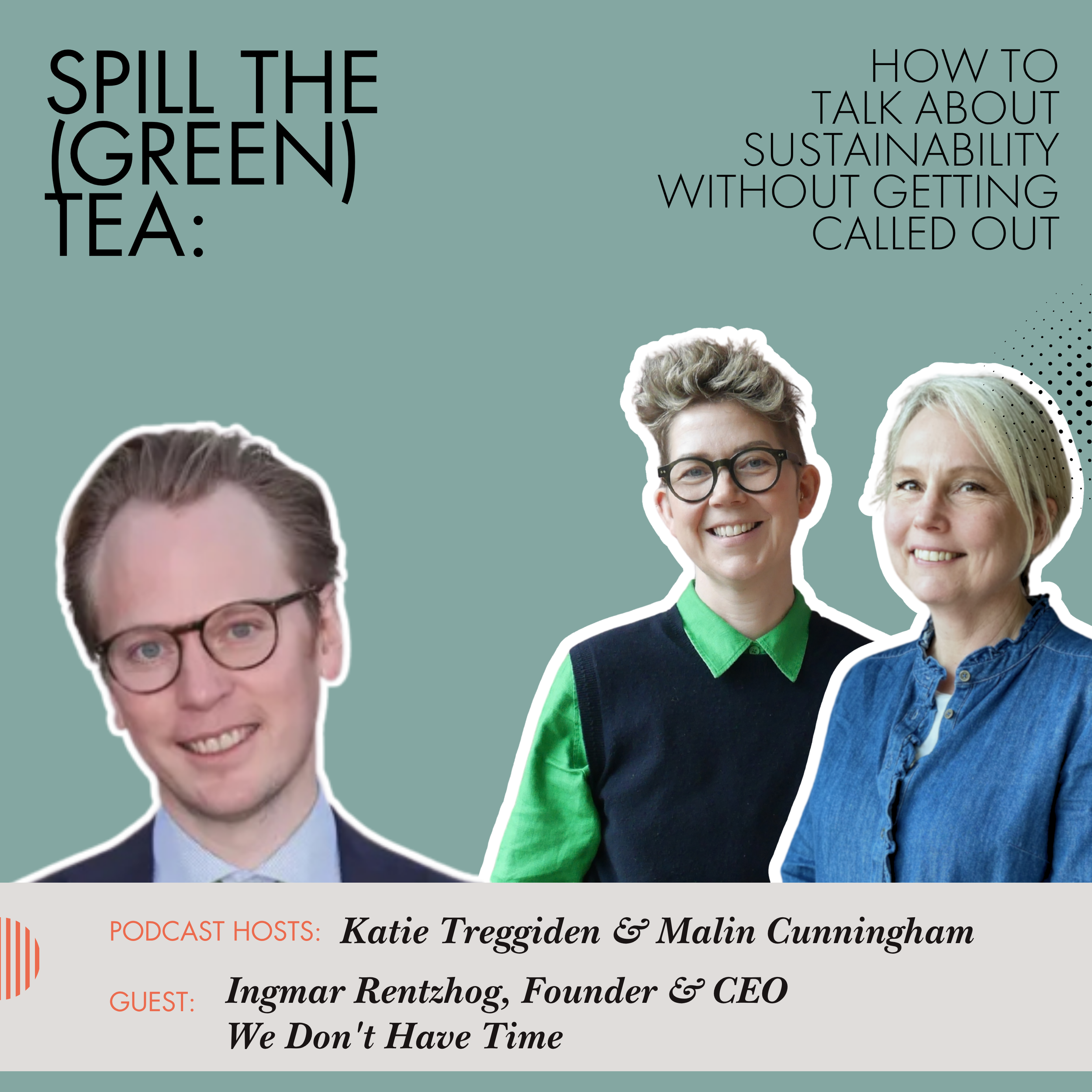
This is an auto-generated transcript that has not been edited or proofread and therefore may contain errors.
Malin Cunningham
Welcome to Spill the Green Tea, the podcast where we dive into perhaps the most controversial part of sustainability, how to talk about it.
Katie Treggiden
That's right, we're exploring how to talk about your eco-efforts without getting called out. Join us for straight-talking, behind-the-scenes insights and practical takeaways that will help you gather the courage to shine your light in these volatile, uncertain, complex and ambiguous times.
Malin Cunningham
It's a serious topic and we don't shy away from that, but we will bring you uplifting, positive and pragmatic conversations with brilliant guests and in-depth discussions between the two of us, all to give you the confidence to talk about your imperfect efforts towards genuine sustainability.
Katie Treggiden
Because it's not just showing off, sharing your progress helps you connect with clients and customers and inspire others to be more open about where they are on their journey. We need your stories now more than ever.
Ingmar Rentzhog
And if you see all those stats, you understand that the people profiting from oil are very desperate and that's why they attack scientists. So standing up for science means that you're standing up for climate and the future and that resonates a lot with people.
Malin Cunningham
Welcome to this episode of Spill the Green Tea. This time Katie and I are speaking to fellow Swede Ingmar Rentzhog, who spent the last decade trying to fix what he sees as the real bottleneck in climate action, communications. He's the founder of We Don't Have Time, a global media platform for climate action, and he's also behind the Make Science Great Again campaign and the soon-to-launch WSocial platform.
Our conversation is centred around why communications, not technology or policy, is what's holding back the climate transition and why the comms and marketing industry might be the most under-recruited force in the movement. We also talked about the comms parallels between selling pensions and tackling climate change and why Ingmar is backing the launch of a new social media platform based in Europe. Ingmar is a real powerhouse in the climate movement and we covered a lot of ground in this podcast.
Can't wait to hear your thoughts. Here we go.
Katie Treggiden
Thank you so much for coming on the podcast, Ingmar. It's great to have you here. We champion progress over perfection on this podcast so we always start with the same question and that is asking for an eco-confession.
What is something that you do that perhaps might not seem super sustainable and why?
Ingmar Rentzhog
Everything. By living in a society that is not sustainable. I mean the way we are used to roads, my kids go to school, etc. It's not sustainable how the society are set up so that's the wrongdoing I do every day.
It's not a choice because I'm born into this society but it's a choice to be passive and I try to be as active as possible to change this society every single day but many times I feel that I should and could do more actually so that's one way to see it. Another way to see it is those simple things like you know that you could have done better and I mean I'm recycling things of course but sometimes I'm cheating and throwing away something in the wrong bin.
Malin Cunningham
Yes, don't we all you know one of the reasons that we were really keen to talk to you because you know our audience are primarily sort of in marketing and comms is the fact that you've got this interesting past in finance communications or PR and you talk about how sort of selling or explain the concept of getting people interested in pensions and you know the same for the climate challenge. There are some real sort of similarities between the two. Could you expand on that a little bit please?
Ingmar Rentzhog
Yes, so my background before I started to focus on the climate and sustainability I was running a financial communication firm so communication has been my professional career and that is what I really like to do and when I worked in finance we had so many companies, insurance companies, banks, fund managers, public-traded companies that we were helping and the biggest similarities I will say when it comes to get people engaged in something is when you are actually saving money for your pension.
That's a choice you do today that will affect your future self 20, 30, 40 years in the future and you can think of if I will ask someone communicate to someone that if you do this choice you just swap pension provider from one company to another that will make that you will have 10% more every month to live with. You will think that that person will take the effort to fill out some forms and maybe have a meeting because that's often the time they need to invest to do to change a pension provider but many many people are not willing to do that because they simply have a hard time to invest in their future self. They understand it intellectually but they don't prioritise it and it's the same thing with climate.
We know what to do but we are not prioritising it because we are not engaged in the future self. So interesting there is some research in this topic where researchers can see that people have very low empathy with their future self. People have a members, friends, people they care about, even dogs and cats but when they compare the empathy they have with all those other people and dogs and cats with the future self they always almost have future self less.
They don't care. They are not kind to themselves in the future. So how can you unlock this?
By communicating smart to get people to understand that maybe you should care about future self and paint a picture of how much better the future self will live tomorrow if they do the choices today etc. So communication is key to get someone to change pension provider. Communication is key to get someone to care about the climate because that's caring about the future.
Katie Treggiden
I love that idea of having empathy with your future self and the idea that we have more empathy for our dog than for our future self is wild. Yeah my husband and I kind of joke about oh I'll make the pat lunches for tomorrow and do a favour for future me or kind of yay past me emptied the dishwasher yesterday and that's like a day apart and we're sort of joking about having empathy with tomorrow's version of ourselves let alone 20 years future self. So I love that idea.
Really inspiring I think for thinking about how to do comms that you're kind of trying to get your target audience to connect with a different version of themselves. You founded We Don't Have Time 10 years ago in 2016 which for those who haven't come across it is a media platform specifically for climate action and we'll pop a link in the show notes. Can you tell us what inspired you to set it up, why that name and what impact it's had since 2016?
Ingmar Rentzhog
So short answer Donald Trump was the man who inspired me to set up We Don't Have Time and that was at least what what kept me doing it but it was not the only reason. I think it was it started when I became a father. I now have three children and my daughter is turning 14 on Saturday so on Sunday.
So it was 14 years ago I think my yarn is down into this. I started to think about the future and as I said earlier I didn't care so much about the future when I was thinking about my future but I cared a lot more when I was starting to think about my daughter's future and when I did that I started to read about the climate and I suddenly I became very concerned that what I read was not what people in my day-to-day life in finance were aware of. I mean of course everyone knows about you know global warming and things like that but it's always been a distant problem for someone else to solve in generations.
But I started to read and you know how social media works when you read in a topic suddenly everything in your feed or feeding you with more and more and more and I was kind of shocked how can people just don't know about this and why are not people caring about it. So I was in a process where I was learning a lot more but I didn't do anything about it until Donald Trump won that US election. On the same day when I saw this victory speech I was realising one thing.
People are not caring about the climate because they don't know about the topic enough. Leaders are not doing anything about it and Donald Trump were the first world leader that were honest saying he doesn't care about it. Other world leaders were pretending but not doing near enough.
So my realisation was very simple. Leaders are not acting. People are sleeping.
We need another leadership. We need to wake the people and we need to take this under our own hands and communication is key to get people on because we have the solutions. We know the problem.
That's not what we need to fix. We need to fix so that more people are engaged in this and that we get another leadership. So that was a starting point and I was thinking what can I mean we need to solve this globally.
It's not a local problem and social media at that time you had this Arabic spring. You had a need to movement so you had a lot of things going on that were triggered through social media and I saw that the climate issue were never discussed in a good way on social media because it always ended up in are you believing in climate or not like this polarisation thing. So I saw there was a need for another platform that were treating those issues more fairly and the day after I woke up and I had a name we don't have time in my head and I googled it and no one were actually using it for anything so I registered we don't have time dot org and a couple of days later I met a childhood friend for dinner and he was the first person I told about this crazy idea that why shouldn't we build a platform to mobilise people and the name for that platform is we don't have time and instead of saying that's a crazy idea he said let's do it together and he's now my co-founder David also.
Katie Treggiden
Amazing.
Ingmar Rentzhog
So that's how it started.
Katie Treggiden
What impact do you think it's had over the last 10 years?
Ingmar Rentzhog
That's a very odd question actually because when you work in climate and sustainability everyone asks what is your impact and if you're running a startup saving water because you have a better innovation or you're selling electric cars or solar panels you can measure number how much water you have saved or how much energy that is now renewable instead of fossil base etc but when you work in communication it's very hard to measure your influence. I mean of course we can measure how many people we are reaching but that's not the whole story because the people you reach they reach people in their turn and we are very much targeting not only you know citizens but also leaders and if you can get an idea in a leader head that will have ripple effect etc so it's practically impossible to see if we have had an impact at all.
This is very hard you know some days it's kind of climate is not moving at the right direction not fast enough am I even contributing is it meaningful but other days you feel like you're at the top of the world and that what you do is really making changing things for real and that's when you look back maybe and you see if we wouldn't have been there doing that it would probably turn out differently because some things in our life or things that can go either way and I don't know exactly how to measure this really but I mean maybe one example right now my co-founder David Olson is on his way to Santa Marta in Colombia because in Colombia there will be the world's first international conference for phasing out fossil fuels that has never been on the table for the climate UN COP meetings so Colombia and Netherlands took the initiative to host this initiative for the coalition of the willing and 54 countries are participating and we don't have time we have been assigned to help the Colombia government so we are the media platform for this conference the only global media platform helping this conference so we at least they had the confidence to let us do that job but if I look back I think that if we will not have started 10 years ago maybe there will be no conference at all I don't know but I mean it's it's like saying that I'm behind everything of course I'm not I'm just one person and one organisation that are doing things for real and we're doing it together with others and the more people doing that the louder we become and we have at least become loud enough so that we will now have a fossil fuel phase out conference if our if we will not be in there maybe that will be loud enough to make that happen anyway or that will be just the level where it wouldn't be loud enough what I'm saying is we've probably been part of it.
Katie Treggiden
I think that's I think that's a feeling that many of our listeners will share because I think when you work in comms what you're doing is always part of the change it's not the end of it where something actually changes and there's a lovely model which I will share in the show notes called the Burkina Institute two loops model and it shows a declining system and an emerging system and all the different roles on both of those systems and one of them is the role of people who connect people who bring people doing interesting things together and I think that's definitely what you're doing with We Don't Have Time is kind of holding the space for those conversations and for those people to connect so it's really important work but I'll share that model in the show notes because I think it can help folks to see what their role is and how they are making an impact as you say even if it's not measurable in gallons of water or whatever it is.
Ingmar Rentzhog
Yes so my conclusion I don't know how big part we played in it I actually don't care because I know that everyone that contributed didn't play an important role and what I also know it was not that many people it's not many people active pushing for a change on an international level but those of us that are actually doing that are making a big difference so if we just can recruit 10 more people 100 more people that can have the tipping point that things are moving in the right direction so that we we are accelerating things up that means that everyone is needed.
Malin Cunningham
Yeah absolutely and we talk about that quite a lot both Katie and I deliver carbon literacy training for organisations and you know that's one of the key themes that we don't actually need everybody doesn't need to take action but you need this that tipping point isn't it you need about 20 to 25 percent of people to really drive the change for that to happen which is I think what everybody's clinging on to really.
Ingmar Rentzhog
Yeah and you don't need many fire starters in that 20-25 percent you just need a few I mean just look at someone like Greta Thunberg she was one individual but there's a lot of other individuals doing things and when we do it in a synchronicity we create waves and when you create waves that when you change things and you just need to you know do something in order to be useful for the wave creation.
Malin Cunningham
Absolutely and I think one of the big challenges and particularly at the moment which is something again that we talk about a lot is the fact that there is a feeling that things aren't happening and because people feeling like that things aren't happening they don't think that they need to do anything either there's no point but actually there is you know there is you know there is still a groundswell of stuff going on out there and you people like you and many others that are really driving these questions.
Ingmar Rentzhog
So actually you just get me my I always ask this question how do you know that I make any difference and actually I know that I make a difference because I know that there's people powerful people that wants to stop what I'm doing and also stop the full green transition and when you meet this resistance that's when you know that you're doing something that matters. So I think this phase of conference in Colombia are actually meeting a lot of resistance. I mean Donald Trump even threatened to invade Colombia a couple of weeks ago it's not a coincidence.
So when you feel the resistance that's when you know that you're on to something.
Malin Cunningham
Absolutely.
Ingmar Rentzhog
And speaking on that what I see the power the special interest of oil and their allies what they are doing now they are doing so much to get to convince people to give up. Exactly. So that we need to know what to do.
So if we are going to make it we know that we need to get people to be more hopeful. So we need to share the progress we're doing and we need to share that there's actually some people out there in their best interest to make us give up. So don't fall for that.
Malin Cunningham
Absolutely that is such an important message isn't it and really what we're trying to do with this podcast as well.
Ingmar Rentzhog
Yeah.
Malin Cunningham
And speaking of that then so the part of the pushback is obviously this alternative narrative that is very strong at the moment. There's loads of misinformation as we know. Yeah.
And which kind of leads us on then because you know the narrative has in part changed I mean it changes all the time. But it's basically you know you have launched another initiative. There are several we'll talk and cover a few more in a bit.
But the whole initiative about make science great again you know so could you just tell us a little bit about that and how that came about and you know what you're hoping to address specifically with that.
Ingmar Rentzhog
Yes. So we don't time we started when Donald Trump got elected the first time. I think that many in the space of climate action started of the same reason.
I know so many corporation CEOs and business people that way woke up and thought that we need to take leadership. So I actually believe that Donald Trump did a lot of good things for the climate issue his first time. But when he came back he has not been doing any good at all for the climate.
I mean he didn't want to do anything but that was kind of the consequence because it met this resistance from us that wants to do the right thing. This time he has changed strategy. This time he's not just don't care about climate he's actively attacking the people that do care about climate.
He's attacking the scientists. So we created we came up with a campaign to put light on this and we borrowed what he is very good at creating attention. So we took the red cap and we took the slogan make America great again and we swapped it to make science great again.
And this is a campaign we now run through time that created a lot of attention because our messaging is very very clear. On one hand we showcase all the craziness all the attacks everything from burning up climate satellites to banning burning books on science. I mean it's all crazy things going on out there to the reason why that is happening.
And the reason why that is happening is because the people in power that are giving Donald Trump money oil interest and their allies they are feeling so threatened. They are becoming desperate. So the first part of the story we show all the negative news coming out that many people start feeling like it's no point.
I give up but we twist it because the second part of the message will make science great again. That's how great science are and that's how much we're actually progressing in the clean energy transition. And if you see all those stats you understand that the people profiting from oil are very desperate and that's why they attack scientists.
So standing up for science means that you're standing up for climate and the future. And that resonates a lot with people. And it gains attention because if you're just you know nice green and correct no one cares about you.
But if you're a little bit provocative and you use a little bit humour it actually works. And that's why people vote on Donald Trump because they see him. So we need to play the same game but use it for good.
And that's what we try to do with Make Science Great Again.
Katie Treggiden
Yeah that's what I think is so brilliant about that campaign because it's a really serious message. It's strategically thought through as you've just explained that it kind of the reason it works is because of that kind of three part approach. But it's funny it's eye catching you know the use of the red caps the slogan.
Ingmar Rentzhog
We even got the Spanish prime minister suddenly he shared a video on Instagram with our cap on it.
Katie Treggiden
Amazing.
Ingmar Rentzhog
And we don't know how we got the cap.
Katie Treggiden
Amazing.
Ingmar Rentzhog
If you want this cap you can actually go to wedontime.org and search for Make Science Great Again and you can you can get one yourself.
Katie Treggiden
Brilliant. But my husband wears a red cap which looks just by coincidence because he likes the colour red but it looks alarmingly Trumpian so I might have to get him one of yours to replace it.
Ingmar Rentzhog
We also have a white version. Al Gore didn't want to have a red version so I gave a white version to him instead.
Katie Treggiden
Amazing. So you've started to answer this question but I think what's interesting about this campaign is that use of humour and that use of kind of attention grabbing tactics in a funny way are so unusual in this space. So what you've mentioned a little bit about why they work.
Why do you think no one else is doing that. Why is everyone else so serious when this this kind of cut through approach clearly is very effective.
Ingmar Rentzhog
I will say because the climate issue needs more people in marketing and comms using their skills.
Malin Cunningham
Yeah.
Ingmar Rentzhog
That's one reason. The other reason, because many people are not feeling comfortable to live outside their comfort zone and wearing a red cap. That is being outside the comfort zone for many and people in sustainability are often nice people, polite people.
So they don't want to go there because they're scared of it because that's out of their uncomfortable soul. However, there is actually a lot of some people in the climate movement that really would like to be outside their comfort zone that do climate protests like climate protest group that attack Stonehenge, for example. They love the attention or the people that, you know, disrupt a ski competition for the climate.
But that doesn't really resonate with many people. It can actually scare people away. So there's, you know, it's the polite climate people and it's the people that really wants to be super disruptive.
And this gap that I see can be filled, like make science greater and reuse humour, attacking is not many people that wants to do because the people that wants to be provocative, they often go to be too radicalised. And the people that don't like that, they are like scared away and we want to be so correct, etc. So I think it's a balancing.
There's a blank spot where you can be provocative without being too radical. I'm not saying that, you know, climate people that are really radical is not doing something that matters. It's not about that.
It's just that I think everything is needed. We need polite people. We maybe also need some really radical people to wake people up.
But there is too few people in that try to balance the polite and the disruptive things. I'm one of them. There is some others using humour as well as a very powerful weapon, but there's room for more.
So we need to recruit the comms people and the marketing people.
Katie Treggiden
Well, listeners, be recruited.
Malin Cunningham
Because it's talking to everyone, isn't it? Rather than people on the extremes.
Ingmar Rentzhog
Yeah, exactly.
Malin Cunningham
You know, it applies, you know, across the board, even, you know, we obviously talk to a lot of businesses. And even if, you know, if you're talking about, you know, the products and services that we're going to need on this transition or how businesses need to change, it's the same thing, isn't it? You know, it's finding ways of telling that story in a more compelling way, rather than, you know, making you feel like everybody has to compromise on everything all the time, you know, making it attractive rather than, you know, something you have to give up.
We'll come on to that in a bit, too. One of the things you've said is that the transition to a circular green economy is inevitable. Can you expand on that, please, for us?
Ingmar Rentzhog
Yes, because there's not unlimited resources on the planet. So, sooner or later, it will be, makes more sense to reuse the raw material instead of, you know, throw them away and dig up new ones. And I think we already see that now for the energy transition.
I mean, oil is very unreliable. You have the wars, you have all the problematic with, you know, the supply and everything. So, it's much cheaper for solar energy, it's much cheaper to store energy.
It's just uneven distributed and you still need a lot of investment to do it. But if you see all the curves, humanity, we will not use fossil fuel in the future. It's just a matter of how fast that's happening.
If you see like the raw material, unfortunately, there's a lot of raw material that we can dig up from the ground and just throw away. But in the end, that's not going to work either. And I think what we see now with the disruption of supply chains globally, it makes more sense to have, you know, used resources locally and reuse them as many times as possible.
Because if you can reuse your raw material, you're not dependent on importing them from places that maybe suddenly it's very hard to import them from. But that circular economy lies, it goes even slower, I will say. So, I have more hope that we will, that the energy transition will happen fast and we need a circular transition after that.
But I also see that if we succeed with the energy transition, that's the main thing, because we will succeed in two things. We will succeed cleaning up our energy use, that's the biggest contributor of global warming. But we will also succeed of the fund, the special interest of oil, and that special interest are currently using their profit, their money to fight us.
So, boycotting fossil fuel means that we are both emitting less, polluting less, that's good. But the best part, we are not funding the power fighting us.
Katie Treggiden
Yeah, that's so interesting.
Ingmar Rentzhog
If we remove that power, fixing everything else in sustainability will be so much easier. But of course, you will have resistance around, I mean, you will have a lot of resistance around change because if you do things in a new way, you challenge power. But the fossil fuel power is so special because they have so much money.
So, they are so hard to challenge. But that is what's happening now. They're feeling challenged.
And what we need to do is to keep going, keep pushing, and keep people to understand that the reason we're not changing is not because people don't want to change, it's because we're getting thought that people fight us.
Katie Treggiden
Yeah, yeah, that's so interesting. I love that idea of kind of boycotting not only the fuel, but also the money and the power.
Ingmar Rentzhog
Yeah, actually, I have a campaign in the making, I can reveal it for you for the first external. And I think this is maybe something that we are going to do after this fossil fuel conference in Colombia next week. Because we need to mobilise a lot of people to embrace that.
And I think one good thing to embrace that we need to start boycotting not fossil fuel, we need to do that, but we need to boycott fossil power. And how are you doing to boycott fossil power? By not using their product, and by not giving them power.
And if you stop buying the product, you actually achieve both. And I think there's a potential to create a global movement that boycott fossil power to get people understand that the most efficient thing they can do is to boycott fossil power. And it's very easy to do that.
You can just change. I mean, you don't need to buy a new car. If you have a fossil car, you can just change the fuel to renewable fuel.
It's not perfect for climate, but you're not giving your money to the power fighting you, you're boycotting fossil power. So if I would like to dream, I will dream about a global movement by boycott fossil power, as the same thing we did with apartheid in South Africa. It was not the only thing that helped, but a global boycott campaign towards the regime in South Africa helped remove apartheid.
So I think we should learn from that. And that is not doing a disruptive protest on a ski competition. I think this is much more powerful.
Stop using their product, stop giving them the power. And to go further, I want to give an example of how absurd our society are working today. I try to share this on social media, but the algorithms are making it invisible.
I mean, normally on LinkedIn, for example, I get hundreds of hundreds of thousands of reach. I'm one of Sweden's biggest influencers. When I shared this this morning, I got 14 likes.
So something is going on there. So what I shared about is the fact that yesterday, the European Union gave Ukraine a loan of 90 billion euro to fight Russia. And this loan was stopped by the government of Hungary, because they wanted to get oil from an oil pipeline that goes through Ukraine from Russia.
And the oil had stopped flowing because Russia had bombed the pipeline. So they said to Ukraine, you need to fix the pipeline. Otherwise, we will block the loan from European Union to you.
So Ukraine had no choice. They fixed the pipeline. And now Ukraine got 90 billion euro to fight Russia, that got a lot of money from selling oil to Europe to fight Ukraine.
Do you see the absurdity? This power needs to be boycotted. I think it's very hard for Ukraine to boycott it, because they are at war.
But if you are standing there at pump, and you're filling up your car with that shitty oil, you're part of the problem. You can change that. It isn't that hard because you don't need to stop using a car.
You just need to buy a slightly more expensive fuel that is renewable.
Katie Treggiden
Yeah, and I think that's so interesting, because I think one of the biggest barriers for kind of individual action is people feel so overwhelmed, because there's so many things that they have to do. As you said in the beginning, what are you feeling sorry for, Yeah, but I can remember even as a little girl, checking apples in the supermarket to see if they had a made in South Africa, you know, grown in South Africa sticker. So, you know, even as a little girl, I understood that boycott.
But talking about these messages being suppressed on social media channels, you are also launching a new social media channel, being the multi-hyphenate entrepreneur that you are, called Wsocial. So I would love to know, firstly, does the world need another social media channel? And secondly, I'm assuming your answer is going to be yes.
If so, what's different about this one? Why is Wsocial going to change things?
Ingmar Rentzhog
Yes, and first, it's not me doing everything. I'm part of it. It's a lot of people involved in this new social media, Wsocial.
I think it's super needed, because my conclusion, as long as we are not getting out the information, as I just told you, we will not be able to mobilise enough number of people. We need to have facts shared. And if it's suppressed, it will be impossible.
It's also that we're drowning currently in AI-flooded disinformation. That means that social media is starting to fail. And that's why we need a new one.
It's so easy to use AI to pretend you're a human person. And you can flood the system with people with strange opinions, etc. It's very hard to know what to trust on social media.
So the reason we need a new social media is that the current ones, they are run either by China or US. And those countries are not good at democracy. The US used to be at least much, much better on democracy, but today they are sliding doors down the road.
So we need social media that have democracy as governance at core. But we also need social media that difference people from AI and bots. So what's special with WSocial, besides being governed and hosted in Europe by European servers that are not controlled by US companies or government, you also need to prove that you're a human being to be able to engage in this platform.
So all users need to verify that they are humans by showing their ID to get access. And we have a very sophisticated technology to do that, that you can scan your passport without revealing that information to W. It stays on your device.
We don't have the information. We don't want information because we can be hacked. It's on your device and you're in control if you want to share your full name, or if you want to still be anonymous when you're posting on social media.
But regardless, we know that you're a human being.
Katie Treggiden
And can people sign up now? Is it ready?
Ingmar Rentzhog
It's ready. We have a community using it, but we are streaming in things. So we are letting in people more and more.
And there's a wait list. If you go to WSocial.eu, you can put your name on the wait list and you can reserve your handle and we will let you in in the coming weeks and months. Actually, we're going to launch this as a public beta where we will let a lot more people in on June 17.
Katie Treggiden
Amazing. We will pop the link in the show notes.
Malin Cunningham
Yeah, I'm on the list. I'm still waiting.
Ingmar Rentzhog
You need to have some patience.
Malin Cunningham
Yes, that's okay. It's not my best trait, but there you go. One more question about comms then.
So obviously, it's really hard to navigate all of this if you're in sustainability and you're doing comms. And we have all of these things we just talked about. What advice would you give to people to help them tackle these issues?
Ingmar Rentzhog
I will say if you're working in comms and sustainability, you need to do one thing and you should do another thing. You should do both. What you need to do, you need to communicate your climate action, your sustainability, your targets, your ambition as transparent and honest as possible.
And this is also very similar to financial communication. If you're helping a public traded company to communicate to the investor market, in order to do that in a good way, you need to tell that company to communicate as honest as possible to build trust. All investors want that their shares will give them return of investment.
But you can't just give them return of investment by saying that they're going to get a lot of money. You need to have a plan to make it happen. And investors will stay on your company, believe in your company if you're trustworthy, communicate your flaws, why you're making a loss today, but what the plan is to make a profit in the future.
And the same thing goes to sustainability. If you're working in comms and sustainability, don't be afraid to say that actually you're not sustainable at all today. Just be transparent and have a trustworthy, realistic plan on how to improve.
If you have honest intentions and if you communicate progress, but you do it in an honest, transparent way, you will build trust. And if you build trust, people will believe in you even if you're not doing it perfectly. So that's my advice to do good sustainability communication.
And unfortunately, many companies react that we're not so good at this, let's not say anything at all. That's not a good strategy. It will not work in them because people will not trust you.
But maybe it's better to do that than being the bragging shit that say we are the best in the world and it doesn't work. It won't deliver. I think both of those strategies are a failed strategy.
You should be as transparent and honest as possible. The other thing, that's what you should do. And that's to show courage.
And we must acknowledge one thing. As individuals, we will never be able to fix the climate crisis alone. Doesn't say that we shouldn't do as much as we can to lead by example, to do the best we can and inspire our neighbour to do the same.
Same thing is true with a company. It doesn't matter if your company are doing everything right, if your competitor are doing everything wrong. But it matters if you lead by example and maybe some other people will look up to you and try to do that.
But it will still not be enough. You need to do another thing as well. You need to use your voice.
And here's the thing. If you're a private individual, it's very hard to use your voice if you don't have a platform. I mean, people really don't listen.
People will listen to you, but you will not reach as many. But if you're representing a big company, politicians are listening to you, people are listening to you, competitors are listening to you, policymakers are listening to you. So voices from companies can be extremely powerful.
I mean, I'm from Sweden, for example. We have 10 million citizens. That's a lot of people.
But some of the big companies that are Swedish like IKEA, I think they have 2 billion customers. So, I mean, if you see the Swedish climate minister or the CEO of IKEA, who do you think influenced the most? Yeah, easy.
So if you're working for communication in a big company, what you communicate matters. So you need to step up and say that we want the policymakers to do this. And like an example, Volvo, Volvo cars, they are actually behind that European Union have banned the fossil fuel combustion engine.
But now that they were the ones pushing for it. As a car manufacturer producing fossil powered engines still, but they don't see any future in it. So they took and standed up for it.
Now, a lot of their competitors are doing the opposite. They are telling the legislator in Brussels to give up on this new regulation. So they are using their voice in the opposite direction.
And here's the thing. Those German car manufacturers, they might have good sustainability action, as good as other car manufacturers. But if their communication, if their leadership communication are using their voice to slow down change, they are on the wrong side of history, regardless.
So it's not only about what you do. It's about what you are standing up for, raising your voice, saying that I don't believe in apartheid. That matters.
And the same thing with climate. But of course, if you're not doing anything for climate, and the only thing you say, politicans need to change. You're not trustworthy at all.
So you need to do both.
Katie Treggiden
Fantastic advice. Thank you. I think that's going to give people a lot to think about.
Zooming out a little bit, what's one thing that you think was different about the conversation around sustainability at the moment? How do you wish people were talking about this stuff differently?
Ingmar Rentzhog
Actually, I feel that something is changing in a positive way right now. If you will have asked that question, like half a year ago, I will say that people are afraid of talking about climate, people are afraid of talking about those things, because they have been politicised. And a lot of corporate leaders are kind of turning down their voice.
There's even those companies, a lot of US companies that are removing the word climate from the webpage because they are afraid of the White House. And they're still doing some actions that they are, you know, just keeping silent on it. But now I see a shift in climate, and that's because the war in Iran, where it suddenly is so clear that it's so stupid to be dependent on fossil fuel.
So more and more people are actually stepping up and saying, hey, maybe we should change the energy system. And it's not about climate anymore. It's about the economy, it's about everything.
And that's really what it is about. So I'm more optimistic that we are going to see more honest conversations out there from company leaders. But there is also some that shy away.
And we need to call those shying away out. Just because you're silent, doesn't mean that you shouldn't be called out. And here is something I want to criticise the climate movement.
There is this big discussion about greenwashing. And greenwashing is always a discussion happening if a company is doing something. You don't see a greenwashing debate around a company doing nothing.
And that means that if you do something, you get penalised from the people fighting you, the oil interest. But you will also get penalised from within the climate movement. So what I hope is doing, what needs to be doing differently, is not corporates communicating in a totally different way.
It's the climate movement itself. We need to stop criticising each other and instead help each other. If you see a company that is doing greenwashing, most of the times they're not doing it deliberately.
They're doing it because they don't have thought things through or the comms are doing one thing, sustainability and other things. Help them instead of criticising them openly. Reach out to them and say maybe they didn't think this through.
We need to help each other to fight the real enemy. And the real enemy is the fossil fuel special interest fighting us every day and laughing when we are divided.
Katie Treggiden
There's a lovely phrase, instead of calling out, you can call in. And I think that's just a lovely distinction. I'm not going to call you out, I'm going to call you in.
It's where someone has sent me a DM on Instagram or sent me an email and gone, Katie, that post you just put out, I know you've got good values, so I'm guessing, you know, I just need to educate you a little. And I'm so grateful for the people who've done that. For me, it's helped me to get better and mostly around kind of social justice rather than environmentalism because it's something I know less about.
But I'm so grateful to those people who are brave enough to kind of risk me getting angry with them by going, uh, I don't think that's, you know, the kind of impression you meant to give. So let me educate you a little bit. And it's, uh, yeah, it's a really powerful and collaborative move, I think, to call people in when you know their intentions are genuine.
There are certainly big companies who need calling out.
Ingmar Rentzhog
Yeah, yeah, absolutely. But we should, when we call out companies and leaders, we should not only focus on the ones doing things, we should also focus on the ones that try to stay below the radar. They are often the ones that needs to be criticised most.
Malin Cunningham
Yeah, yeah, no, absolutely. Right. So come to quickfire round.
So just a quick few questions. The first one, and I'm sure we know how you're going to answer to this one. But the first one is, hope, is it a cop out?
Or is it vital?
Ingmar Rentzhog
I will say, without hope, how will people motivate themselves to keep going? And without action, no hope. So we need a lot of hope.
But we don't need stupid hope. We need fact based hope. And there's a lot of positive facts out there that people don't know about.
So let's focus on those facts. And let's focus on the action. We need a lot of hope, but we need a lot of action as well.
Yeah, absolutely. There's, I mean, I would like to say like this, if you are a go, if you are an athlete, that is going to win a race. Every athlete, every sportsman knows one thing, you will not win that race if you don't believe you will win.
If you don't believe in hope, you will never solve climate crisis.
Malin Cunningham
Oh, well said. Amazing. And what book is on your nightstand at the moment?
Ingmar Rentzhog
I work a lot, so I don't have as much time to read books. But I actually have a book from an old colleague of mine since I worked in finance that made a fantastic career in investment banking, one of the biggest, most influential investment bank in London. She was brilliant.
I was not surprised at all. But mid-career, she actually had enough because she wanted to do something else. So she become an author instead.
So I'm reading her book right now.
Katie Treggiden
What is the name of the book and what's her name?
Ingmar Rentzhog
The author name is Gina Sakkusson. It's a Swedish author that worked in a big investment bank and had enough. There is something bigger for life than just work for banking.
So I'm a big fan of her books.
Katie Treggiden
Amazing. We will link to that one in the show notes.
Ingmar Rentzhog
But it's a Swedish book, so it's not in translation.
Katie Treggiden
I'm sure we have some Swedish listeners. Yes, we will.
Ingmar Rentzhog
And I can just add something. For some reason, people are sending me so many books in China. It can be because they want me to write about them so that they get more readers.
Unfortunately, when I'm not working, I'm not that super keen to read a book about that the world will end. Most of those books, they're beautiful, very good, etc. But they're always about the negative stuff.
I know that. If you want to send me a book in climate, send me a book about solutions at least. So I have a big library with climate books I haven't read actually.
Of course, I'm thankful for people sending books. We need more books giving hope. That's for sure.
Malin Cunningham
Yeah, definitely. I think we're all in the same boat in that one.
Ingmar Rentzhog
But I mean, those people that are not yet in the climate, they need to read those books about the negative facts as well. But when you have read like 10 of those, you know the problem. If you get too high doses of that, it can be too much of the negativity.
Malin Cunningham
Yeah, it can be hard to climb out of that hole afterwards. Can you give us an example of great sustainability comms that you've seen lately? So ticking some of the boxes you were talking about before, perhaps?
Ingmar Rentzhog
Yes, I will say the National Emergency Briefing in UK. That's an initiative from some private individuals that get fed up that the leaders in UK and elsewhere were not understanding the risk of climate. So they created this brilliant event where they got the leading scientists and the parliamentarians in UK in the same room.
And they educated the leaders. And it really, I mean, everyone there were really affected, no matter the political affiliation. Because they did something brilliant.
They did not talk about it as an international thing. They talked about it as a national security thing. So they have an expert in food crisis, how will the climate impact food, security, transport, whatever.
So that really hit home. But they didn't stop there. They were also brilliantly recording this and also making an after recording.
So for the general public. So right now there is hundreds of cinemas in UK. We have local organisers inviting people to digest those facts.
And I think this is so brilliant communication. But I have one thing I would like to add if I will do the same. And I'm actually thinking of, you know, doing this in other countries as well, because I think it was so brilliant thought through.
They didn't have enough hope and progress. It was a little bit too much on the negative news. I will not say that shouldn't be shared.
But they can also educate around the solutions more to balance it up a little bit because people don't really know how fast we're progressing on the positive side. So that's the only thing I see room for improvement. But overall, that campaign, national emergency briefing, Google it if you listen to this.
It's also very relevant if you don't live in UK. Brilliant campaign.
Malin Cunningham
Yeah, absolutely. We'll definitely share that in the show notes. And like you say, they're happening now as in April, May, I think even into June here in the UK.
So it's amazing.
Ingmar Rentzhog
Yeah. And the same people behind this national emergency briefing, they also have done something else brilliant. They have recorded leading scientists that they have a comedian translating into normal language.
And those are really educated videos and also very fun.
Malin Cunningham
Excellent. Again, we will share them.
Ingmar Rentzhog
Those are people knowing comms, getting into the climate and I see directly, wow, that was really powerful. So again, if you're working communication, the climate movement needs you. Your future self needs you to spend time on doing your job for your future, not only for your paying clients.
Malin Cunningham
Well said. And Kate, do you think looking at positive stories and did you have an example as well?
Katie Treggiden
Yeah. So guests keep mentioning Patagonia's 2025 impact report as an example of good comms on the podcast.
Ingmar Rentzhog
I don't agree.
Katie Treggiden
You don't?
Ingmar Rentzhog
No, I'm telling you a little bit.
Katie Treggiden
OK, tell us, tell us, tell us why you don't think it was good.
Ingmar Rentzhog
You lost me in the word report. A report is something you read if you're interested in what a company do. If I am interested in Patagonia sustainability, I don't need a report that is funny.
I need Patagonia to do a campaign in the United States, changing the political climate. And I know they are too afraid doing that. That is what they should invest in.
Katie Treggiden
That was your point about the difference between using your voice to bring about systemic change. Yeah. Interesting.
Ingmar Rentzhog
And yes, Patagonia are doing many, many good things. I don't want to call them out, but I want to challenge them.
Katie Treggiden
Yeah. Well, we talked in episode three about the three C's frameworks that Malin and I both used. And I have developed something called a credible comms audit out of mine.
And obviously, Patagonia have to produce these reports as part of their B Corp status. So what I thought I'd do is run the Patagonia impact report through my credible comms audit to see what I found. And I won't go into lots and lots of detail, but I thought there were a couple of things that were quite interesting.
And if you haven't listened to episode three, go back and listen to it. One is that we talk about communicating progress rather than communicating goals or waiting until you've got everything perfect. I mean, they've called the report work in progress.
So they're definitely.
Ingmar Rentzhog
I love that. I mean, I haven't read. I have actually not read the report.
I'm just saying the communication can't stay in the report.
Katie Treggiden
Completely agree. There was a lovely quote in the intro from Yvonne who said the fear of getting things wrong in the process cannot stop us from getting things right in the end, which I thought was a nice articulation of that.
Ingmar Rentzhog
That's very good comms, I agree.
Katie Treggiden
Yeah, I thought that was a nice articulation.
Ingmar Rentzhog
Now I'm getting some bad consonants to criticise them, but I think your point is valid.
Katie Treggiden
We also talk about transparency and kind of sharing your workings with external validators. And they've shared nine external standards and industry organisations who audit their sustainability actions, along with wholesale partner requests, NGO organisations and the regulatory audits they go through in California. And they're also advocating for mandatory reporting across the board on sustainability.
So that is somewhere where they're advocating for changing the system, I guess. And they also talk about the goals that they haven't met and why and what they're doing about it. So to your point about financial comms, Aymara, well, if you're not making a profit, people can handle that as long as you explain why and what you're doing about it.
That is something they're applying to sustainability. One of the other parts of my credible comms framework is to be specific. And this is the level of specificity they get into in this report.
And this is very much for those who are already interested, is that they have hit 6% against a target of 50% for their synthetics to be made of secondary waste. So currently 80% are recycled, but are made mostly from single-use plastic bottles. And they want to move away from that towards second.
And I just love the level of granularity they're getting into. It's not enough just to say, yeah, yeah, it's recycled. It's that level of granularity.
But what I also thought was interesting was having signed up for the report. I'm obviously now on their email list. And the first email I got after downloading the report was selling me a product.
And I was just like, interesting. I don't really need another jacket right now.
Ingmar Rentzhog
But if you can't make money by being sustainable.
Katie Treggiden
Yeah. And then, you know, they say that in the report, they acknowledge that duality. But interestingly, the next email I got from them just this morning, allowed me to set my preferences and say, actually, I don't want to hear about your products.
I just want to hear about, you know, surfing or environmental, whatever it is. So I thought, again, that was very smart communications was straight up saying what and also I could set whether I wanted to hear from them daily, weekly or monthly. So I thought that was very smart in terms of giving me some control over the dialogue that I'm having with them.
So yeah, it was an interesting, I'm going to dig into that in a lot more detail.
Katie Treggiden
Thank you so much, Ingmar. So much in there. And it's nice to see how much chimed with previous episodes and conversations we're having, but also how much was different and new.
Ingmar Rentzhog
So let's keep the hope up. Thanks.
Malin Cunningham
Yeah, definitely. Thank you so much.
Katie Treggiden
Thank you, Ingmar.
Katie Treggiden
We have been Katie Treggiden and Malin Cunningham, and this has been Spill the Green Tea. Please leave us a review and share this episode with anyone you think might find it helpful. And let's get people talking about this stuff.
Malin Cunningham
Thank you my co-host, author, journalist and consultant, Katie Tregidden. Katie is on a mission to share true stories of imperfect progress towards genuine sustainability, and to help purpose-driven brands talk about their eco-efforts for clarity, credibility and confidence. Katie has a brilliant resource called Green, Not Greenwashed, that will help you do just that.
You can find a link in the show notes.
Katie Treggiden
And thank you to my co-host, Malin Cunningham is the founder of B2B comms consultancy, Hattrick. They help businesses build commercial credibility and a competitive edge through standout PR, thought leadership and carbon literacy training. And Malin has a fantastic guide for sales and marketing professionals called Green or Greenwashed?
Great minds think alike, what can I say? And you can find a link to that in the show notes too.
Malin Cunningham
And a final thank you to all our brilliant guests and to Kirsty Spain for editing and producing this and every episode.