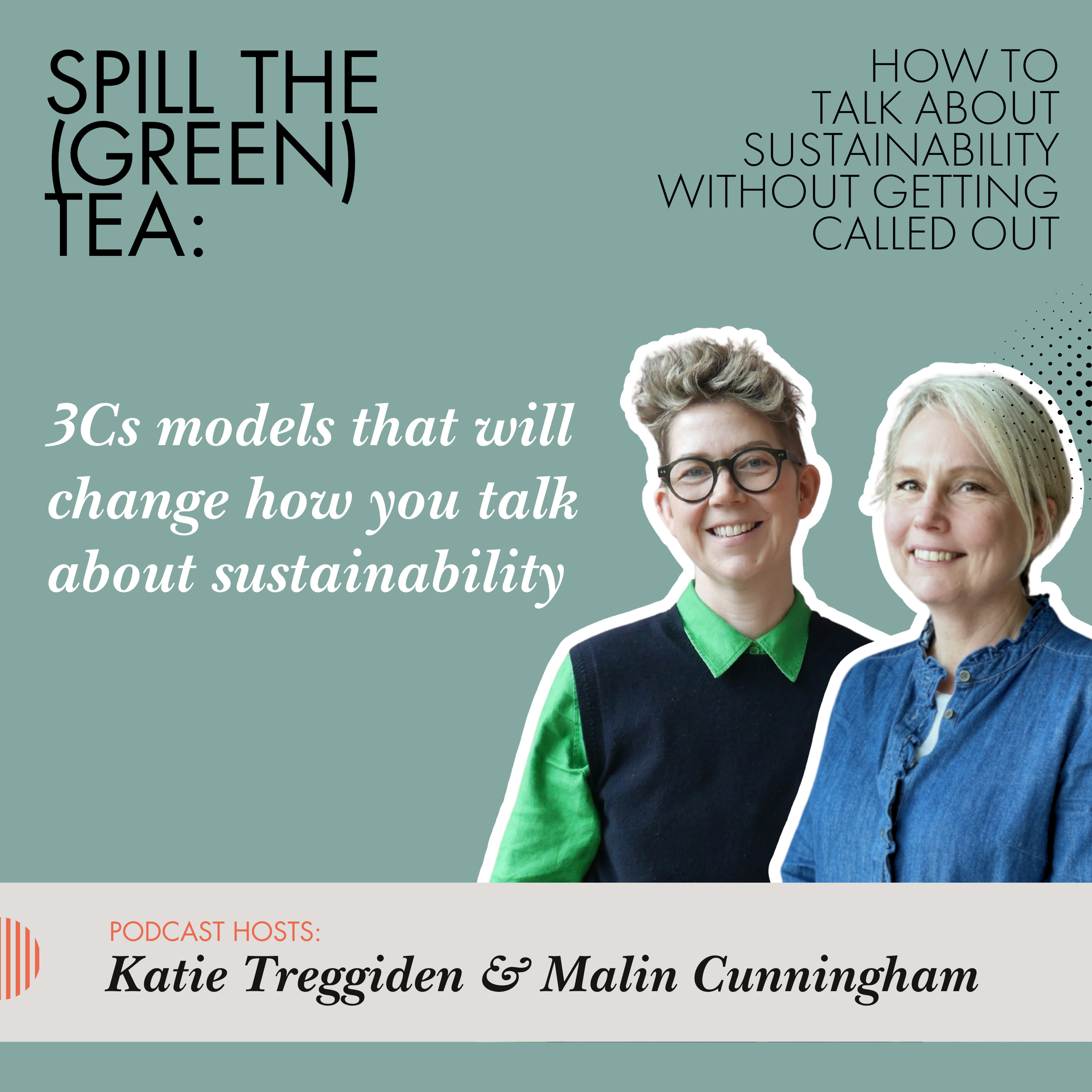
3Cs models that will change how you talk about sustainability
This is an auto-generated transcript that has not been edited or proofread and therefore may contain errors.
Malin Cunningham
Welcome to Spill the Green Tea, the podcast where we dive into perhaps the most controversial part of sustainability, how to talk about it.
Katie Treggiden
That's right, we're exploring how to talk about your eco-efforts without getting called out. Join us for straight-talking, behind-the-scenes insights and practical takeaways that will help you gather the courage to shine your light in these volatile, uncertain, complex and ambiguous times.
Malin Cunningham
It's a serious topic and we don't shy away from that, but we will bring you uplifting, positive and pragmatic conversations with brilliant guests and in-depth discussions between the two of us, all to give you the confidence to talk about your imperfect efforts towards genuine sustainability.
Katie Treggiden
Because it's not just showing off, sharing your progress helps you connect with clients and customers and inspire others to be more open about where they are on their journey. We need your stories now more than ever.
Malin Cunningham
Welcome to this episode of Spill the Green Tea. This time Katie and I are sharing our two very different but surprisingly aligned three C's frameworks for navigating sustainability comms. We're unpacking what it takes to build trust and bring audiences with you on your journey, not just to the finishing line.
In coming up you will hear why clarity and action must come before comms, how transparency builds trust and how to structure and layer your messaging so it actually works. It turned out to be a really productive conversation for the both of us. I hope it does for you too.
Happy listening.
Katie Treggiden
Today we're going to talk about frameworks. Malin and I both have three C's framework, great minds think alike, and they are slightly different ways of thinking about how to talk about sustainability without getting called out. So we're going to go all the way through Malin's first and then all the way through mine and hopefully that will give you lots of food for thought when looking at your own sustainability communications.
So Malin, as I mentioned these are both three C's models, I love how we keep doing this. And your three C's are clarity, commitment and journey and communicate transparently. So why don't you start by telling us about clarity and kind of what that means and why it's important in your framework.
Malin Cunningham
Yes, so to my framework I sort of developed that for my carbon literacy course, thinking about, so it's not just sort of communicators maybe that do the course, but it's about thinking about how the organisation talks about what it's doing. So I wanted to make the point for the first bit that businesses need to have clarity about what they're doing and what they're tackling. Before they even start talking about it, right?
Yeah, exactly. So the idea is it's kind of a step, you know, always a step-by-step approach and the idea is actually that you don't start communicating until the last step is to set that up a bit. So the first bit is just sort of taking stock and being clear about what they're tackling and then for those who do have a marketing or a comms kind of role, having them think about as well what that means for the customer.
So that's only not the first step, but that's kind of like a duality there. So the first bit is thinking about what the organisation is tackling and, you know, gathering the data around that or crunch the numbers etc and then think about, okay, so why does this all matter to the customers? We're not talking to anybody at the moment, but it's thinking about what do they care about and what do they not care about?
You know, it's recognising that not everything is interesting at this stage. So it's like actually some of it is, I guess, what we would call just sort of what we would call, I guess, help content or more like background noise almost, you know. They're kind of given things that everybody needs to do.
Health and safety type content that nobody needs to know about. But you need to do it, but you don't need to talk about it. Yeah, so there's sort of hygiene factors.
Yeah, hygiene factors, that's the word I was looking for.
Katie Treggiden
Hygiene, that's it, thank you. And why is it important that there's this hot, you know, you can sort of imagine someone's raring to get going, they're in the comms department, they're listening to this podcast, they're like, right, I want to start communicating. Why is it important that they take a step back and do this clarity step first?
Malin Cunningham
I think because a lot of people are talking about this stuff, it can feel like everybody's clear already, and the conversations can be quite confusing, and then it's easy to get confused yourself. So if you don't have clarity about what you're doing and why it matters, you're not going to be able to tell a very compelling story either. So it's just sort of having those things lined up in your mind.
And some things, you know, will have a big impact in certain sectors and some things won't. So it's knowing, you know, where you're sort of playing and playing well, and where you're just ticking boxes, I guess, would be, you know, would be the explanation around that. And I guess also then having clarity around what the data is telling you.
So if you are counting and tracking things, you know, being clear on what those figures are telling you, and what matters in your bit.
Katie Treggiden
Yeah, making sure those numbers all stack up, and then and what insights are that are interesting to share. Yeah, and I think that's a really interesting distinction. Like, this is all the stuff we're doing, but which bits, you know, everybody's doing, and of course they are, and which bits are like, actually, this is differentiating, this matters to our audience, this is when we get to the communications bit, perhaps the bit that we'll focus on.
Malin Cunningham
Yeah, and I think also, this is maybe where, like, business roles split down a bit. So on the one hand, you have like a sustainability team, or a technical team, and obviously, they might be interested in different things than the comms or marketing team might be. So that it might matter to them, but actually to the comms team, you've kind of got a dual role, you need to both understand it, but also pick out what's interesting and important.
Katie Treggiden
Yeah, yeah, yeah, absolutely. So your second C is commitment and journey. Tell us about this one.
Malin Cunningham
So, you know, having have done some clarity, and hopefully got that down, and kind of moving towards this before I was talking about it, is that making sure that you understand how that plays out over time. So, okay, so this is where we are now. And this is where we're saying that we're going, you know, what does that look like over time?
How are we going to get from A to B to C? You know, how do we how do we plan that out? And that might sound really obvious.
And it kind of is obvious. But the reality is, particularly in this space, I think a lot of businesses have have set the end target before knowing how to get there. Because that's been the name of the game, hasn't it?
So we're going to be, you know, net zero by insert very ambitious date. So 2050, or 2020, 2020, not 2020, because I've gone 2030, or whatever it is, you know, that, you know, that's inspiring, potentially. But if you're not sure how to get there is, you know, you haven't really got a story to tell, I guess, just then breaking that down and working that back.
And I think quite a few businesses have got to the stage now, where they realise just how ambitious those targets are, they might not have completely comprehended that because everybody was jumping on that bandwagon at a time not to say that people shouldn't be ambitious, of course, they should. But when it comes to breaking it down, it's actually quite hard.
Katie Treggiden
And I think, you know, those are targets that are driven by planetary realities, right? We need to as a planet hit net zero by 2050. So yeah, it's very good to have that bold target.
But as you say, it's the next step is then working out, mapping out your journey, which is part of your your second sea of commitment and journey. So kind of figuring out how you're going to do that. And then you talk about tracking your progress.
So having set that ambitious goal, worked out your journey. Tell us a bit more about tracking the progress towards that bold ambition.
Malin Cunningham
Yeah, so it's seeing on a regular basis, then, you know, looking at how you're doing against the targets that you have set, essentially, and having some kind of, you know, some kind of report or, you know, some way of sharing the progress that you're making, you know, with your various stakeholders, whoever they might be, on a regular basis. So for instance, when you're a B Corp, you need to do that on an annual basis. That's one of the criteria.
But obviously, that's, you know, lots of businesses do that. And large businesses are, you know, they have to, if you have set the science based targets, that's, again, that's a criteria that you have to fulfil. So large organisations tend to have to, to do that as a matter of course.
And obviously, that can be, you know, that can be challenging in itself is a lot of work to do that. From a commerce perspective, I guess the good news is that if your mind is that way inclined, it can be really story rich, that kind of material, you know, help translating to some really exciting stuff, basically. And, you know, it's, and I think it's helping maybe sustainability teams, and, you know, depending on what the organisation looks like.
So sustainability will maybe a leadership team, bring that to life in some way. And it can be quite exciting.
Katie Treggiden
Yeah, because I think, as we talked about in our first episode, I think there's a sense of until we're doing it all perfectly, we shouldn't start talking about it. But as you say, there's some really rich stories along the way. And I think it's also a way of building trust is to sort of say, look, this is our goal.
We're not there yet. But this is where we are. And then these are the bits we're still working on.
Malin Cunningham
Yeah. And actually, I think, you know, some of the stories that come out of it, which is kind of what you're saying there is, you will, you know, some of them you will struggle to reach, and there will be breakthroughs, and there will be the opposite, you know, you'll realise, actually, this is not going to happen, you know, we have been far too ambitious for that. But telling that story is a great way of building trust, basically, saying, actually, we were just too ambitious here, we're not going to get there.
But, you know, we're working on it, and this is what we're going to do. And, you know, in the meantime, we're looking at these, you know, so it's just acknowledging where you're at.
Katie Treggiden
And I think that is, I think that's a common misconception, is that people think by admitting fault, they'll lose trust. But I think actually, that transparency is what builds trust, which brings us really nicely to your third C, which is communicate transparently. So tell us a little bit more about, about that.
So we've done all of this, we've got clarity, we've made that commitment, we figured out the journey. And now we're ready only on the third C to start communicating, which I love. And it's what does that look like?
Malin Cunningham
Yeah, so, so the first thing to say, then is, so like I said, this is part of the course, and unfortunately, I can't pronounce this guy's name, but I'm sure you can. So basically, it's the is the founder of Patagonia, and it's a very French name, and I don't know how to pronounce it. But anyway, his quote is, it is for 1% for the planet, to do good, you actually have to do something.
And it's kind of built around that. So it's like, you have to do something before you start talking about it, set ambitious targets and everything, by all means. But before, you know, it's basically saying, don't pretend, be transparent.
And actually start making some progress towards that goal before you shout about it, right? Yes, yeah. Otherwise, you know, you're not actually doing something, you know, you're just arranging words in a painful way.
So yeah, so activate before you communicate, basically. And then the transparency bit then is also, so it kind of multi-layered. So again, if we're imagining that you're in a comms role here, or a marketing role, so you have to then think about your audiences.
And terminology is really important here. So understand, you know, who your audiences are, and how much they know. And in all likelihood, you will have a range of, you know, knowledge levels, and levels of sophistication in terms of sustainability in particular.
So, you know, it's basically right-sizing it in some way, you know, getting, you know, hitting the right level in terms of how technical you can be with the content. I mean, we work a lot, we only work with B2B audiences. And on the whole, you know, they have technical teams, maybe sustainability teams, they can unpick things.
But also other, you know, other parts of organisations that don't necessarily know much at all. So it's understanding what the audience understands, and how you need to talk to them, and how much you need to explain to them. But it's also being clear about the difference between certain terms.
So, you know, when we do training, we talk a lot about the difference between net zero and carbon neutral, for instance, they're two key ones, aren't they? Or compostable and biodegradable. And there's like all of these different, and I mean, sustainable in general, I mean, there's so many terms, aren't they in this space?
And it's making sure that you're clear on what you mean by that term, and that you tell the audience what you mean by that term. So you're speaking, you know, you're speaking the same language, basically.
Katie Treggiden
Yeah, you're sort of defining your, your terms. And I think it's really interesting, because as you say, things like carbon neutral and net zero have scientific factual definitions, you have to be really careful using those correctly. But I think, as we've touched on already, and I think we'll continue to touch on throughout the podcast, the language is always changing.
So when I first came into this space, sustainability was the word we used. And again, you know, it has a UN definition, but it's it's taken on this pattern of business as usual, which is not actually what it means. But there's this idea that now we should be talking about the circular economy and regeneration, because they are more specific.
But I've certainly been in situations where my audience have got no idea what those things mean. So you have to meet them where they are and talk about sustainability, because that's the word they know, and then draw them into a conversation about how that's different from circularity, perhaps. So I think I think meeting your audience where they are and speaking in their language, and then perhaps taking them on an education journey is a really important point.
Yeah, absolutely.
Malin Cunningham
And actually, you know, from the sort of green claims code perspective, it is one of the requirements, you can't, you have to speak to them in a language they understand. I know, for instance, you know, businesses like Oatly have been called out, because, you know, they have, I think, they've just been kind of too good. So they've shared, you know, the carbon footprint of the milk, of the milk, of the oat drink, as I now have to call it, against, you know, a dairy, dairy milk.
And they've been so specific, they're actually losing most of the audience, because most people don't know what the carbon footprint of a glass of milk would be. So they haven't got anything to compare, they don't understand the context. Right.
Katie Treggiden
So that's really interesting, isn't it? But you know, what they're doing is factual, it's backed up, it's all been figured out, it's fully transparent. But because they haven't provided the context, it's kind of falling on deaf ears.
Yeah, exactly.
Malin Cunningham
So it's like, yeah, so basically, you then have to help break it down for the audience. And I think in their case, it was also because they were talking about milk as something generic, rather than specifically comparing the full fat version of each of the products, if you see what I mean. So like being really specific.
Yeah, but that's, that's the, you know, that is one key sort of dimension of the of the regulations that you need to make it, you have to write it in, in the audience's language, you have to make it easy to find the, you know, or sit behind it and explain what you what you mean by it. So, you know, proper layered communication, basically, around it, which makes it sound really onerous. But actually, it doesn't have to be, you know, for instance, you know, we work closely with the, with the anti greenwash charter.
And they have, you know, the, you know, one of the things you have to do to be a signatory, you have to put a policy in place that's publicly available. And that is part of that is a glossary. So you just have a glossary of all your terms and explanations where you talk about this, this is what you mean, etc.
And obviously, anybody can do that. And just link to it, you know, it's not, it's not, it's not that hard. And it's actually useful for the communicator anyway.
Because you then you know, you have a framework to talk around makes everything easier.
Katie Treggiden
Yeah. And I think, you know, for for whichever poor soul is in charge of the social media content, a lot of those definitions could make amazing Instagram posts in themselves. Well, exactly.
Yeah, exactly.
Malin Cunningham
And, you know, and make them, you know, fun and interactive, it doesn't sound like you might be able to, but I'm sure you can.
Katie Treggiden
Yeah, yeah. Well, I mean, they're masters at that, aren't they? They've got that brilliant tone of voice that does make things really accessible.
Yeah. Amazing. So anything that we haven't covered on your three Cs?
Do you want to kind of do a bit of a sum up before we move over to mine?
Malin Cunningham
Yeah, no, I think that's it. So this is basically about building the foundations for great communication. So it's starting having clarity about what you're tackling, and why it's interesting for your audience, you know, parks and hygiene.
You know, what is what are the commitments that you've made? And what is the journey that you're on? And once you have that in place, you can communicate transparently bringing your audience with you.
So those are kind of the foundations for starting this exciting journey. And I think from memory, I think you'll take over quite well from here.
Katie Treggiden
Yeah, yeah, it's so interesting. I've kind of heard Malin talk about these before, but not in this depth. So this has been really interesting for me, because it's kind of given it some some colour.
And there's definitely some overlaps and also some places where we differ, which I think will be really interesting to explore.
Malin Cunningham
So in fact, we're actually using the same words as well, which is which is fascinating, isn't it? So do you want to talk us through your three steps?
Katie Treggiden
So you've got clarity, credibility and confidence as your three. And again, they kind of build on each other. So clarity is what are we talking about?
Credibility is why should anybody believe us? And then confidence is kind of how do we stand behind that? How do we kind of actually stand up in a room and talk about it without our knees shaking?
And again, I think the way I've sort of built the model, clarity builds credibility and credibility builds confidence. So there's a sort of flow to them.
Malin Cunningham
Talk us through the clarity part then and what the component parts of it is.
Katie Treggiden
Yeah, so when you get to see the visual of this, it's built on what's called a genius model, which is I just love it as a visual. It looks like a three circle Venn diagram, although it doesn't function as a Venn diagram. So anybody who's particularly nerdy about Venn diagrams will get frustrated.
But it looks like a three circle Venn diagram and then each circle has kind of three pillars to it. So you've got nine things in total, which I just find very pleasing. The sort of symmetry of it.
So within clarity, you've got the law, the science and the sort of internal stuff. I need to give that a better name. Yeah, this is still a bit of a work in progress.
But yeah, essentially, it's about understanding the law. So understanding the Green Claims Code, understanding what greenwashing is, what it is and what you can and can't say. So you've sort of got this framework, understanding the science.
So Malin and I both run carbon literacy training, which I think's so important just to have that basic literacy in what is carbon, why it matters and how it's related to climate change. And it's amazing how many people I know who are absolutely literate in the carbon footprints of their products, but couldn't really articulate what carbon is and why it's important. So that kind of base understanding of the science that goes behind all of this stuff, you know, things like net zero and carbon neutral and all those sorts of things.
And then the internal values, commitments and definitions. So similar to you, Malin, kind of having internal alignment, commitment and understanding across the organisation. So what you've committed to, why you've committed to it, that being absolutely at the heart of the business and in line with the company values.
Because if the sustainability department's made a bunch of commitments, but actually the whole company is pointing in a different direction with a different set of values, that's going to cause you problems. So kind of making sure that everybody internally is on board and everything is pointing in the same direction, that it's kind of genuinely part of the business DNA.
Malin Cunningham
Yeah, that's really interesting. And I think you talked a bit about carbon literacy then as well, and how, you know, that's great foundational knowledge. I'm guessing that could be a tool for the internal bit as well, you know, like, you know, bringing people on the same page, helping people speak the same language.
Katie Treggiden
Yeah, absolutely. So I often do carbon literacy training for organisations who have a net zero commitment, for example, by 2030, by 2050, but they're not really sure what net zero means. So they're not confident talking to people about it, because, you know, they're terrified of getting questions about scope three, for example.
And I think there's so much jargon and so much language. And, you know, I come from a science background, but I think a lot of people find science intimidating. And actually, it's, it's not super complicated.
There's a, there's a lovely video that helps explain the carbon cycle, like a Tetris video, which, like a Tetris game, which is just such a, we'll pop a link to it in the show notes, because it's just such a brilliant metaphor for how this stuff works, so I think there's a lot of ways of kind of making the science accessible, so that you can kind of talk about it with confidence and credibility.
Katie Treggiden
Yeah, absolutely, and just one more thing on that, I think one of the things that we talk about a lot around that as well, is that because it can feel like, oh gosh, you're going to learn about all this terminology, and this all feels a bit heavy kind of thing, and science, the reality is actually reasonably simple, you know, there's nothing hard about it, and that video is amazing, but also it helps you ask better questions.
Do you know what I mean? You don't feel intimidated. If somebody, like, brings all of this up, you don't feel like, you don't start sweating, you just think, actually, I understand the foundations of this, and I can just ask you a few more searching questions, if you're buying stuff, for instance, or, you know, you're negotiating with somebody.
Malin Cunningham
Yeah, kind of, and digging into the supply chain, and all that sort of thing, you know exactly which questions to ask. Yeah, and on that kind of note of making it accessible, one of the other things that I do is, I'm a certified How About A Bananas facilitator, yeah, and I think you have the small 99 toolkit, which is similar, so these are kind of, like, super fun card games. If anybody remembers the sort of 70s quiz show, it's a bit like a higher or lower game, and the feedback I tend to get from that training is, it was fun, which is not something you expect when you go to learn about carbon, but yeah, I think it's super important.
So, clarity is about understanding the law, understanding the science, and understanding your internal values, commitments, and definitions. And what about credibility, then?
Katie Treggiden
Be interesting to see how this differs from what we just talked about in terms of, you know, how I defined it.
Malin Cunningham
Yeah, so I think having that clarity inherently gives you credibility, so I think that's kind of the first building block, but then the sort of three pillars under credibility are, firstly, transparency, which we've touched on a little bit, so I think transparent supply chains, kind of showing the behind the scenes, you know, showing people inside the factories, letting people see what's going on, and I also think another really important thing for transparency is those external validations, so whether it's B Corp, whether it's environmental product declarations, whether it's ISO certifications, there are lots and lots and lots of badges around. Some of them are better than others, and I think where you have a certification or a validation, that doesn't require, that doesn't involve you marking your own homework, you know, there's some sort of external validation, and increasingly those are becoming compulsory in supply chains, so kind of worth having from a business point of view, but that sort of real transparency helps to build credibility, as we've talked about. There's also something in there about proportionality, so I think focussing on why you can actually move the needle and make a big impact as a business, rather than fiddling around the edges, so I think one of the things we covered when we talked about the different types of green washing is this idea of green lighting, so kind of if you're focussing on the fact that you've got, I don't know, you've removed all the plastic from your packaging, but the thing you're selling is deeply damaging to the environment, then I think that can lose all your credibility, so just making sure that you've got that sense of proportion, and the thing you're focussing on and communicating is kind of central to your business.
Katie Treggiden
Yeah, absolutely, and I think on that as well, that just to say, as long as you recognise that, it's all right to still talk about it, isn't it, so that people don't feel like they then have to have everything sold again, but you know, so basically if you start by tackling your packaging, because actually there is so much to do with the product that you're selling that, you know, it's going to take years, maybe, then that's fine, as long as you acknowledge that, and that's the thing, isn't it?
Malin Cunningham
Yeah, and sort of communicating that proportion, so sort of saying, yeah, we've reduced the carbon footprint of this by 90%, but acknowledge it's only 10% of our overall carbon footprint. Exactly. Yeah, kind of acknowledging that proportionality, which I think is the important bit.
I've now got this little panic that proportionality is a really American word, and that should just say proportion. We'll play with this, work in progress. I'm sharing.
Yeah, and very much like you, Malin, the third point under credibility is progress, so focussing on progress over perfection, communicating the journey, and again, not doing that thing of green rinsing, which we talked about already, which is where you realise you haven't hit your targets, just coming up with a new bunch of targets, so it's having a long-term commitment to a journey, and then communicating transparently where you are on that journey, and I think, you know, as we've touched on already, that's something people tend to be a little bit afraid of, because they want to communicate the end result, but, you know, the goalposts are always moving in environmentalism, so there is very rarely an end result. Being able to sort of say, look, this is the journey we're on, this is how far we've come, this is what we still have to do, I think really builds credibility.
Katie Treggiden
Absolutely, and I also think the other side, the other part of progress, you know, obviously communicating that externally, but that's also where, you know, there is a real sense of achievement built in, potentially, you know what I mean? You are tracking how you're doing and all of the things you're doing to get there, and I mean, you know, there's something about it, isn't there? And I think, you know, when, I'm sure you'll say, when I delivered the CarbonLift training in particular, there's such an important part of it, so we don't feel stuck, you know, we feel like things are actually moving, and even, you know, even if they're moving in small steps sometimes, at least it's going in the direction that we want.
Malin Cunningham
And I think, kind of, having milestones and celebrating, achieving those milestones, rather than always just looking at that end goal, sort of, yeah, kind of celebrating along the way.
Katie Treggiden
Yes, and then the final one, then, you had confidence, which, you know, I completely missed out on mine, or hadn't, you know, hadn't thought about that one. So, yeah, give us an example of, you know, the component parts for that and how that works.
Malin Cunningham
Yeah, and I think this is just a factor of the fact that yours starts a little bit earlier in the process, but because I'm doing the writing, it kind of, inherently, goes a little bit more into the execution, and I think, you know, with a background as a journalist, this is, kind of, very much my world. So, the three pillars within confidence are specificity, layering, and tone of voice. And so, I think, I think there's two elements of specificity.
One is, I think, often where people are a little bit nervous and lack confidence, they'll chuck a phrase like, where possible, in, just to cover their arses. Yes. It's the worst thing you can do, and I've spoken to people where I know for a fact, because I've worked with them closely, that, let's say, for example, their products are 97% made of recycled materials, but they will say they're made of recycled materials where possible, which is just a get-out-of-jail-free card.
Reading that as a consumer or as a business-to-business client, you immediately smell a rat, don't you? Yeah. Whereas, even if it's not 97%, even if you say it's, sort of, it's 70% and we're still working on the other 30%, I think that sounds a lot more confident.
It gives that, sort of, it's a more grown-up conversation, isn't it? Yes. And I think the other, kind of, piece of confidence is, kind of, linked to proportionality, and it's understanding where, as a business, you can have an impact and where you just can't.
What are the things that fall within your remit as an organisation to change, and which things are systemic? And whilst you might influence them in the long term, you can't change them. I think it's really interesting hearing the founder of Fairphone speak.
He talks a lot about the fact that his tiny little organisation can't change mobile phones everywhere. He can influence them. He can, kind of, show people a different way of doing things, but he communicates the, kind of, boundaries of what is within his control.
And it was really interesting that when Nokia launched their first repairable phone, he celebrated, because he was like, cool, that's influence. That was beyond my control, but I still made it happen. So, I think understanding the difference between what's within your direct control and what's within your influence is part of specificity and, kind of, communicating specifically as an organisation, this is what we can change, so this is what we're focussing on, but we are operating within a context that, you know, and one of our guests who will be having on the podcast in future episodes is Dean Connell, who talks about building the products before the systems are ready, and so he's designed a circular furniture collection before necessarily all the systems are in place that would make what he dreams of happening possible, and we will come on to that in his episode.
Katie Treggiden
Right, so next then is what you're calling layering, and I can see something about an iceberg model, so I'm very intrigued now.
Malin Cunningham
Yeah, I have, when I teach this, I have a diagram of iceberg which helps to explain it, but essentially this comes from my training as a journalist, so, and I think very similar training in PR, is you're taught to write either articles or press releases, so you tell the whole story in the headline, you tell the whole story again in the subhead, you tell the whole story again in the first paragraph, you tell the whole story again in the first, like, paragraphs two and three, and this is because in the old days, when people laid out newspapers, it was with, kind of, little tiny metal letters that they would line up next to each other, so if they ran out of space, they would just chop the bottom off the article, so it had to make sense without whatever needed chopping off, and if they suddenly sold an ad, you know, that might steal some of the space that was supposed to be fewer articles, they might just chop off the last couple of paragraphs, so this is how journalists and PRs are taught to write press releases and newspaper articles, but the kind of brilliance of it and the helpfulness of it is you get trained into a method of being able to communicate very succinctly, so you need to be able to tell a full, honest, true story that meets all the green claims code guidelines in a few words for a headline, and then do the same thing again in a bit more detail in a subhead, and then do the same thing again in a bit more detail in your body copy, all of this is above the water on the iceberg model, right, this is the bit people see, the bit people don't see is all the substantiation, all the research you've done, all the sources that you will have cited, but kind of the whole articles that go with those sources, so you've also got this kind of below the water bit of the iceberg, which is bigger than anything that's above the water, which is your substantiation, and I think sometimes what comms departments do is they try to share all of that, and it's just too much information, it's too detailed, to your point, it's not going to land with audiences, so it's about understanding which bits to put at which layer of your messaging, so that you're always being fully transparent, but you're sharing the right amount of information, and the same thing would apply, you know, in the difference between a website, a brochure, social media post, you've got to have that substantiation, but you're not necessarily communicating everything in every place.
Katie Treggiden
No, exactly, and it's a good way of I suppose, in this context, helping readers build the story properly as well, isn't it? You know, I mean, that's another reason why it's like that, isn't it? You know, we need to hear things so many times, and I think it's fascinating now, you know, they're talking about, you know, people double screening and everything, and you're having to be more and more specific about, you know, what you're saying in a simple language, because otherwise you lose people.
Malin Cunningham
Yes, and it's interesting, if you watch TV series now, some of them are clearly written, assuming you're also looking at your phone, and if you're not looking at your phone, they feel very patronising, because it's like, I know, you just told me that! So understanding where your audience is, and how much of their engagement you have. Yeah, exactly, and then there's one more point here, I think, around tone of voice.
Yeah, so the last point under confidence is tone of voice, and of course, you know, people will often put confident in their tone of voice. For anyone who's not familiar with what a tone of voice is, I should back up a little bit. Typically, a brand will have a tone of voice developed for them, so that's kind of, if the brand was a person, how would they sound?
And you will usually have kind of five words that might be things like, you know, you might sort of describe the brand as funny, or serious, or professional, or informal. They tend to kind of, when you're creating them, you tend to have these sort of dials from one extreme to another that you play with. But I think tone of voice is really important with this stuff, because it tells the audience subconsciously whether or not you believe it yourself, and they're not going to believe it if you don't.
So hopefully, by the time you've been through all this, you are feeling confident, you are writing with a confident tone of voice, but I think there's some things to remember and think about, particularly in a situation where something's happened, where you might have been criticised, you might have been called out, something else might have happened in the news that you're feeling very reactive to. And I think the kind of points under tone of voice are, the first is to be calm and grounded, so not to kind of respond in a panic, and kind of very quick, but in a spoken voice, it would be a slower spoken voice, which I tend to get quite excited and talk quite quickly, which is terrible for a podcast, I apologise.
But it would be quite a slow voice, it would perhaps be a slightly lower voice, and obviously there are ways of sort of creating that feeling in writing as well. So it's calm and grounded, it's direct and factual, so a lot of the things we've spoken about already, it's not vague, it's specific, you know, it's informed by all of this stuff, it's understanding the bits you are talking about and the bits that are beyond your remit. And then finally, it's neither heroic nor defensive, so I think sometimes brands can get a little bit overexcited and sort of have this, we're going to save the world kind of approach.
You're probably not, you're probably going to do a tiny little bit, but equally you shouldn't shrink too much and sort of be like, oh there's nothing we can do, you know, we're only doing this little tiny thing, or kind of over-defending your position. I think it's far more confident to kind of state it once, state it clearly. So yeah, the sort of tone of voice around this stuff is calm and grounded, direct and factual, and neither heroic nor defensive.
Katie Treggiden
Yeah, it's almost like, it feels like it's always like you, you know, you confidently own it, you know where you're at, you know the journey you're on, and you know, you feel confident sharing that, so therefore that's, it's that kind of assured, you know, holding back, straight back and all of that kind of thing, without being boasting, yeah.
Malin Cunningham
It's that sort of quietly confident, self-assured, isn't it? And I think getting your voice right when you're talking about this stuff happens as a result of moving through this whole kind of three Cs model, but as the writer, and as the person creating the copy guidelines and the tone of voice, it's an important thing to bear in mind. And also something that's worth, so one of the things I do is a credible copy audit, where you can send me your copy and I run it through these lenses to sort of see how it's coming across, and so if you're editing copy, or I'm editing copy, or auditing copy, the tone of voice is one of the things I look for, kind of does it sound calm and grounded, is it direct and factual, is it falling into the risk of being heroic or defensive, so it's a useful lens just to review comms through, as is all of this stuff.
Katie Treggiden
Yeah, definitely, and I think we're not trying to sell training here, but in whatever way that you're doing it, the training part of it, and getting your head around some of this, is such a key component, isn't it, of building that confidence and credibility, both for yourself, but also for the organisation. And I think it was interesting, I think we mentioned it in the last podcast as well, that there are some stats showing that there are more and more people in comms roles are having sort of a dual sustainability role, because, you know, we are so well-placed to tackle a lot of this, but it's just making sure that we have, you know, we don't have to have all the science knowledge, but we need to understand it enough to be able to talk about it in a competent way.
Malin Cunningham
Yeah, absolutely, and I think that's why this stuff is so layered, and that article, which we'll link to again in the show notes for this episode, was sort of talking about the fact that when people first started talking about this idea of dual comms sustainability people, there was sort of a, oh, doesn't that just mean it's all going to be greenwashed? Well, no, because the point is that person has a deep grounding in both, so it's almost like giving your sustainability person the comms to do, they also need to understand comms, right, if you give your comms person the sustainability to do, they also need to understand sustainability. So I think it's just understanding the importance of this stuff in communications now, and the fact that having those twin skills is really powerful.
Katie Treggiden
Yeah, well, let's say it, and I think it's a recognition that comms isn't all promotion, is it? It's about, you know, so much more, it's about bringing people with you, you know, regardless of who they are, and understanding your audiences, and I think there's quite a lot of misconceptions about that as well, you know, what you do in sort of marketing, or whatever the sort of, you know, the division that you're in, or the, you know, part of the business.
Malin Cunningham
Yeah, and of course, there's internal comms and stakeholder comms, and, you know, there's so many different audiences that an organisation is communicating with. And I think, you know, I'm always making the assumption on this podcast that our audience are brave brands, we called them in the first episode, didn't we? But people who are purpose driven and doing this for the right reasons.
And if you're doing it for the right reasons, the more people you can bring along that journey, the better. So I think it's really important. And I do think that storytelling is one of the key skills that we're going to need in moving towards a regenerative economy.
Yeah, definitely. Amazing. So those were just two, two ways of looking at this two frameworks.
The one I work with, and the one Malin works with, and as you can see, they've got some differences, an awful lot of commonalities. And so I hope those were helpful in terms of thinking about how to talk about sustainability without getting called out. Great, yes.
Katie Treggiden
And mine is certainly included in the green or greenwashed in there with a brief explanation, if you want to use it. And, you know, we've talked about progress over perfection. And I think these are both in progress as well.
You know, things are always evolving. And Katie's given me some food for thought. And they might they might evolve.
Malin Cunningham
Yeah, absolutely. We will be modelling imperfection.
Katie Treggiden
Yeah.
Malin Cunningham
And making progress. I think that's really important in this in this space is learning from each other and constantly getting better. So amazing.
Katie Treggiden
Thank you, Malin. Good chat.
We have been Katie Treggiden and Malin Cunningham, and this has been Spill the Green Tea. Please leave us a review and share this episode with anyone you think might find it helpful. And let's get people talking about this stuff.
Malin Cunningham
Thank you my co-host, author, journalist and consultant, Katie Tregidden. Katie is on a mission to share true stories of imperfect progress towards genuine sustainability, and to help purpose-driven brands talk about their eco-efforts for clarity, credibility and confidence. Katie has a brilliant resource called Green, Not Greenwashed, that will help you do just that.
You can find a link in the show notes.
Katie Treggiden
And thank you to my co-host, Malin Cunningham is the founder of B2B comms consultancy, Hattrick. They help businesses build commercial credibility and a competitive edge through standout PR, thought leadership and carbon literacy training. And Malin has a fantastic guide for sales and marketing professionals called Green or Greenwashed?
Great minds think alike, what can I say? And you can find a link to that in the show notes too.
Malin Cunningham
And a final thank you to all our brilliant guests and to Kirsty Spain for editing and producing this and every episode.