Use your words or lose them (Crafts Council)
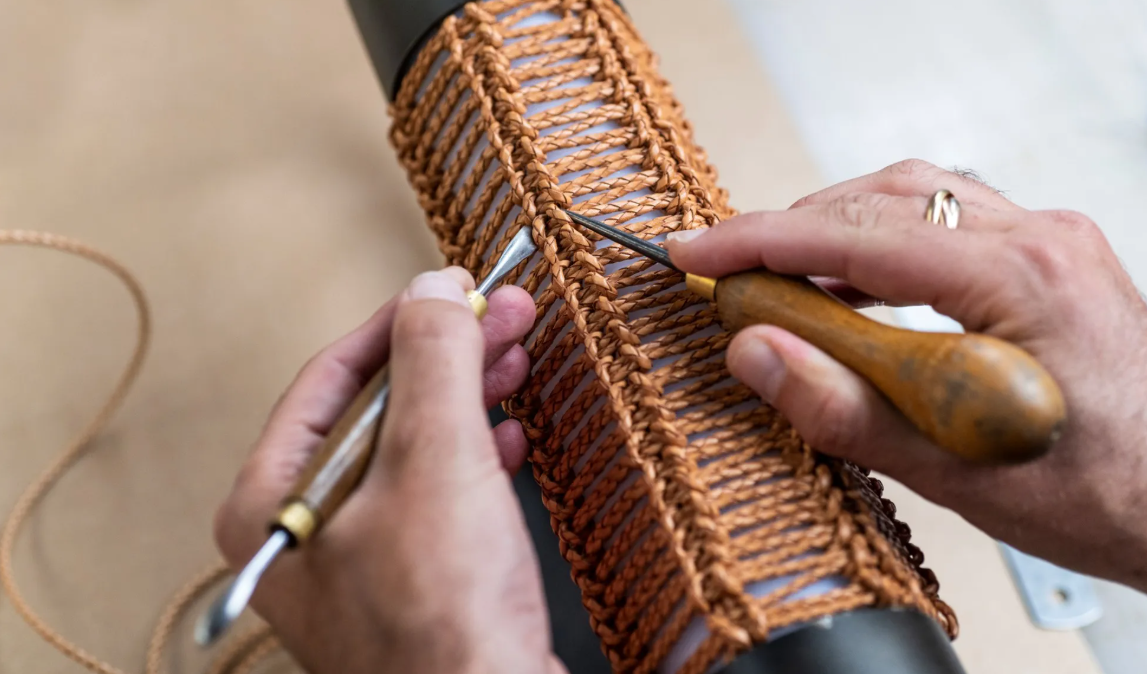
Bill Amberg Studio, Hand-knotted leather. Photo by David Cleveland
Craft journalist Katie Treggiden is launching a crowd-sourced dictionary of craft words to capture the language of making before it is lost.
I am asking for your words. Words of action, words of craft, words of making. I want you to contribute to Making Words, a collaborative online dictionary.
This may seem like a strange or superfluous request. Making, after all, is a hand skill, passed from craftsperson to apprentice or student. For self-taught makers, online courses and YouTube videos have long since replaced how-to books, and even those books relied on images. In fact, in all the ways that craft skills are shared, the written word is secondary at best. So why a dictionary?
We are all aware that we are losing some craft skills. As Heritage Crafts’ Red List of Endangered Crafts so starkly demonstrates, against a backdrop of dwindling university craft courses, the lineage from master craftsperson to student is breaking. For example, arrowsmithing is critically endangered with only two full-time makers and two trainees. Silver spinning is similarly threatened with eight full-time makers, but no apprentices. And 69 other crafts from industrial pottery to diamond cutting are at risk of dying out. Heritage Crafts is working to prevent this, but too many have already been lost. Neither lacrosse sticks nor cricket balls are made in the UK any longer. “Heritage crafts are more than old-fashioned pastimes; they are the DNA of our material culture,” says Heritage Crafts’ head of craft sustainability Mary Lewis. “If we let these skills die, we lose more than just a specific basket or chair, we lose a piece of human ingenuity; a ’seed bank’ of cultural knowledge. These skills offer a practical blueprint for a sustainable and engaged future.”
“If we let these skills die, we lose more than just a specific basket or chair, we lose a piece of human ingenuity; a ’seed bank’ of cultural knowledge. These skills offer a practical blueprint for a sustainable and engaged future”

Bill Amberg Studio Leather Chair Hand Stitching, Photo by David Cleveland
If the hand-to-hand lineage of making breaks and crafts become extinct, all that will be left of that ‘seed bank’ is the written record. But given the specificity of many words to their craft, every time we lose a craft, we lose its language. And, as well as making skills disappearing from everyday life, specialist vocabularies are fading from everyday speech too. “Many crafts have specific names for tools or techniques that don't exist in standard English,” says Lewis. “If the word for a specific notch in a timber frame is lost, for example, the understanding of why that notch exists may follow.”
In 2017, Robert Macfarlane and Jackie Morris responded to the removal of nature-related words such as ‘acorn’, ‘kingfisher’ and ‘wren’ from a popular children’s dictionary with a project called Lost Words, of which Macfarlan” said: ‘names, good names, well used, can help us see and they help us care. We find it hard to love what we cannot give a name to. And what we do not love, we will not save.”
Almost a decade on, Making Words is a crowd-sourced dictionary that will enable craftspeople in Britain and Ireland to give names to what they love. As Emeritus Professor of Field Linguistics Peter Austin told me: “any area of human life that is meaningful and significant to a group of people will have a rich vocabulary.” Making Words an attempt to document that vocabulary while it is still alive in the mouths of makers: words such as ‘skive,’ meaning to reduce in thickness the edges of sections of leather before they are overlapped in a shoe to avoid discomfort. It is the only shoe-making task done sitting down and perhaps where ‘skiving,’ for avoiding work, comes from. These words are not just part of craft, but part of our culture.
“Different languages enable us to view the world from different perspectives and give us a tantalising glimpse of how different cultures interact with the world around them.”
Making Words will capture words in English, but also in regional dialects and minority languages such as Welsh, Manx, Cornish, Scots, Gaelic and Irish, which are also under threat. Until January of this year, the only protection offered to Cornish was that the government couldn’t stop people from speaking it—a pretty low bar. It has now been awarded the same level of protection as other Celtic languages: a necessary correction for a language almost wiped out by English dominance.
Cornish language consultant Elizabeth Ellis was instrumental in creating an online dictionary of ‘standard written form’ that has been key to gaining this protection. “Different languages enable us to view the world from different perspectives and give us a tantalising glimpse of how different cultures interact with the world around them,” she says. “The fact the Cornish word “glas” can encompass blue, natural green, grey and the colour of the sea makes complete sense because the land is surrounded by water on three sides.”
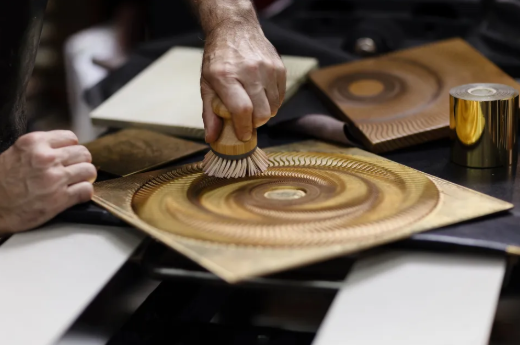
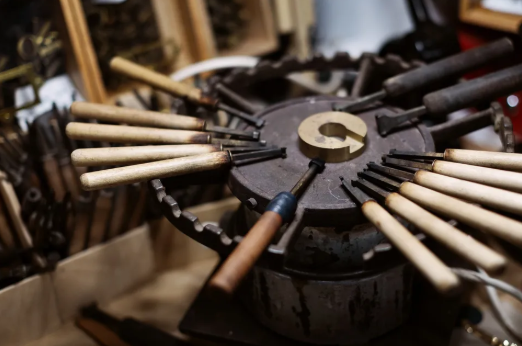
Gavin Rookledge making in his studio and Tools in Gavin Rookledge's studio. Photo credit: Andy Bate Photography
Even in Ireland, where according to the 2022 census almost 40% of the population claim some ability to speak their mother tongue, only a tiny minority do so outside educational settings. This is coupled with a homogenisation of regional accents and local terms, partly caused by the proliferation of online slang. A study by Amazon found that 30% of younger people in the UK are confused by regional phrases or words, and the use of dialect is in steep decline, for example ‘ansom’ (from ‘handsome’ to mean ‘nice’ or ‘good quality’) is down in Cornwall by 97% 1919–2019 and ‘scran’ (food) has fallen in the Northwest by 96% over the same period.
Because the words used to describe crafts are often both deeply regional and highly specialised, this homogenisation affects how we talk about making. Translation to the nearest layman’s English equivalent flattens nuance and specificity. Think of replacing the Cornish word ‘glas’ with ‘blue’. And that matters for craft words as much as for minority languages because, as Lewis puts it, “if we only use one language to describe making, we will end up with only one way of making.” She goes on to say: “diversity in language protects diversity in thought and technique. [It is] is essential because language and craft are symbiotic.”
Language doesn’t just describe the world around us, but shapes how we move through it, sometimes literally. Crowd-sourcing empowers craftspeople to define their own terms and fosters a sense of belonging. “It’s important to use your Celtic language in life and work and that includes craft,” says jeweller and Welsh speaker Erin Maddocks. “It’s a personal way to communicate; a way for two Celtic crafters to bond.”
So, this is a call to action. I am asking for your favourite craft words—good words, well used. You can submit them in any of the languages or dialects spoken in Britain and Ireland, and if you disagree with someone else’s definition, submit your own. Name what you love, help us see and help us care. Submit your craft words at makingwords.org.
We’re counting on you.
All copy is reproduced here as it was supplied by Katie Treggiden to the client or publication.
Katie Treggiden is an author, journalist, speaker & strategist helping the design sector understand, navigate and communicate the transition to a regenerative future.