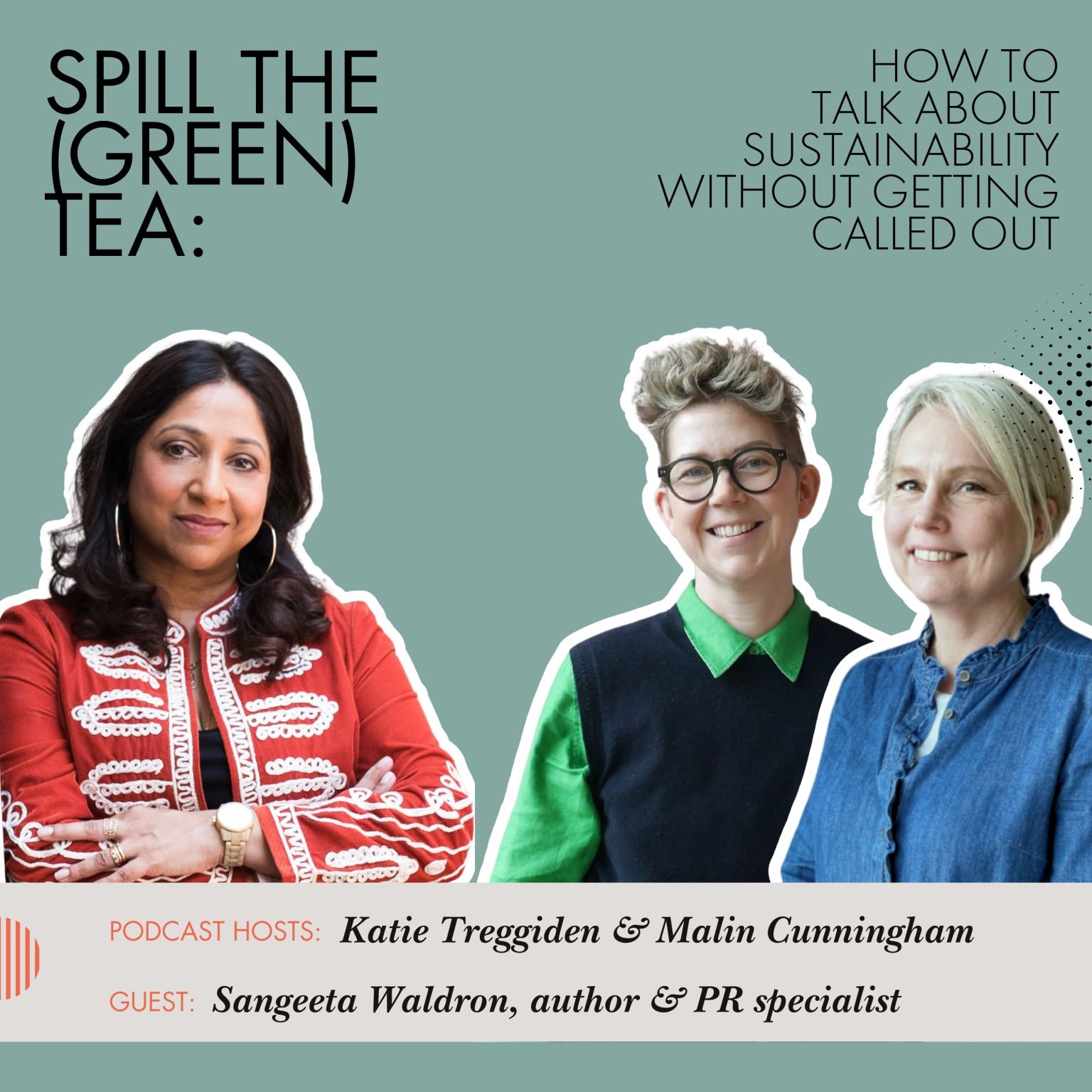
Spill The (Green) Tea with Sangeeta Waldron
This is an auto-generated transcript that has not been edited or proofread and therefore may contain errors.
Malin Cunningham
Welcome to Spill the Green Tea, the podcast where we dive into perhaps the most controversial part of sustainability, how to talk about it.
Katie Treggiden
That's right, we're exploring how to talk about your eco-efforts without getting called out. Join us for straight-talking, behind-the-scenes insights and practical takeaways that will help you gather the courage to shine your light in these volatile, uncertain, complex and ambiguous times.
Malin Cunningham
It's a serious topic and we don't shy away from that, but we will bring you uplifting, positive and pragmatic conversations with brilliant guests and in-depth discussions between the two of us, all to give you the confidence to talk about your imperfect efforts towards genuine sustainability.
Katie Treggiden
Because it's not just showing off, sharing your progress helps you connect with clients and customers and inspire others to be more open about where they are on their journey. We need your stories now more than ever.
Sangeeta Waldron
The climate crisis is a communications issue and it's a comms issue because we're having to talk about it, we're having to convince people that it actually exists. We haven't been very good at engaging people into the climate narrative, into the climate storytelling. I mean, right now we're also living in a world where climate science is being dumbed down, particularly in America right now, it's eroding climate science from its framework.
So all these challenges make it very difficult to tell the climate story. And also the climate story has also been a hard one because it's always been about facts and data and data doesn't win hearts and minds, stories do.
Malin Cunningham
Hey and welcome to this episode of Spill the Green Tea with me and Katie. Today we're talking to Sangeeta Waldron, who is an author and award-winning communications specialist. Sangeeta is also the founder of Serendipity PR and Media and a climate reality leader, trained by no other than Al Gore.
She is the author of three books, including What Will Your Legacy Be, which was presented at Davos in 2025. And today we're exploring, amongst lots of other things, how storytelling, not statistics alone, builds trust, engagement and hope, and why diversity of voices are essential in climate storytelling, and what companies often get wrong when they are leading with CSR but it's driven by PR rather than values, and why admitting mistakes can strengthen credibility rather than undermine it. And as always we'll share lots of tips and links in the show notes if you want to dive in further.
Enjoy!
Katie Treggiden
Well thank you very much for joining us Sangeeta, it is a joy to have you on the podcast. We are here to champion confidently communicating imperfect progress towards genuine sustainability. So, spill the green tea and tell us something that you have done or that you do that might be seen as imperfect from an environmental point of view.
Sangeeta Waldron
No, that's a really good question and before I answer it I just want to say this, you know, when we think of being green or we want to be environmentally friendly or conscious, it's not a religion and it's not perfect and I do fly because I want to and I need to and I don't feel guilty about it because it's the world I am living in and it's the world we're all living in and I think that's really important. Sometimes I know the environmental space can be very judgemental and I want us to stay away from that, steer away from that because we're all in this together and it's whatever we can do it makes it matters.
Some people will be vegetarians, some people will be vegan, some people will just eat meat once a week, that's, you know, that's your journey and that is perfectly okay and I think that's just, I just want to really sort of stress that point.
Malin Cunningham
Yeah, there's a real nuance here as well isn't it and how do you deal with that particularly on social media where, you know, where conversations might get a bit heated maybe, I don't know, you know, I can go on there, yeah.
Sangeeta Waldron
I think it's just to be honest, authentic, honest communications about who you are, what you do, whether you're running a business or you are a social media influencer, you could just be a mini me, you know, and it's just being honest, just being honest and authentic and I don't think you can go wrong with that and if somebody does challenge you then you can, you have that sort of platform to argue your case or whatever that might be, put your position across.
Katie Treggiden
Yeah, it's so interesting isn't it because I think people tend to have kind of their perspective on the important things in environmentalism and those differ depending on your personal circumstances, depending on your values and I think one of the things I talk about a lot is making a decision that aligns with your values and then if someone does challenge you, you know, an informed decision that aligns with your values so you've thought it through, you understand it but I think sometimes admitting to those imperfections and sharing the whole truth can actually help build credibility rather than kind of projecting an image of perfection. Would you agree with that, Sangeeta?
Sangeeta Waldron
100%. Where is there, perfection does not exist, nothing perfect exists, you know, not in our lives, not in the world right now and certainly not in this movement, not in this green conversation, perfection does not exist and I think that's a great leveller because that means we're all in this together and everyone is welcome, we all make a difference in our own ways and I think that message we need to keep sort of emphasising because social media makes everything look glitzy, everything looks easy and it's not, nothing's easy, to speak your truth is not easy, especially today with social media because on the other side of things you can also get the climate deniers trying to shut you down which is a different conversation altogether but basic, I think as long as you, as you beautifully said Katie, it's about knowing your values, being aligned with your values and making sure you're living your truth, standing in your truth is an old shaman term so I think it's very, it's very hard to stand in your truth but if you can then nothing can pull you out of it or side to side or compromise you.
Malin Cunningham
Yeah absolutely and there is, I guess because there is a lot of questions around what is real and what isn't at the moment by being transparent and open you're basically more credible and believable aren't you as a, both as an individual but also as business and I thought it's really interesting, I'm going to hold up your book now, your latest book, you know What Will Your Legacy Be, you talk about the fact that actually climate change is a comms issue today, well could you expand on that a little bit, what do you mean by that?
Sangeeta Waldron
Yeah so I would, first I need to say I didn't coin that phrase, Sir David Attenborough did, I would love to have thought I'd come up with that but he actually said the climate crisis is a communications issue and it's a comms issue because we're having to talk about it, we're having to convince people that it actually exists, we haven't been very good at engaging people into the climate narrative, into the climate storytelling, for years we weren't bothered about what was happening in Africa, parts of the Indian subcontinent who were experiencing climate change and on the front line and we just, I mean right now we're also living in a world where climate science is being dumbed down, particularly in America right now, it's eroding climate science from its framework, so all these challenges make it very difficult to tell the climate story and also the climate story has also been a hard one because it's always been about facts and data and data doesn't win hearts and minds, stories do and not that I'm plugging my book but that's why I wrote that book, to engage people into the climate conversation, that it affects all of us.
Katie Treggiden
Yeah I mean I think you're so right and I come from a science background so I'm here for the science, I'm here for the data, it's so important that this stuff is rooted in provable fact, but one of the things I loved about your book was it did tell those stories and that you shared your platform with so many other experts from scientists to global thought leaders, from foodies to people in music and the arts and I think what really came across throughout all of that was the importance of storytelling and hope actually, kind of hopeful storytelling and I think one of the things the environmental movement has done a brilliant job of is telling us how awful this is all going to be if we don't sort it out, but I'd be interested to know more about your thoughts on the role of storytelling in building a kind of hopeful future that we want to move towards.
Sangeeta Waldron
Well we all love a good story don't we, we are a species that started from storytelling, stories engage us, they help us to connect, so stories are powerful, doesn't matter what kind of story it is, but I think the climate story, I think this is where it's important, it is a story that comes out of data, it's not a fairy tale, it's a real story that is affecting people and stories help us not just connect but they also give us hope because within the climate story there is lots of positive action, there are lots of solutions, there are lots of people doing great things at grassroots and we forget those stories because we just seem to fixate on some of the the doom and gloom and while there is, you know, some statistics there saying we can't reverse the last 20 years which we can't go back and do, that might seem to some people that there's no hope, but there is hope because while we can't change the past we can certainly make the future, I wouldn't say it's going to have, you know, we're all going to walk off into the sunset, but it will make the future better, it'll improve what we have now for the future generations and I think that's really important because we're not doing it for now, we're doing it for the future.
Malin Cunningham
And the other thing that obviously sort of relates back to the whole comms piece, you know, which is what we're talking about here really, is the language for use and there's always conversations about language isn't it, you know, do we talk about sustainability, do we talk about circularity, you know, what is the latest term, loads of people seem to be talking about resilience at the moment for instance, so what are your thoughts on terminology and, you know, how much it helps or hinders communications, particularly some of these phrases that have been around for a while and may seem a bit well worn by now, I don't know.
Sangeeta Waldron
Yeah, so I might not be very popular with this thought, but I think all these acronyms and all these words we come up every year tie us, bog us down, you know, we forget the real crux of the story that all the real words we're trying to do is just be kinder to ourselves and better to the planet and it's about businesses doing better, that's it, it doesn't need a fancy word, I mean resilience is great, but what about resilience for nature, what about putting back into nature, so I think we can all get, these are all semantics and we can get bogged down into what's the right word and we can argue and theorise on that, but I think what's really important is the doing.
Malin Cunningham
Do you think that's something that is, that we in the comms world get stuck on or in the sustainability world, but actually the sort of public outside don't care as much?
Sangeeta Waldron
Yeah, they don't care, how many people actually understand resilience really, how many people really use resilience in their everyday lives or corporate social responsibility or when we're shopping are we saying is this a CSR company, no we're not, we're just saying is it, can we afford it, can we put it in our basket and maybe somebody might think, well the likes, probably the three of us will probably be thinking is this actually the right thing to put in my basket, is it kind to the planet, but on the whole people are about everyday living, cost of living and how are they just going to make it through to the end of the month. So I think it's about, and it goes back to the story, what's the words, what's the story that's going to engage people, what matters and I think that's the bottom line.
Yes, in comms we can get so wrapped up in these words that we forget the actual message which you know we're trying to give.
Katie Treggiden
Yeah and I think the danger is the more they get used, the more they sort of lose any meaning. It's interesting that when I was an in-house design reporter at Dezeen, we had a list of banned words and the filter we always had to run an article through was would my mum understand this, assuming your mum didn't work in the industry. But I think one of the other things that I really enjoyed about your book, Sangeeta, was that you made a particular effort to bring in voices from India and I know that was something that was really important to you.
Why is it particularly important in climate comms that we have a diversity of voices and a diversity of stories?
Sangeeta Waldron
Because there isn't one right now, first of all. You know I've been to so many conferences here in the UK and in Europe and you have great storytellers but you don't have the diversity of voice on the stage. And it's so important because these voices have been working on this for decades.
They've been campaigning on this for decades. They've been trying to fight this within their communities for decades. So and now here in the West we're talking about it because it's on our doorstep but we could be learning from other countries, other cultures about what they're doing.
And also we have, I believe here in the West, we've forced a lot of our thinking on what we call the global South. We have forced them to shop at Marks and Spencer's in capitals like in India, in Delhi. And we have forced out the artisans.
So a lot of what they are dealing with has been because of decisions and systems here in the West. So I think we need to have a level playing field. We need to bring in these voices.
We learn, we connect. And there's one thing the pandemic, the global pandemic, did teach us is that how we're all connected. And we need to have these.
I really believe that we can't move forward without being connected, joining the dots and having representation.
Malin Cunningham
Yeah, definitely. And I think, you know, obviously Katie referenced the book there again and I know that you've spent some time in India promoting your book, but also obviously there's lots of... which is fine.
And also, you know, for the book, obviously, like Katie said, there was a lot of voices there. They represented particularly India because of your personal connections there. What are the cultural differences and what can we sort of learn from each other that you're sort of noticing having those conversations?
Sangeeta Waldron
Really good question. And there is so much to learn. But one of the key things, it was a notion, an idea I had when I was writing the book, but it was really reinforced when I last year to India and I met people.
And it doesn't really matter whether you're talking to people who live in a village or live in a big city, whether people are educated or they're from vulnerable communities or they are from middle class families. It doesn't matter what gender, what age group. It doesn't matter where you are in India.
And India is a big subcontinent and it's the largest population in the world right now. You do not find climate deniers. And I think that is the bottom line.
That is really such a powerful thing because people there have been experiencing the climate crisis since the 70s, the 80s. They've been experiencing drought, severe cases of famine, torrential monsoons. That's where the rivers have broken and people have lost their homes.
To farmers no longer being able to farm because of the drought and the way the climate is affecting the land. And India has had, and I can't remember the statistics, but there has been a period in living history where farmers have been ending their lives because of how destructive farming has become because of the climate crisis as well. So I think that for me is, you know, you might find people who are not very interested because they've got other things going on, but they certainly don't deny it.
And they don't try to argue when you talk about it. Whereas here you can come up against climate deniers or people who will say it's nonsense. It doesn't exist.
We don't believe in climate science. No one will say that there to you.
Malin Cunningham
That's so interesting, isn't it? And I think that really underlines what you were saying about the importance of having a diversity of voices in this conversation. You know, here are people with devastating frontline experience who represent the global majority.
Let's be honest, white Westerners are a minority of people on the face of the planet that is being affected by this stuff. And I think there is a move in the environmentalism movement to listen to indigenous wisdom and to understand that perhaps, you know, post-industrial ways of thinking have got us into this mess and may not be the ways to get us out of this mess. And I can't believe I'm asking you this in 2026.
But given all of that, what advice would you give to companies who are trying to improve diversity in their communications? I mean, I have something written into my contract that I won't take part in all white lineups. And it's almost always a point of contention.
I almost always have to fight for that. Which I find slightly. I don't know what the word is beyond baffling.
What advice would you give to the to the people who are kind of creating com corporate coms in particular around sustainability about about the how as well as the why?
Sangeeta Waldron
I think really, first of all, look at your brand, look at your what is that your value? Because there's no point because it goes back to being authentic. You're you know, you're honest communications.
Are you really committed to diversity? If that's not one of your values, then there's no point trying to pay lip service to it because you'll just come unstuck. But if it's something you really do value, and it's something you do believe in, then build that into your business strategy, make that the heart of your brand.
So everyone in your organisation understands that's one of your values. That's one of your commitments. And then start to look at is your board diverse and inclusive?
Are your suppliers diverse and inclusive? The events that you're doing? Are you reflective of that?
Are you reflective of that in your partnerships? I think it really you if that is your your value, and that's what you want to commit to, then you need to really look at it holistically. Is your workforce something starting as simple as that?
Is that diverse and inclusive? And, you know, McKinsey brings out reports. So they brought one out in 2023.
And it goes back to Malin when you said about the word resilience. And they have said diverse and inclusive workforces are more innovative, they can weather storms, you know, financial storms, whatever kind of storms there are that we are all kind of coping with sort of on a day to day basis right now. But it makes those organisations and those companies more resilient.
Because you can think more out of the box more creatively.
Katie Treggiden
Yeah, that's great. So, so changing topics slightly. So there's a there's a real sort of pushback on sustainability comms, for want of a better word, at the moment, you know, we talk about green hushing, a business is not sharing, you know, what they're doing, you know, either for fear of, you know, backlash, or they feel maybe that they don't have the right framework to talk about it for whatever reason.
And so, you know, what are you seeing? But also, why is it so important that we do keep talking about these topics and talking about the successes we're having, as well as the challenges, I suppose?
Sangeeta Waldron
It's so important, because nothing will change. And, you know, if you're a company, if you're an organisation that has, I don't know how, so some organisations think this is a nice thing to do, let's just do it, right. And then they're going to, they're going to come up, they're going to have challenges, because it's not baked into their business strategy.
It's not part of, it's not a brand value, it's something that they think is nice to do, they're going to just bolt it on, they're going to come a cropper. But those organisations that are doing it authentically, talk about it. Okay, you might have a mistake, talk about it, because what you'll find is that we've all made mistakes.
And we learn from our mistakes, failure isn't a bad word. You know, and it goes back to your first question, you know, spill the bean, you know, spill the green tea. You know, what is it, you know, is there anything you'd like to share?
We're not, this is not a religion, you know, this, these are not 10 commandments that we are meant to do. So, it comes back to being, be kind to yourself. It's okay to admit that you've got it wrong.
And this is how you're going to try and fix it. Or can anyone give us an idea of how to fix it? And learn from each other, we learn from each other.
But I think the green hushing, it's because everyone feels they have to be perfect, and we're not living in this perfect world, or that people are going to shut them down, because the way social media is, it's very reactive, you don't have time to implement your crisis strategy. It's all very in the moment, in the now. But I think if you're honest, and you're open, then you can say, yeah, we've got it wrong, or we've tried, but we realised it hasn't worked.
Can anyone tell us how we can do it better? Or this is what we're thinking of doing. And that kind of conversation and engagement, A, it wins trust from your clients and customers.
And B, it's a good story. It's a good story as well.
Malin Cunningham
There's a lovely statistic that oops, we made a mistake is one of the most opened email subject lines. Because it makes us human.
Sangeeta Waldron
Yeah, it just makes it we all suffer from all kinds of things, imposter syndrome, insecurity. And then on top of this is we're trying to be perfect. And no organisation is, no brand is, no individual is.
Malin Cunningham
And I also don't think people want perfect. I had a conversation at the London Design Festival, when somebody told me that something was 100% sustainable. And I apologise, because I did laugh in their face.
It's just like, what on earth does that even mean? You know, it's a nonsense, isn't it? And I think when you get into the imperfections, that's when you, you know, that feels real, doesn't it?
And I think in this age of sort of AI and everything being kind of generated, the little imperfections are how we know something's real.
Sangeeta Waldron
Is that, is that you are honest, and you've made a mistake, or it hasn't worked out? Yes. And it it cuts through that noise as well, you'll suddenly feel your customers will just trust you better.
Malin Cunningham
Yeah, yeah, which is really counterintuitive, because I think we sort of imagined that we that we have to be perfect. But Sangeetha, I want to talk about your other book, which I've got here with lots of post-it notes in, which is called Corporate Social Responsibility is not Public Relations, or CSR is not PR. And you've mentioned this idea of both diversity and sustainability needing to be built into your brand DNA in order to communicate it effectively.
But I'd love you just to elaborate on that a little bit. What is the difference between CSR and PR? And why is it so important that CSR comes first rather than being driven by public relations?
Sangeeta Waldron
So I'm going to answer this sort of starting with the PR side of things. So pre-pandemic. So if we go back to 2019, if we can remember that far back, PR was, was this, it was all about the all, you know, and you'd use CSR to make your brand look good.
You use CSR as a, as a team building exercise, because we're all in this, you know, we're going to, I don't know, wear pink, you know, for breast cancer awareness. It's a good thing that it brings everyone together. And that's where you go wrong, because it's not, it's not built into the brand, it's not aligned with the values.
You're organising your, your team, your workforce probably doesn't know that you've actually, you are committed to a breast cancer charity, or that you are investing in, I don't know, planting trees, whatever it might be. There isn't a holistic comms process for that. And the other thing is when you do your, when you're just using your CSR for your PR, that's an external, it's, it's for your external face.
But also, when you build in corporate social responsibility, and you use that as the heart of your comms strategy, at the heart of your business strategy, it also means your internal comms will be very strong. And I think people forget a lot about, they think that they forget about the internal comms, they think PR is all about outward facing, and it is to some extent, but it's very much the internal comms, that's the engine to everything. So when you build in corporate social responsibility, everyone understands what you're doing.
Your CEO is walking their talk. It's authentic, and you don't really need the PR then, because you, your organisation is talking for itself. Your workforce is talking about what a great company we work for, it's authentic, it's really trying to do these things.
And that's, that's authentic comms. And when we try to do the do it, leading with PR, that's when we are greenwashing. That's another term, apart from greenhushing, you have greenwashing, which just means you're pretending.
And it's like having a beautiful shop window, like a Selfridges window, you're walking past, but everything's actually fake behind that window. So that's how I would describe it.
Katie Treggiden
Great. Right. Well, this is the, we've come to the end of the questions on the podcast.
So I've got some quickfire questions for you now. So the first one is, Hope, is that lazy or vital? Oh, come on.
Vital. Excellent. What book are you reading at the moment?
Sangeeta Waldron
Actually, I'm reading What's Your Dream by Simon Squibb. Have you heard of it? No.
Oh, I thought I'm the only one who's come late to this. It's a Sunday Times bestselling book. It's one of these bestsellers.
And it's about finding your passion, finding your work. And it's about purpose. And that's what I'm reading.
Katie Treggiden
Oh, wow. Sounds amazing.
Sangeeta Waldron
It is. It's really interesting concepts in there. Very interesting concept.
So that's what I'm reading. Great.
Katie Treggiden
We'll add that to the notes as well. And have you got an example of a great piece of sustainability comms that you've seen recently? Yes, I have.
Sangeeta Waldron
This morning, literally. So it's a little bit of a long story, but I'll try and shorten it very quickly. So I use this sustainable deodorant called ROLLR.
It's a fairly new brand. Everything from your container is sustainable to your deodorant. It's a little powder.
You put it in the jar, put it with water, and you just shake it. And that's your deodorant. No toxins.
It's as sustainable as it can be. No nasties, nothing. And it's good for the planet.
So anyway, I've been buying this deodorant. And I got an email from the founder to say, I have been there. They hit 5,000 sales.
And I was the 5,000 person who bought. And I've been one of their best customers. And he emailed me and saying, we're really grateful.
We've given you this voucher. Please spend it on other products. And would you like to have a conversation with me about how we can continue evolving the brand?
And why do you buy ROLLR? I just thought that was fantastic, to have that access to the founder. So yeah, I bought two by the time.
Katie Treggiden
Yeah, I did. And guess what? Now you're talking about it.
Yeah, I think it's genius.
Sangeeta Waldron
I've never had that kind of customer experience before. So do you think you were handpicked? No.
Well, I think, I mean, if you look at the brand, it's very authentic in its communications. Yeah. And they wouldn't know me.
They wouldn't know my background. Yesterday, I did buy it because I was thinking, oh, my God, I'm running out. I was coming back from a meeting.
And I was trying to do it on the train. Couldn't do it. And then when I came home, as you're trying to multitask 10 things, I thought, I must buy my refills.
And this morning, I got that. Yeah. So that's fantastic.
Katie Treggiden
It's so really personal, isn't it?
Sangeeta Waldron
Yes. And it happened this morning. So it's great.
It was great to be able to answer your question with that.
Katie Treggiden
Excellent timing. And what about you, Katie? I'm going to bring you in as well.
Have you seen anything that stands out?
Malin Cunningham
I mean, not quite that cool. I've got two examples to share with you, which I think are interesting. One is that at the time of recording, the UK government has just launched a bunch of funding and grants and loans for renewable energy, so for people to fit solar panels and air source heat pumps.
And I just think the way they've messaged it is really interesting. So the lead message on every news article I've heard or read about this has been about lifting families out of fuel poverty. So the lead message has been about the economy, about the benefit to the most vulnerable people in society.
And then it's been backed up with, oh, well, it'll also save carbon. And I just think that's an interesting example of the fact that when we're trying to bring about behaviour change, people don't always have to believe what you believe. You just have to appeal to something that they care about.
So I thought that was interesting. I was glad they were also mentioning climate change, because when I was first listening to the news report, I thought, is this even going to get a mention? And the other one is a really old one.
But there is an organisation called Project Drawdown, who did a vast amount of research into both how we can stop putting more carbon into the atmosphere and how we can draw that carbon down from the atmosphere. And they have produced a set of six videos, which are kind of climate change 101. They're very simply explained, but without losing the nuance and the complexity.
And something Malin and I talk about a lot is offsetting. And their video on offsetting is particularly nuanced and kind of really explains why that can be problematic. And I just thought they were a really useful training resource.
And even for somebody like me, who's been working in this area for a long time, just to kind of get that breadth of knowledge covering off all different industries. So we will pop a link to both of those in the show notes if anybody wants to check them out.
Katie Treggiden
That's great. Thanks, Katie. And then back to you, Sangeeta, what about your favourite podcast?
What would you, would you listen to?
Sangeeta Waldron
The Restless Politics. I find that fascinating. And also they have to, what I find also fascinating, they have to keep updating their podcast because so much is happening.
You know, they're like a 24 hours news stream almost because you just can't keep up.
Katie Treggiden
Yeah, I was, it's interesting because I was thinking that only just yesterday listening to I think News Agents, which is another one to BBC Ex-Journalist, I listened to quite a lot. And I was thinking, how do they keep up? It's crazy, isn't it?
Sangeeta Waldron
Yeah.
Katie Treggiden
And then finally, what is your top tip for communicating imperfect progress towards genuine sustainability with confidence and gusto?
Sangeeta Waldron
Speak about it, own it. I mean, these very simple principles, own it, speak about it and just be honest. And I'll just tell you this very quick story.
There's a small brand. It's a small well-being brand, beauty brand. And when they started, two founders, when they started, they, they were so careful in their language because they didn't want to mislead.
And but they said, look, we're going to get it wrong sometimes, but we want, but, you know, and we don't profess to be perfect. So I think that's just a very honest approach. And it's gone on to be a brand now that's really popular.
It's found in certain hotels and they have grown from just being honest and continuing to be honest. And I think we can all do. I think as a society globally, we just need more honesty in the world.
Honesty has become a real currency, hasn't it?
Katie Treggiden
Yeah, absolutely. There's a lot. We talk a lot about credibility being the new business currency because, you know, people just don't trust stuff that's out there.
But, you know, it takes guts to do that, doesn't it?
Sangeeta Waldron
Yes. Sorry. I'm just I just I'll just say this.
Yesterday at Davos, with all that noise going on, the Edelman Edelman released their trust trust barometer for 2026. And I thought this was really interesting. Seven in 10 say they're unwilling or hesitant to trust someone with different values from them or or approaches to social issues.
And this trust lives more in advanced economies, which includes the UK, Germany, US, Japan than it does in the developing world. So trust is a it's a very big thing right now.
Malin Cunningham
Amazing. I think that is a perfect note to end on. So thank you so much, Sangeeta, for your pearls of wisdom.
It's been fantastic talking to you. I've loved it.
Sangeeta Waldron
Thank you. I could go on chatting, as you can tell, but I've really had a great time. Thank you.
Thank you.
Katie Treggiden
We have been Katie Treggiden and Malin Cunningham, and this has been Spill the Green Tea. Please leave us a review and share this episode with anyone you think might find it helpful. And let's get people talking about this stuff.
Malin Cunningham
Thank you my co-host, author, journalist and consultant, Katie Tregidden. Katie is on a mission to share true stories of imperfect progress towards genuine sustainability, and to help purpose-driven brands talk about their eco-efforts for clarity, credibility and confidence. Katie has a brilliant resource called Green, Not Greenwashed, that will help you do just that.
You can find a link in the show notes.
Katie Treggiden
And thank you to my co-host, Malin Cunningham is the founder of B2B comms consultancy, Hattrick. They help businesses build commercial credibility and a competitive edge through standout PR, thought leadership and carbon literacy training. And Malin has a fantastic guide for sales and marketing professionals called Green or Greenwashed?
Great minds think alike, what can I say? And you can find a link to that in the show notes too.
Malin Cunningham
And a final thank you to all our brilliant guests and to Kirsty Spain for editing and producing this and every episode.