Image Credit: Sam Rowland
There are just five wheelwrights in the UK young enough to be considered ‘the next generation’ of the craft. Katie Treggiden speaks to one of them, and the man who taught him how to keep the craft—and a name—alive.
Wheelwright Sam took his wife Lilac Rowland’s surname when they got married, much to the dismay of his grandparents. But, in his mind, it was never up for debate.
He was standing in Lilac’s father’s wheelwrighting workshop, helping out on his day off, when he got a call from his employer to say they would be making his job as a car mechanic redundant. “I panicked at first,” he admits. At just 21 and 19 years old, he and Lilac had recently moved into their first home, and he was worried about how to make ends meet. He hung up and relayed the conversation to Lilac’s father, Greg, who responded; “Well, I guess I'll see you on Monday then.” And so, the next generation of Mike Rowland & Son Wheelwrights and Coachbuilders was hired.
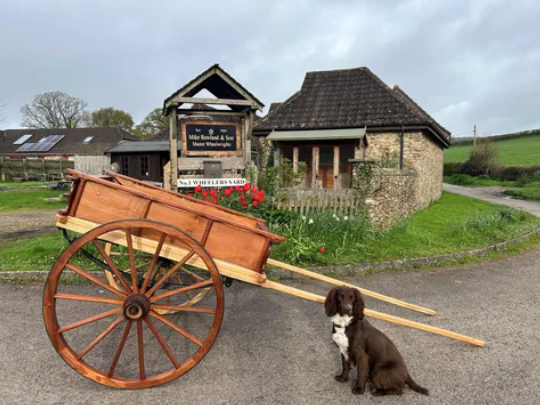
Greg is the “& Son”—Mike being his father, who established the workshop in Colyton, Devon, in 1964. Mike’s grandfather was a wheelwright, but with his father was away for much of the Second World War and not returning for many years afterwards, Mike learnt woodworking from the Romani Gypsies and traveling communities on nearby Farway Common. “Woodworking has always been in the family,” says Greg. “It's as if it’s in our blood.” Indeed, wheelwrighting is woven through their family tree all the way back to 1331 when local records show Edward D. [son of] Rowland making a wagon to carry stone from Beer Quarry Caves to Exeter Cathedral. Mike worked in timber and woodworking, eventually specialising in wheelwrighting and coachbuilding, before being awarded the royal warrant in 2005.
But neither Greg nor Sam had any intention of getting into the trade. Despite tiring his first wheels at just five years old, Greg joined the army at 15, training to be both a mechanic and a blacksmith. He left at 21, setting up a forge nearby, and then within, his father’s workshop at the same time as joining the local fire service, with whom he served for 30 years. During that time, he also worked with his father for a decade without pay to ensure the business stayed afloat. “I wasn’t interested in wood or wheels—I was into metal,” he says. “I don’t actually remember Dad teaching me anything, and yet somehow, he taught me everything I know.”
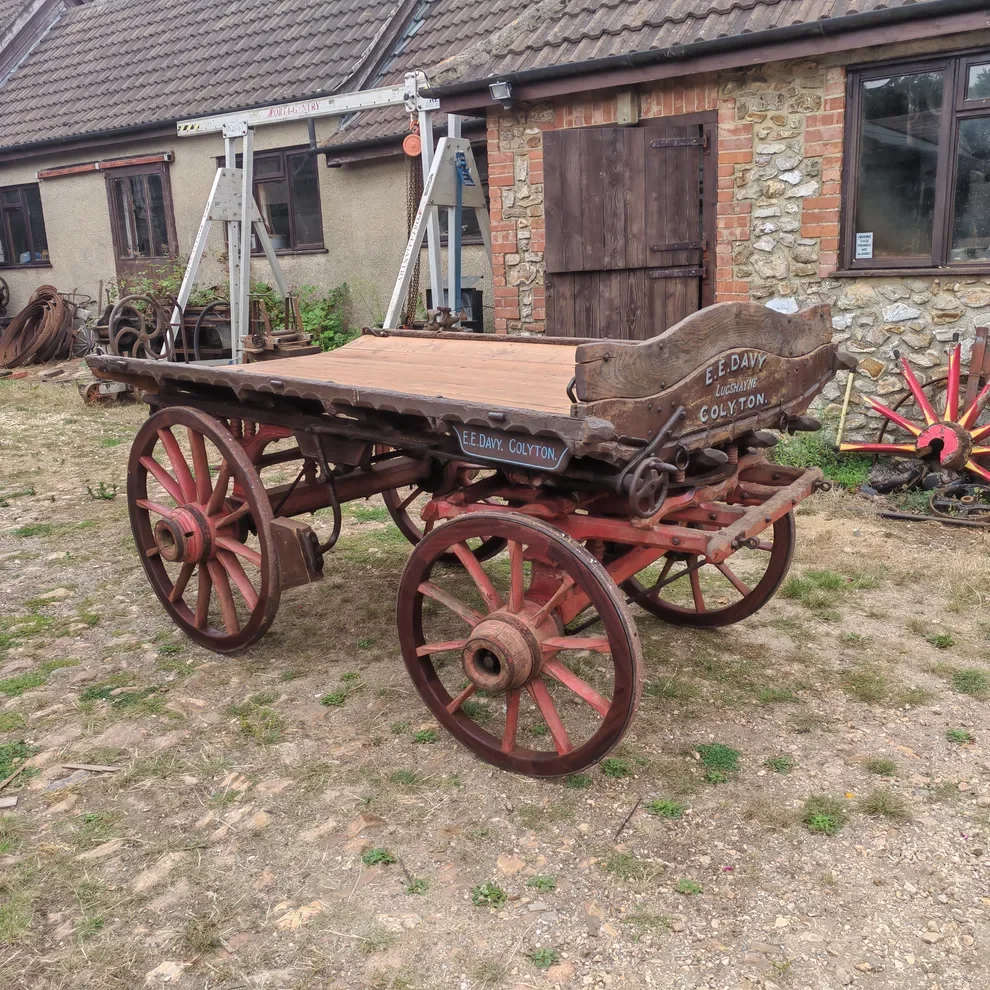
Image Credit: Sam Rowland
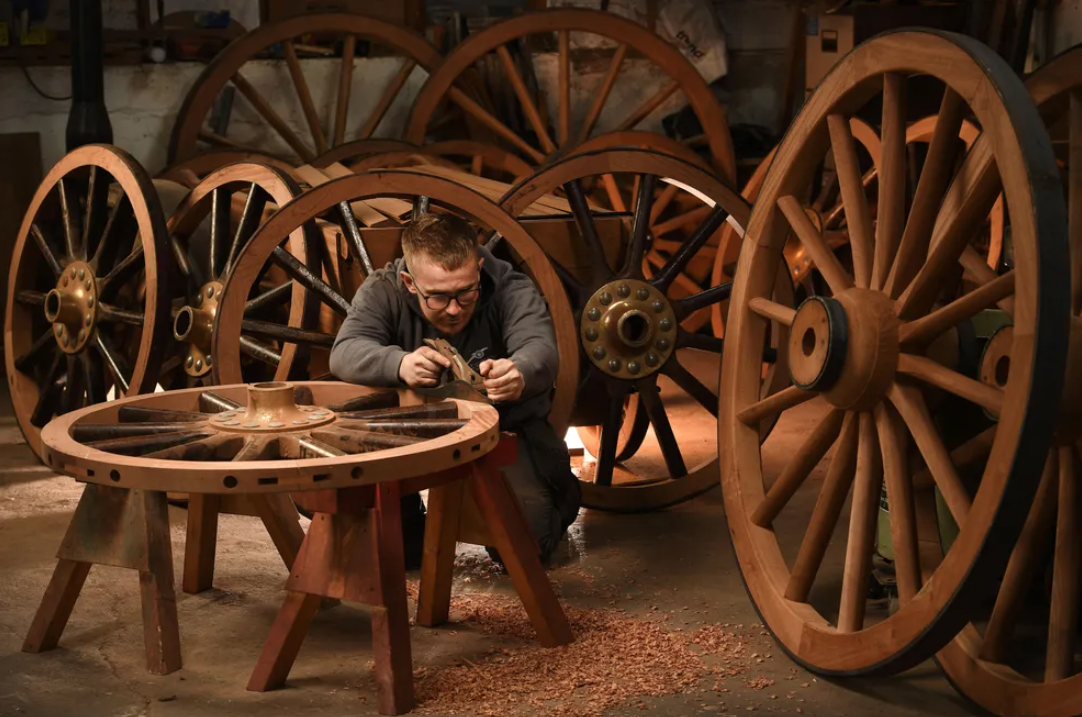
Sam too was a reluctant convert to the craft. “At first, it was a way to keep a roof over our heads,” he admits. “But as soon as I made my first wheel and felt that sense of achievement, I was hooked, and now I am knee-deep and it’s brilliant.” Greg says he often hears his father’s words coming out of Sam’s mouth while training their work experience students.
Sam’s sense of achievement is well-earned. A wheel is a phenomenally complex thing to construct. At its heart is the hub, traditionally made of elm for its tortional strength—its ability to resist twisting. The hub has heated metal bands shrunk around it to enhance that strength and mortices (holes) notched into it to receive the spokes, traditionally made from oak to resist compression. The spokes are angled not only to comprise the 360 degrees around the hub in one plane, but also to form a gentle saucer shape in the other. Each wheel receives weight from one side, so if the spokes were in the same flat plane as the hub, that weight would make them splay out. Angling them inwards towards the vehicle means that the weight is channelled through the spokes and into the hub and axle where an equal and opposite force is coming from the opposite wheel. “If you can work out all those angles, you can make anything,” says Greg. The spokes are connected to fellies (or ‘felloes’ depending on which part of the country you’re from)—perfectly curved segments, made typically of ash and joined together to form the slightly flexible rim of the wheel. The whole thing is wrapped in metal again, this time a tire (from ‘tie-er’), which is heated in an open fire and shrunk around the wheel, tying everything in place, as it cools. Due to the declining availability of seasoned British timber and because heritage wheels today are often ceremonial, necessitating durability while stationary in all weathers alongside occasional functionality, Greg and Sam mostly use a sustainably sourced West African hardwood called sapele. “I've been castigated for that,” says Greg “But I've never had a wheel break. Historically, people would have used the best available timber for the job. What’s the saying: ‘Tradition is not the worship of ashes, but the preservation of fire?’ That’s what we’re doing.”
Sam’s love of the craft might have taken hold when he completed his first wheel but on Monday 7th August, 2023, his commitment to was put to the test. “I drove into work as normal and said to myself, ‘Right, I'm the only one here. What do I do now?’” Returning home from a run the day before to find his phone lit up with missed calls from his girlfriend Lilac and Greg’s wife Nina, he knew something was wrong. Greg had been involved in a motorcycling accident which resulted in 22 broken bones, multiple operations and extensive rehab. Sam was 23 years old and had never sent an invoice nor towed a trailer, let alone run a business. Mike sadly now suffers from dementia so wasn’t on hand for advice. “I took a deep breath and told myself: ‘If the business is still going when Greg gets back, I've done my job.’” The first thing he did was figure out the firm’s accounting software and invoice every outstanding client with an explanation of what had happened and a promise that their project would be finished within the week. Everybody paid up. Then he taught himself how to tow the workshop’s 16-foot trailer and, after a few practice-runs around the yard, drove from Devon, through central London, to Covent Garden to deliver to two finished coster barrows and collect more for repair. “It was a very, very steep learning curve,” he laughs. “But knowing what the business meant to Greg, to Mike, and to everyone involved, there was no other option but to ensure its survival.”
When Greg made it back into work, first on a mobility scooter and then on crutches, both thumbs remained out of action. All the tendons had snapped in the accident, and they couldn’t be operated on until he was off the crutches. “I'll remember it forever, because it makes me laugh so much,” starts Sam, already laughing in the retelling. “Greg was struggling to paint this wheel, so he asked me to tape the paintbrush to his hand.” They can laugh about it now, but it has been a long, hard road to recovery. Three years on, his thumbs are operational, but he has more operations to go, and a blue badge proudly attached to his motorbike. “We adapted and we overcame,” he says. “If I had given up, I would have got a lot more compensation, but where does that get you? That was never an option.” If nothing else, he wanted to walk Lilac down the aisle when she married Sam, which he did in 2024.
Greg was heavily involved in the new apprenticeship scheme for wheelwrighting and was awarded an MBE for services to heritage crafts in 2022, while Sam won Heritage Crafts’ Robin Wood Changemaker Award in 2023 to honour his stewardship of the business, and yet, ask them what they’re most proud of and neither of them mentions awards. Nor do they talk about resilience, loyalty, or even survival. Instead, of course, they talk about something they’ve made.
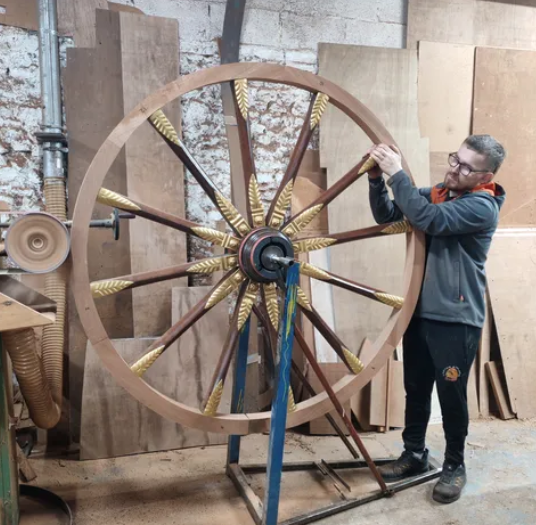
“The state funeral carriage wheels,” says Sam without hesitation. “We had to close the workshop for 14 days at a time, because no-one could know we had them here. They came down one wheel at a time, and we stripped them, did all the repairs, re-bonded them, refitted the rubber, and had them hand painted. Seeing wheels that Greg and I worked on carrying the Queen on her final journey will stick with me for life.”
Greg was invited to the funeral. “I was sitting in Westminster Abbey, watching wheels from our tiny workshop in Devon take the second longest-serving monarch in British history to her funeral,” he says, but his proudest moment came when she was still alive. “Talking with the Queen and my dad on the lawn of Buckingham Palace in a wheelwright shop I created for the Coronation Jubilee Festival,” he says. “That was pretty special.”
According to Heritage Crafts, wheelwrighting is 'endangered' with just 12 full-time wheelwrights working in nine commercial-scale businesses, and Greg, who supplies those figures as part of his work as a liveryman with the Worshipful Company of Wheelwrights, says that there are just five wheelwrights young enough to be considered ‘the next generation’ of the craft: Sam and four others.
If the other four are anything like Sam Rowland, there is no cause for concern. And his grandparents should be very proud of him, whatever his surname.
About Crafts Council Membership:
Crafts Council Membership is the essential offering for craft makers and enthusiasts looking for connection, inspiration, and guidance. Our members form part of a dynamic community of craft champions, connected by a shared belief in the power of making.
Whether you’re developing a professional practice or exploring a personal passion, Crafts Council membership connects you to digital editorial, year-round events, the Crafts Council Directory, inspiring business resources, exclusive offers, opportunities, on-demand recordings, the Crafts magazine archive, and much more. To discover the Membership, visit the Crafts Council website: https://www.craftscouncil.org.uk/become-a-member/
All copy is reproduced here as it was supplied by Katie Treggiden to the client or publication.
Katie Treggiden is an author, journalist, speaker & strategist helping the design sector understand, navigate and communicate the transition to a regenerative future.